Financial Need Trumps Longtime Aversion to Foreign Trade
By Blaine Harden and Ariana Eunjung Cha Washington Post Foreign Service Sunday, February 24, 2008; Page A19 SEOUL -- North Korea's Kim Jong Il has a chronic cash-flow problem.
In the 1990s, his Stalinist state nearly capsized -- and millions starved -- for want of subsidies from China and the defunct Soviet Union. Since then, despite arms dealing and the receipt of international aid in return for talking about abandoning nuclear weapons, North Korea has often gone without rice, fuel and medicine.
In the past couple of years, though, Kim's government has quietly begun to milk a long-neglected cash cow: deposits of coal, minerals and precious metals that are among the largest in Asia.
As mineral prices soar on world markets, foreign access to mines in the North is accelerating at a rate unseen in the more than five decades since the division of the Korean Peninsula, according to South Korean government officials, Chinese mining experts and scholars who study North Korea.
They say that Kim's government is increasingly willing to lease mines to outside companies and to negotiate joint ventures with foreign governments.
"North Korea is trading what she has for what she hasn't," said Xu Wenji, a professor of East Asian studies at Jilin University in Changchun, China.
At the same time, mining operations have been delayed and derailed by erratic, maddening and corrupt behavior on the part of North Korean officials, according to businessmen in South Korea and China.
"North Korea -- they are a country of scoundrels," said Sun Demao, a manager at Zhaoyuan Gold, a Chinese company that has canceled all its contracts with mines in the North because of chronic delivery troubles.
Still, exports of North Korean coal and zinc to China have jumped sharply in the past three years, as have zinc exports to South Korea and gold exports to Thailand.
For the first time, North Korea agreed last May to a long-term joint mining deal with the South Korean government, and more deals are in the works, said Jeong Dong-moon, director of the inter-Korean industrial team in the South's Ministry of Unification.
Officials from the two countries met seven times last year, including three inspection trips to a large zinc- and magnesite-mining complex in the North.
"The North Korean leadership now realizes that mining is a realistic tool for getting dollars," said a senior South Korean official who attended the meetings and spoke on condition of anonymity to protect his job. "We could feel their passion. They were really into it."
Kim Jong Il told machinery workers last August, "We have to improve mining machinery spectacularly in greater scale," according to the official Korean Central News Agency.
For many years, Kim Il Sung (who died in 1994) and his son Kim Jong Il (now 66 and leader since his father's death) preached a defiant philosophy of self-reliance, emphasizing local production of goods using local raw materials. Selling unprocessed minerals was seen as a demeaning submission to colonialism. The system worked, after a fashion, throughout the Cold War, with the help of large subsidies from the Soviet Union and China. When those subsidies fizzled out, North Korea descended into heavily armed penury, where it remains.
"North Koreans don't understand modern business because they have never done it," said Andrei Lankov, a professor who specializes in North Korean studies at Kookmin University in Seoul.
That lack of understanding, he said, has stalled and scuttled several mining operations.
More important are Kim's conflicted feelings about mining, said Lankov, a Russian who studied in the North and is a periodic visitor there. "He sees the money now," Lankov said. "But he believes that by reforming, he would be committing suicide. So he wants mining done under strict control of North Korean managers."
The cash infusion the North could receive from large-scale industrial mining is potentially huge, especially for a country that had just $1.4 billion in exports in 2006, according to a CIA estimate.
The estimated value of the country's reserves is more than $2 trillion, according to the Korea Chamber of Commerce and Industry.
There are large deposits of iron ore, zinc and uranium, as well as coal. The North also has the world's largest known deposit of magnesite, an essential part of lightweight metal used in cars, airplanes and electronic equipment.
As North Korea's closest ally and principal benefactor, China has had better access to its mines than any other country.
In exchange for mining rights, China has helped the North construct roads, repair ports and build a glass factory, while providing oil, equipment and food. But even as Chinese investment grew in 2007, exports of some minerals stalled -- as Chinese businessmen bickered with North Korean officials about how to run the mines, according to Xu at Jilin University.
Late last year, in a somewhat alarmist report, the Korea Chamber of Commerce and Industry warned that South Korea was dithering while China was locking up rights to North Korea's minerals.
The report said that in 2006, China imported more than four times the amount of minerals from North Korea as the South did, as measured in dollars.
The report struck a nerve because the South has virtually no mineral wealth of its own. "We really need iron ore and magnesite," said Jeong at the South's Ministry of Unification. "We import everything."
South Korea is rushing to catch up. It has opened regular rail freight service to parts of the North. At a summit last year, the leaders of North and South Korea agreed to $11 billion in economic projects. Zinc exports from the North to the South doubled last year.
An unanswered question for South Korea is whether the new government of president-elect Lee Myung-bak, who takes office Monday, will make denuclearization or human rights a condition of its investment in the North's mines.
"It is clear that somebody has to pay for the infrastructure that will open up the North," said a South Korean official. "It just hasn't been decided who will pay the most."
Cha reported from Shanghai. Special correspondent Stella Kim contributed to this report.
N。 韓国は鉱物富から利益を得ます。 財政的な必要性は対外貿易に長年の反感に切り札を出します。
ブレインで、硬くなってください、アリアナEunjung Cha ワシントンポストの外国サービス 2008年2月24日日曜日; ページA19 ソウル--北朝鮮のキムジョンイルには、慢性のキャッシュフロー問題があります。
BEIJING, China (CNN) -- Pingpong helped thaw relations between China and the United States more than three decades ago. Now the catalyst of that thaw wonders whether music can do the same for the U.S. and North Korea.
Zhuang Zedong, a three-time world champion in table tennis, also known as pingpong, faced a quandary one April day 37 years ago.
He was sitting at the back of his Chinese team's bus, waiting to drive to the stadium during the 1971 world championship in Japan.
Perhaps by mistake, a longhaired athlete got on the bus with the Chinese team. When the door closed and he turned around, the Chinese noticed the three letters on the back of the athlete's uniform: USA.
Glenn Cowan, a 19-year-old Santa Monica College student, sat in the packed bus for 10 minutes and no one dared talk to him.
"We were all tense," Zhuang recalls. "Our team had been advised not to speak to Americans, not to shake their hands, and not to exchange gifts with them. "
Zhuang didn't want to get into trouble, but he thought snubbing the American went against China's tradition of hospitality. For about 10 minutes, he considered his options.
"I looked at him, thinking, 'he is not the one who makes national policies, he is just an athlete, an ordinary American'," he recalls.
Defying political correctness, he walked up to Cowan and struck a conversation through a translator. He even gave the hippie-looking American silk brocade as a gift. The next day, Cowan gave him a T-shirt emblazoned with a peace sign and the words "LET IT BE."
Pictures of the meeting were all over the papers the next day. Soon, the news reached Chairman Mao Zedong in Beijing.
"Zhuang Zedong is not only good at pingpong, he is good at diplomacy too," Mao reportedly remarked. Later that night, he ordered the Foreign Ministry to invite the American team to China.
Days later, in the midst of the Cold War and the Vietnam War, Cowan and 14 companions visited Beijing. The team, accompanied by a gaggle of American reporters, was treated royally. During their visit, the U.S. announced the end of a 20-year trade embargo against the People's Republic. Their journey turned out to be the first public move in a rapprochement between the two bitter enemies.
"The ping heard round the world," Time magazine intoned in its cover story. "Probably never before in history has a sport been used so effectively as a tool of international diplomacy."
President Richard Nixon visited China in 1972, and relations between the two countries were normalized in 1979.
"Chairman Mao used the small ball to push a big ball forward," Zhuang gushes.
Zhuang, 68, is now retired. His hair is balding but he remains energetic and quick-witted. The legendary paddler is often invited to give speeches on career-building and the history of diplomacy.
He says he never thought his simple gestures of friendship would start what is now known as "pingpong diplomacy."
"I had no idea what was going on," he tells CNN. "I didn't know what Chairman Mao was thinking. I was merely a pingpong player."
He says he simply created the opening for Chairman Mao to finesse his geopolitical strategy for China to break out of its isolation.
The New York Philharmonic this week is traveling to Pyongyang to perform and perhaps help thaw the icy relations between the U.S. and North Korea. A variation of pingpong diplomacy, perhaps?
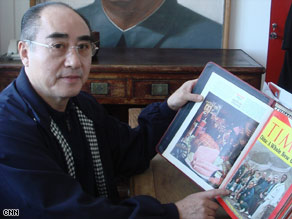
"It makes sense, and it's a good thing," Zhuang says as he flips through the April 1971 cover story of Time, which chronicled the U.S. pingpong team's visit to China. He believes even the worst of enemies can build up friendship through engagement.
"Sports and trade can break down diplomatic walls," he says. "So can music."
Zhuang hopes North Korea can pick up a few pointers from China's experience. "I hope the North Koreans can reform their theory and adapt with the changes in the world."
He says China used to face similar challenges: China and the U.S. used to be bitter enemies, and China used to be diplomatically isolated and economically decrepit.
"But as China's economy developed," he says, "we have also made friends with other countries and we started to gain their respect. We now have a win-win relationship with America."
Much credit, he says, goes to the pingpong diplomacy that he unwittingly kicked off that fateful day in April 1971.