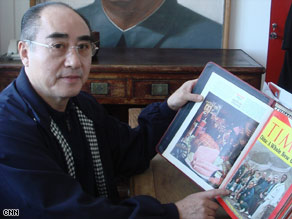
BEIJING, China (CNN) -- Pingpong helped thaw relations between China and the United States more than three decades ago. Now the catalyst of that thaw wonders whether music can do the same for the U.S. and North Korea.
Zhuang Zedong, a three-time world champion in table tennis, also known as pingpong, faced a quandary one April day 37 years ago.
He was sitting at the back of his Chinese team's bus, waiting to drive to the stadium during the 1971 world championship in Japan.
Perhaps by mistake, a longhaired athlete got on the bus with the Chinese team. When the door closed and he turned around, the Chinese noticed the three letters on the back of the athlete's uniform: USA.
Glenn Cowan, a 19-year-old Santa Monica College student, sat in the packed bus for 10 minutes and no one dared talk to him.
"We were all tense," Zhuang recalls. "Our team had been advised not to speak to Americans, not to shake their hands, and not to exchange gifts with them. "
Zhuang didn't want to get into trouble, but he thought snubbing the American went against China's tradition of hospitality. For about 10 minutes, he considered his options.
"I looked at him, thinking, 'he is not the one who makes national policies, he is just an athlete, an ordinary American'," he recalls.
Defying political correctness, he walked up to Cowan and struck a conversation through a translator. He even gave the hippie-looking American silk brocade as a gift. The next day, Cowan gave him a T-shirt emblazoned with a peace sign and the words "LET IT BE."
Pictures of the meeting were all over the papers the next day. Soon, the news reached Chairman Mao Zedong in Beijing.
"Zhuang Zedong is not only good at pingpong, he is good at diplomacy too," Mao reportedly remarked. Later that night, he ordered the Foreign Ministry to invite the American team to China.
Days later, in the midst of the Cold War and the Vietnam War, Cowan and 14 companions visited Beijing. The team, accompanied by a gaggle of American reporters, was treated royally. During their visit, the U.S. announced the end of a 20-year trade embargo against the People's Republic. Their journey turned out to be the first public move in a rapprochement between the two bitter enemies.
"The ping heard round the world," Time magazine intoned in its cover story. "Probably never before in history has a sport been used so effectively as a tool of international diplomacy."
President Richard Nixon visited China in 1972, and relations between the two countries were normalized in 1979.
"Chairman Mao used the small ball to push a big ball forward," Zhuang gushes.
Zhuang, 68, is now retired. His hair is balding but he remains energetic and quick-witted. The legendary paddler is often invited to give speeches on career-building and the history of diplomacy.
He says he never thought his simple gestures of friendship would start what is now known as "pingpong diplomacy."
"I had no idea what was going on," he tells CNN. "I didn't know what Chairman Mao was thinking. I was merely a pingpong player."
He says he simply created the opening for Chairman Mao to finesse his geopolitical strategy for China to break out of its isolation.
The New York Philharmonic this week is traveling to Pyongyang to perform and perhaps help thaw the icy relations between the U.S. and North Korea. A variation of pingpong diplomacy, perhaps?
"It makes sense, and it's a good thing," Zhuang says as he flips through the April 1971 cover story of Time, which chronicled the U.S. pingpong team's visit to China. He believes even the worst of enemies can build up friendship through engagement.
"Sports and trade can break down diplomatic walls," he says. "So can music."
Zhuang hopes North Korea can pick up a few pointers from China's experience. "I hope the North Koreans can reform their theory and adapt with the changes in the world."
He says China used to face similar challenges: China and the U.S. used to be bitter enemies, and China used to be diplomatically isolated and economically decrepit.
"But as China's economy developed," he says, "we have also made friends with other countries and we started to gain their respect. We now have a win-win relationship with America."
Much credit, he says, goes to the pingpong diplomacy that he unwittingly kicked off that fateful day in April 1971.