
山崎氏の最後のひと花
政治部 坂口幸裕(1月22日)
風車、風の吹くまで昼寝かな――。戦前に首相を務めた広田弘毅が外交官時代、オランダ公使に左遷されたときに詠んだ句だ。
広田と同じ福岡県出身の山崎拓氏は苦境に立つたびに、この句を口ずさんで自らを鼓舞してきた。盟友の小泉純一郎氏に引き立てられ、自民党の幹事長や副総裁を歴任したものの、中国などとの間合いの取り方を巡り徐々に関係が悪化。小泉政権での最後の人事だった2005年秋の内閣改造で山崎派は閣僚どころか副大臣までゼロだった。
このときもこうつぶやいた。「今は昼寝中や」。
党内では、昨年12月に古希を迎えた山崎氏を「もはや過去の人」とみる向きが少なくない。山崎派にも「そろそろ派閥会長の座を後継に譲るべきだ」との声がある。だが、本人はまだ退く気はない。「最後にもうひと花咲かせるまで政治家を辞められん」。周囲にはこう語る。
「復党組11人のうち5、6人は我が派に入るよう努力中や。必ず入れてみせる。反対の者はおるか」。昨年12月5日夜、東京・赤坂の日本料理店「球磨川(くまがわ)」。山崎氏は黒糖焼酎「里の曙」のお湯割りを口にしながら、同席していた保岡興治事務総長や中堅議員らに問うた。出席者の1人は「派閥拡大にこれだけ汗を流しているのに会長職を譲るなどあり得ない」という意味だと受け止めた。
山崎氏の政治手法の特色はよくも悪くも融通無碍なことだ。仲違いしたと思われていた小泉氏と昨年末に2回も酒を酌み交わした。山崎派を離れて小泉チルドレンとの新派閥を旗揚げするとの見方もあった武部勤前幹事長とも何となくよりを戻した。小泉氏は山崎氏との関係を「何を考えているか分からないから続くんだ」と解説する。
もちろん考えていることはある。山崎氏が「最後のひと花」と見据えているのは、北朝鮮との国交正常化だ。今月9日から13日まで急に訪朝。圧力路線をとる政府の非難を無視するかのように、「対話の窓口が必要」と言い放った。
加藤紘一氏らと一緒に以前から日朝関係改善に取り組んできた山崎氏だが、2002年の電撃訪朝で世界を驚かせた小泉氏と連携しているとなれば、北朝鮮だけでなく、日本国内に向けても発言が重みを増す。目立った成果がなかった訪朝後も「今回は第1段階で、いずれ必ず功を奏する」と語り、小泉氏の3度目の訪朝の可能性をほのめかすのは、北朝鮮と小泉という2つのカードを絡めることで切り札としての威力がさらに高まることを意識しているからだろう。
昨年9月の党総裁選への出馬を断念した際、山崎氏は強調した。「他日を期したい」。今年の元日には自身のホームページで、新年の抱負について「行動力発揮」と書いた。安倍内閣の支持率低下を横目に、「最後」の勝負に打って出ようとしている。
NIKKEI NET:風向計
Joe Dresnok: An American In North Korea
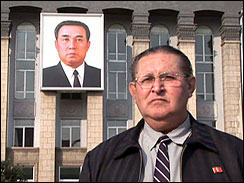
Bob Simon Reports On The Last U.S. Soldier Still Living In North Korea
PYONGYANG, North Korea, Jan. 28, 2007
(CBS) Joe Dresnok could be the ultimate runaway. Growing up an orphan in Virginia, he kept running away from abusive foster homes. Then, as a soldier serving on the DMZ between North and South Korea, Dresnok did the unthinkable: in 1962, he ran through a minefield and defected into North Korea, where his unthinkable act led to an unimaginable life.
As Bob Simon reports, Dresnok has had for 44 years a mysterious isolated existence in that mysterious isolated country. No one outside North Korea has heard from Dresnok – until now.
Dresnok told his story to two British filmmakers, Dan Gordon and Nick Bonner, who have made a documentary called, "Crossing The Line." They had already made two documentaries in North Korea―one on that country’s soccer team; and another on star gymnasts training for North Korea's annual spectacle called the Mass Games.
Gordon and Bonner earned the government's trust, so much so that after six years of trying they finally met Joe Dresnok.
"This is a man who disappeared off the face of the known world in 1962. And I went into this room, very sort of dark brick room. This sort of tall man in a black uniform came in. And he sat down, said, 'Hello Boy. I gather you wanna, gather you wanna talk about making a film about me.' And it would have been less surprising to have met Elvis Presley," Bonner recalls. "And yet here was this man in front of me, sat there, Joe Dresnok, who no one has seen since 1962."
Back in 1962, JFK was president and Dresnok was depressed and desperate. His wife had just divorced him, and then after leaving his base without permission for a night of womanizing, he was about to be court-martialed.
"I was fed up with my childhood, my marriage my military life, everything . I was finished. There’s only one place to go," Dresnok told the filmmakers. "On August 15th, at noon in broad daylight when everybody was eating lunch, I hit the road. Yes I was afraid. Am I gonna live or die? And when I stepped into the minefield and I seen it with my own eyes, I started sweating. I crossed over, looking for my new life."
North Korean soldiers surrounded him, as portrayed in the documentary, and some wanted to kill him. Instead, Dresnok was taken by train to the capital, Pyongyang, for interrogation. He was used to running away but he had never run to a place like this before.
Much of North Korea was in ruins a decade after the war. Kim Il Sung, known as "The Great Leader," was Asia's version of Joseph Stalin. One morning, Dresnok woke up to discover that North Korea already had an American defector.
"I opened my eyes. I didn’t believe myself. I shut them again. I must be dreaming. I opened them again and looked and, 'Who in the hell are you?' He says, 'I'm Abshier.' 'Abshier? I don’t know no Abshier,'" Dresnok remembers.
Larry Abshier was another American soldier who had defected three months before Dresnok. Two more GIs would follow over the next two years, Jerry Parish and then Sgt. Charles Jenkins.
They were a propaganda bonanza for the north, which put them on magazine covers, looking pleased and prosperous in paradise. They broadcast their happiness in the north through loudspeakers to American troops at the border.
All were high school dropouts, who had thought more about what they were running from, than where they were going. Misfits in the Army, they were outcasts in North Korea.
"Different customs. A different ideology," Dresnok explains. "The uneasiness of the way people look at me when I walk down the street. 'Oh, there goes that American bastard.' I didn't want to stay, I didn’t think I could adapt."
Four years after Dresnok defected, he and the other Americans had had enough. They sought asylum in the Soviet embassy but the Soviets handed them right back to the North Koreans.
"I think all four of them thought they’d be shot. And what’s remarkable to me is that they weren’t. The authorities painstakingly decided that we will convert them almost. That, you know they will come to our system," Dan Gordon says.
The filmmaker says that conversion process worked. Running away was no longer an option. So, since he couldn’t get out, Dresnok vowed to fit in.
"They might be a different race. They might be a different color. But God damn it I'm gonna sit down and I'm gonna learn their way of life. I did everything I could. Learning the language. Learning the customs. Learning their greetings. Their life. Oh, I gotta think like this, I gotta act like this. I’ve studied their revolutionary history, their lofty virtues about the Great Leader," Dresnok recalled. "Little by little, I came to understand the Korean people.
And "the Korean people" finally accepted the Americans when they started starring in propaganda films that were big hits in the north.
CBS)
In their first epic in 1978, Dresnok played the brutal American commander of a POW camp.
"I don’t consider it a propaganda movie. I took great honor in doing it," Dresnok said.
“And that was how he found salvation in North Korea is that he played the part of an evil American,” Gordon says.
“And he’s the John Wayne of North Korea,” Bonner adds.
“The John Wayne of North Korea playing the villain,” Simon remarks, laughing.
And he enjoyed becoming a celebrity. "We walk around with him and people say, 'Come here, come here,'" explains Gordon. "He’d never have done that in Virginia, you know? He wasn’t exactly Hollywood material."
Beyond starring in dozens of movies, he translated the Great Leader's writings into English. He taught some English as well.
"I've taught in a foreign language college in 1986. I poured all my knowledge and effort to help them, to teach them. Some of the places in the educational fields, they invite me to give a lecture once in a while," Dresnok says.
In North Korea, Dresnok finally got what he had never had in America: a family. He married an eastern European woman and had two sons. But his wife died young. Then, he married the daughter of a Korean woman and an African diplomat; she and Dresnok have a six-year-old.
The British filmmakers were stunned by his eldest son James, who’s studying at Pyongyang’s elite foreign language college.
"My father is American and I've got American blood. But as I born here I consider myself as Korean," James told the filmmakers.
"He speaks and acts like a Korean. He speaks English in a Korean accent. It’s a very strange thing," says Gordon.
"When we interviewed him he says you know, you want peace in this world. I don’t understand what all this war is going on―or “wer” as he calls it. I would like to be in a position where we can we can stop all this," Bonner adds.
"I start to learn English to become a diplomat. I’d like to make the world which has no war at all. And no terror at all," James told the film team.
“He thinks of himself as Korean. His friends are Korean. But you mentioned, he doesn’t want to marry a Korean woman,” Simon asks Gordon.
“Yeah. I mean, that’s what he was saying. But you know, his best friend, who’s Korean is like, ‘All the Korean girls love him,’ you know,” he replies laughing.
Gordon says James is a popular kid. “I mean they love him. And you know, he’s got blond hair and blue eyes.”
Now his father's days are pretty dull―fishing, and smoking, and drinking. The government provides a small apartment and a monthly stipend, but even in the capital, where only the privileged are allowed to live, blackouts are frequent, and running water seldom runs. All homes have a built-in radio speaker that pipes out propaganda. The radio can be turned down, but not off.
"There is this propaganda everywhere in North Korea," explains Gordon. "You walk down the street, there’s all sorts of revolutionary music that will just play out from loud speakers. Down the escalators into the metro, propaganda is playing. If you’re in the fields, you’ll have news read to you. And that’s all part and parcel of their propaganda machine."
The wide streets of the capital see little traffic and surprisingly few bicycles. The government believes bikes give people too much mobility and make them too hard to keep track of.
(CBS)
But Joe Dresnok doesn’t want to go anywhere. He’s the last American defector alive in North Korea. Abshier reportedly died from a heart attack; Parish from kidney failure; and Jenkins was allowed to follow his Japanese wife back to Japan. Dresnok doesn’t miss him.
Speaking about Jenkins, Dresnok says, "Bye-bye, baby! Who cares?"
Their hostility is mutual: in Japan a year ago, Jenkins told Scott Pelley in a 60 Minutes interview, that when the North Koreans wanted to punish him, they would tie his hands behind his back and tell Dresnok to beat him.
"He beat me. Dresnok is a man that likes to hurt someone believe it our not. He told me, he feels good after he does it," Jenkins told Pelley, recalling the beatings.
But Dresnok says Jenkins is a "liar."
Asked if there was any sense of the government ordering Dresnok to beat Jenkins, Gordon says "We never got that sense from Dresnok. He just denied and denied and denied that he was like the North Korean strong arm."
"Jenkins has a scar where he says Dresnok knocked his tooth through his lower lip," Simon remarks.
"From what we can gather there was a lot of times when it was drink oriented. They went out and they drank and they drank and they had a fight," Gordon replies.
"One day he tried to push me around with his so called rank and there was two blows. I hit him and he hit the ground," Dresnok told the filmmakers. "I think you know Alice in Wonderland. Well, I just wonder if it’s not Jenkins in Wonderland."
But it has been Dresnok in Wonderland for 44 years―a Caucasian among Asians; an isolated man in an isolated country. He is an outsider who claims to fit in.
"I don’t have intentions of leaving. Couldn’t give a s--- if you put a billion damn dollars of gold on the table," he told the filmmakers.
"He really doesn’t have any desire to leave North Korea at all," says Gordon.
Asked if they asked him political questions, Gordon says, "We asked him about the nuclear issue, you know? And he was like, 'If America attacks, we’re ready.'
His health is failing now. The smoking and drinking have taken their toll. "I go to the doctor when necessary. Right now this doctor is necessary," Dresnok says. "I’m too old and wore out. I’m getting old quick."
The government he ran to still takes care of him and didn’t cut his rations even during the recent famine when perhaps a million North Koreans starved to death.
"When I eat my rice I think about the people who died who starved to death but yet they fed me. Why do they let their own people starve to death and feed an American?" Dresnok wonders.
And so, appreciative of his treatment; and fulfilled by his family and his celebrity, Joe Dresnok says he has no regrets about running through a mine field and into the unknown.
"I feel at home. I really feel at home," he says. "I wouldn’t trade it for nothing."
Joe Dresnok: An American In North Korea, Bob Simon Reports On The Last U.S. Soldier Still Living In North Korea - CBS News
朝鮮総連傘下の「科協」顧問らを、無届け派遣容疑で逮捕
国に無届けで労働者を派遣していたとして、神奈川県警は29日、川崎市にある人材派遣会社「大宝産業」の前社長徐錫洪容疑者(74)=東京都世田谷区岡本2丁目=と、妻で現社長の朴鍾淳容疑者(72)を労働者派遣法違反容疑で逮捕した。徐容疑者は在日本朝鮮人総連合会傘下の「在日本朝鮮人科学技術協会(科協)」の顧問を務めており、県警は派遣先企業が持つ技術の取得を目的に違法な人材派遣をしていた可能性があるとみて調べを進める。
調べでは、大宝産業は04年3月~06年6月、人材派遣に必要な厚生労働相への届け出をしないまま、金型や鋳鉄製品などを作る川崎市川崎区にある鋳造会社や、発電機やモーターを製造する群馬県太田市にある電気機械会社など計3社に、労働者9人を派遣した疑い。県警は昨年11月、徐容疑者の自宅など計4カ所を家宅捜索していた。
関係者によると、徐容疑者は東大工学部で学んだエンジン工学の権威で、98年8月にテポドン1号が発射された時期に北朝鮮に渡っていたことなどが確認されている。
警視庁は科協に対する捜査で、朝鮮労働党の工作機関「対外連絡部」が科協に先端技術の提供をするよう指示したとされる文書を押収している。警察当局は科協が北朝鮮に日本の先端技術を提供する際の窓口になっているとの見方を強めており、北朝鮮のミサイル開発への科協の関与についても注目している。
asahi.com:朝鮮総連傘下の「科協」顧問らを、無届け派遣容疑で逮捕?-?社会