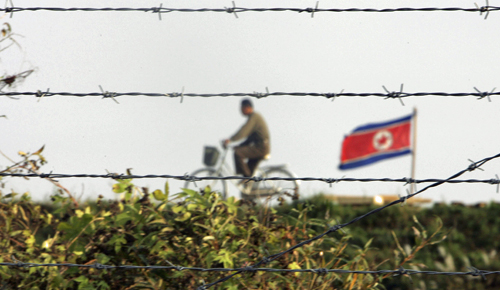
As Olympics approach, activists push Beijing to halt its crackdown on refugees from its impoverished neighbor and those who help them defect to South Korea. By Barbara Demick, Los Angeles Times Staff Writer February 22, 2008 SEOUL -- Steve Kim went to China to make money.
The furniture dealer from Huntington, N.Y., sniffed an opportunity to manufacture colonial reproductions at a fraction of the cost for export to the U.S. market. He had no interest in politics or human rights.
That was until one Sunday morning, when he ran into a couple of North Korean defectors at the church he attended in Guangdong province. They were thin with bad skin and shabby clothing and had the terrified, needy look of stray kittens. Kim ended up hiring one of them, finding apartments for others and arranging for them to seek asylum in South Korea.
Soon, more North Koreans found their way to his doorstep.
"How could I not help?" said Kim, who emigrated to the United States from South Korea with his parents as a young man and became a U.S. citizen in 1975. "I'm human, after all."
Kim ended up spending four years in Chinese prison for violations of Article 318: "making arrangements for other persons to illegally cross the national frontier." Released in September, he is one of a dozen foreigners who have received stiff sentences for helping North Koreans.
The arrests have been part of China's relentless crackdown on North Koreans who cross over in an attempt to defect to South Korea. High barbed-wire fences have been erected along the banks of the Tumen River, which runs along part of China's border with North Korea. Recently, the Chinese have started blocking routes leading out of China as well, installing ultrared heat and motion sensors in the desert terrain near the border with Mongolia.
Mobile telephone calls and e-mails among activists are monitored, and informants pose as defectors to infiltrate safe houses where North Koreans are hiding. Those caught are repatriated to North Korea.
Human rights advocates are now pushing China for at least a truce in honor of the 2008 Summer Olympics in Beijing in August. The treatment of North Koreans, along with concerns that China is not doing enough to stop the bloodshed in the Darfur region of ally Sudan, threatens to shadow the Games.
"These Olympics are just about the most important international event in Chinese history. If they want to brag to the world about what a safe and stable place China is, they have to do something for the refugees," said Do Hee-youn, who runs a fund for North Korean defectors in Seoul.
As many as 100,000 North Koreans are thought to be hiding in China, including dozens in foreign embassies and at the office of the U.N. High Commissioner for Refugees in Beijing.
The North Koreans have won sympathy in foreign capitals, from Tokyo to Washington, especially among Christian groups. Activists held nearly simultaneous demonstrations Nov. 30 and Dec. 1 in front of all the Chinese consular offices in the U.S., calling for a boycott of the Olympics over the North Korean issue.
There are some indications that the Chinese are paying heed. In December, they unexpectedly released Yu Sang-jun, a defector who had become an activist. Caught guiding refugees to the border, he was held for less than four months, a short stay compared with the years-long sentences doled out to others who did the same.
In Seoul, activists say that 40 North Koreans who have sought asylum in embassies in Beijing might soon be given safe passage by the Chinese government to leave for South Korea. The South Korean Constitution gives all North Koreans the right of citizenship.
At a recent briefing in Beijing, Chinese Foreign Ministry spokeswoman Jiang Yu, responding to a question about North Korean refugees, said, "Our position is clear and consistent. These people come to China for financial reasons. They are illegal migrants, not refugees."
North Koreans started pouring into China in the mid-1990s, fleeing the famine and repression of one of the world's most totalitarian countries. Since it is impossible to cross the heavily mined demilitarized zone leading to South Korea, the 850-mile border with China is the only practical escape route from North Korea.
China, which still supports its old Communist ally, North Korean leader Kim Jong Il, works closely with his government's security services to catch defectors. North Korea sends those caught to labor camps.
Many North Korean defectors try to reach Thailand, Vietnam or Mongolia, all of which are more sympathetic. But the "underground railroad" bringing these people to safety is under increasing pressure from the Chinese government.
"Wherever you are in China, the police can barge in at any minute and arrest you," said Kim Young-mi, a 30-year-old North Korean who spent four years living undercover in China before arriving in South Korea last year.
Yu Sang-jun, the recently released activist, was arrested in September at a train station in the northern Chinese city of Ulanhot as he escorted three refugees to Mongolia. In an interview in Seoul, he recalled that plainclothes Chinese police had been tracking his little group for days before they took them into custody. The three defectors were immediately whisked away, presumably to be repatriated to North Korea.
"I never got to say goodbye to them. It happened so fast," said Yu, 45, who escaped from an agricultural cooperative near the city of Chongjin, North Korea, in 1998. "I want to die myself when I think what may have become of them."
Yu lost his wife and a 4-year-old son in the North Korean famine. His older son, 12, died of dehydration attempting the difficult desert crossing from China to Mongolia. Yu has since devoted his life to helping North Korean defectors, traveling back and forth to China on his South Korean passport.
Christian activists in Seoul had lobbied hard for Yu's release and were delighted when he arrived safely home. But the activists were not counting on his release signaling a change of course by the Chinese.
"At best, they'll put on a public relations show for the Olympics," activist Tim Peters said. "But it won't be anything more than smoke and mirrors."
PHOTO FENCED OUT: China has installed barbed wire along its border with North Korea to keep out those fleeing the repressive and impoverished country. As many as 100,000 refugees are thought to live in hiding in China hoping to find a way to South Korea.
By BURT HERMAN – 1 hour ago SEOUL, South Korea (AP) ― The oldest U.S. orchestra is using the power of music to pierce North Korea's isolation, playing a historic concert in the communist nation as the two countries struggle to resolve a protracted standoff over Pyongyang's nuclear weapons program. The New York Philharmonic will be the most prominent American cultural group to travel to North Korea since the peninsula's division after World War II. The orchestra departs Monday for the North following a tour of the greater China region, and will perform Tuesday evening at the East Pyongyang Grand Theater in a concert to be televised internationally and live inside the country. "Our hope is to bring this great music to as many people living there as possible, people who may not otherwise be exposed to such a performance, and touch their lives in the way that this music so often touches ours," Philharmonic President Zarin Mehta said in a statement this week. The performance comes amid a U.S. diplomatic push to engage North Korea in the wake of Pyongyang's October 2006 nuclear test that cemented its status as a nuclear-armed state. The U.S. government has supported the concert, and the main American negotiator at nuclear talks with Pyongyang lobbied Philharmonic musicians to make the trip ― stressing the need to reach out to the North. Assistant Secretary of State Christopher Hill said Wednesday that the concert was in line with U.S. efforts to show North Korea that Washington harbors no hostile intentions, as Pyongyang repeatedly claims. "Sometimes the North Koreans don't like our words; maybe they'll like our music," he said in Seoul. Hill was touring the region to prepare for a trip next week by Secretary of State Condoleezza Rice, who will be in South Korea for the Monday inauguration of the country's new president and also travel to Japan and China. U.S. officials have said she will not go to Pyongyang for the concert. It is not known whether North Korean leader Kim Jong Il will be in the audience, which will consist of the capital's elite who are largely insulated from the hardships that face most of the country's 23 million people. North Korea invited the Philharmonic last year amid rare optimism in the nuclear negotiations that began in 2003. In July, North Korea shut down its main nuclear reactor and has since begun disabling it. However, the gloss of those achievements has faded since the North missed a Dec. 31 deadline to give a complete accounting of its nuclear programs, which the U.S. hopes could be dismantled this year. Hill met his North Korean counterpart this week and said they agreed to try to move beyond the latest impasse. As is custom for a traveling orchestra, the Philharmonic will perform the national anthems of the host country and the United States ― bringing "The Star-Spangled Banner" to North Koreans who are daily implored by state propaganda to maintain vigilance against a possible U.S. attack. The orchestra will then open its program with Richard Wagner's prelude to Act 3 of "Lohengrin" followed by Antonin Dvorak's Symphony No. 9, written by the Czech composer mostly in New York and premiered with the Philharmonic in 1893. The concert will end on a distinctly American note with George Gershwin's "An American in Paris," a piece the composer refers to as a "rhapsodic ballet" that includes elements of jazz ― a form of music essentially banned in North Korea. Kim Cheol-woong, a North Korean pianist who defected to South Korea in 2002 because of the lack of musical freedom, said regular citizens in the North were prohibited from listening to or playing foreign music produced after 1900. He was punished in 1999 for playing jazz in a vacant symphony hall. "I think the concert will change ordinary North Koreans' view of Americans to some extent," Kim said of the Philharmonic's trip. "It could soften their negative views of the United States, who they have been taught to view as imperialist forces." The country's state-run media will likely portray the concert as a tribute to the greatness of North Korean leader Kim, said Andrei Lankov, a North Korea expert who studied there and teaches at Seoul's Kookmin University. Still, Lankov said the event would help open the eyes of people in the North. "In order to survive, they have to keep their population as ignorant as possible. Any kind of contact with the outside world is poison," Lankov said. "If you want to bring changes to North Korea, you should encourage exchanges of all kinds even if any particular project looks like a concession to the 'dear leader,'" Lankov said, referring to the title often used for Kim in state propaganda. Others remained skeptical. "The mere presence of happy, smiling Americans in Pyongyang is in itself not going to accomplish very much at all," said Brian Myers, an expert on North Korean propaganda at Dongseo University in Busan, South Korea. He said the regime's ideology is founded on race-based nationalism that claims North Koreans are superior. "You don't engender goodwill with people who consider you racially inferior," he said. "It's a propaganda gift to them." At the Pyongyang Music Conservatory this week, students were preparing for the visit that will also give them the opportunity to attend master classes by Philharmonic musicians and a rehearsal. O Yong Ah, 21, recalled her government's claims that the U.S. was at fault for starting the Korean War, a position that goes against the commonly held view outside the North. "I have a good feeling toward the people of America, but we have a history in which we were invaded by the United States and now still we are threatened and under pressure from the United States," the music student told broadcaster APTN in Pyongyang. But she implied the concert could help transcend the countries' bitter past. "I think that music instills people with warmth and enthusiasm and ardor ― and hope for the future," O said. Associated Press writer Hyung-jin Kim contributed to this report from Seoul.