
Don't furl the flag
Oct 18th 2007
From The Economist print edition
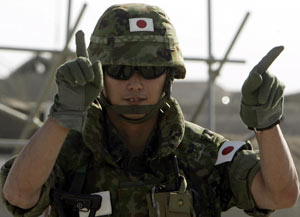
Japan's soldiers deserve better support from its politicians
FOR the first time since it started sending its soldiers, sailors and airmen to report for duty in the world's trouble-spots, Japan is about to sound an embarrassing retreat. In November supply vessels and escort ships, deployed to the Indian Ocean for the past six years in support of counter-terrorism operations in Afghanistan, will steam home to a political crisis over their role that will confine them to port for months. Worse, it could end Japan's role in Operation Enduring Freedom, the crucial battle against the Taliban.
So is this the Japan of old: self-absorbed, unashamed at leaving others to do the hard military tasks? The row about the ships has triggered a crisis of confidence about what Japan's role in the world should be (see article). But with luck the debate will also remind Japan's voters, its neighbours and its allies of what all stand to lose should Japan go AWOL.
Cocooned in its protective alliance with America, Japan started scrambling to attention when it discovered that its cheque-book diplomacy in the 1991 Iraq war bought neither influence nor gratitude. Since then, North Korea's threatening missile tests and rival China's increasingly capable ships, submarines and aircraft (and its missile build-up near Taiwan) have drawn Japan into more active service with America.
For the past 15 years Japan has also volunteered for a variety of peacekeeping duties for the UN. But after the September 11th attacks, its Self-Defence Forces (SDF is a euphemism for its armed forces that gets round its pacifist-sounding constitution) have been deployed in much more determined fashion. Besides those supply vessels loitering in the Indian Ocean, Japan has contributed soldiers for reconstruction work and air crews for logistics support in Iraq. Its ships and aircraft have assisted relief efforts from post-tsunami Indonesia to quake-stricken Pakistan. Lately it has struck up closer military ties with Australia and to a lesser degree India, and drawn closer to NATO and the European Union.
For Japan's government, this broader military effort has had a clear diplomatic purpose. Japan would like a more permanent seat on the UN Security Council and presents its readiness to shoulder some of the harder security tasks as one of its credentials. A more striking global role, its military component firmly anchored in co-operation with allies and with the UN, is also a way of bolstering Japan's influence against a rising China and a confident Russia without causing alarm.
Most Japanese have been comfortable so far with the good work their soldiers have been doing. That is partly because, in carrying the flag to dangerous places, the SDF, relying on the protection of others, has taken no casualties (though Japan has lost some courageous diplomats). But such support is another reason to hope that Japan's well-drilled and helpful defence forces are not about to be ordered back to barracks.
Support your troops
It is a pity then that the ships row―which started as a cynical ploy by Japan's opposition Democratic Party (itself in favour of a bigger security role for Japan) to bring down the government―is preventing the Diet debating more useful things. The cap was officially lifted 20 years ago, but Japan's defence budget is still under 1% of GDP and so is increasingly stretched by the SDF's new overseas duties. Draft legislation to lay down more predictable guidelines for deploying troops overseas will languish until the row about the ships is resolved. It would help too if tight limits on the numbers of SDF members able to be deployed at any one time and for how long could be eased. Japan's soldiers do increasingly difficult jobs around the world. They deserve better support at home.
Japan | Don't furl the flag | Economist.com
Serenading a Tyrant

Why is the New York Philharmonic going to North Korea?
BY TERRY TEACHOUT
Saturday, October 27, 2007 12:01 a.m. EDT
If you want to know what's going on in the Democratic People's Republic of Korea, all you have to do is look at a picture--the one that Donald Rumsfeld displayed at a Pentagon press conference in 2002. Snapped after dark by a weather satellite, it shows what the Korean peninsula looks like from outer space every night of the year: North Korea is nearly pitch black, South Korea ablaze with countless points of electric light. It is a jolting visual metaphor for the dark isolation of an impoverished totalitarian state whose hungry citizens are not permitted to own cellphones, surf the Web or listen to radio broadcasts from other countries.
Why, then, is the New York Philharmonic giving serious consideration to playing in Pyongyang, the capital of what may be the world's most viciously repressive dictatorship? And why is the Bush administration encouraging it to do so?
When I heard that the Philharmonic had been approached to visit North Korea, I thought at once of Van Cliburn's 1958 visit to Moscow, where he won the Tchaikovsky Competition and taught a generation of Russians that there was more to America than what they read in the pages of Pravda, thus helping to bring about the ultimate collapse of communism. The State Department reportedly believes that a Philharmonic tour will have a similar effect on North Korea, and the management of the Philharmonic seems inclined to agree. A delegation of orchestra officials visited Pyongyang two weeks ago and came home making positive noises.
But the parallels between Moscow in 1958 and Pyongyang a half-century later are--to put it mildly--inexact. In the Soviet Union under Stalin and Khrushchev, classical music was generally accessible and composers like Sergei Prokofiev and Dmitri Shostakovich managed to write major works in spite of the rigid censorship to which they were subjected. North Korea, by contrast, does not have anything remotely resembling a serious musical culture--and what it does have is not available to ordinary citizens.
Eric Latzky, the Philharmonic's director of communications, gave the game away when he made the following euphemism-clotted statement to the New York Times: "We went to Pyongyang and discovered a city that was clean and orderly and not without beauty, and had a kind of high level of culture and intelligence." Note especially that last phrase: A kind of high level of culture. In fact, Pyongyang under Kim Jong Il, who has imposed a Stalin-style cult of personality on the country he rules, is widely reported to be exactly like London under Big Brother in George Orwell's "Nineteen Eighty-Four," where "culture" existed solely to serve the state and its murderous purposes.
Elsewhere in the Times story, other unnamed Philharmonic officials admitted that the apparatchiks who run North Korea's State Symphony Orchestra "did not appear overly familiar with Western classical composers." (They go in for folk songs.) One member of the delegation, however, was assured that North Korea's Dear Leader--as Mr. Kim is compulsorily known to his subjects--is a musical expert who "personally fixed the acoustics at Moranbong Hall." No doubt he also wrote Beethoven's Ninth and "Hamlet."
Should the orchestra of Gustav Mahler, Arturo Toscanini and Leonard Bernstein be making music for a man like that? Some thoughtful observers think it's worth a try. Music critic Greg Sandow, a contributor to the Journal, has argued on his blog that "if even a few North Koreans can see for themselves what the West is like, and if they can meet some Americans, there's no telling how deep the effect might be. . ..a Western orchestra playing its heart out--as I'm sure the Philharmonic will--might well be a revelation."
I take Mr. Sandow's point, and I, too, believe devoutly in the life-changing power of Western art. But as he himself acknowledged, "Attendance at the Philharmonic's concerts will be carefully controlled. And of course any concert in Pyongyang can't possibly reach the North Korean people, because only the elite, for the most part, are allowed into Pyongyang." Even if such a concert were to be telecast, the handful of North Koreans lucky enough to see it, isolated as they are from the rest of the world, might well conclude that by sending a great orchestra there, the U.S. was showing its support for the tyrants who rule them. That's why I've come to the conclusion that should the Philharmonic choose to play in Pyongyang, it will be doing little more than participating in a puppet show whose purpose is to lend legitimacy to a despicable regime.
What would you have thought if Franklin Roosevelt had encouraged the Philharmonic to accept an official invitation to play in Berlin in the spring of 1939? Do you think such a concert would have softened the hearts of the Nazis, any more than Jesse Owens's victories in the 1936 Olympics changed their minds about racial equality? Or inspired the German people to rise up and revolt against Adolf Hilter? Or saved a single Jewish life?
The New York Philharmonic and the Bush administration would do well to ponder these questions before consenting to put America's oldest orchestra at the service of the man who turned off all the lights in North Korea.
Mr. Teachout, the Journal's drama critic, writes "Sightings" every other Saturday and blogs about the arts at www.terryteachout.com.
OpinionJournal - Leisure & Arts
暴君にセレナードを聞かせます。
cca3c3e8.jpg
ニューヨーク・フィルハーモニック管弦楽団はなぜ北朝鮮に行く予定ですか?
タオルTEACHOUT
2007年10月27日土曜日の東部夏時間午前12時1分
あなたが、何が朝鮮民主主義人民共和国で起こっているかを知りたいなら、あなたがしなければならないことは絵を見ることです--ドナルド・ラムズフェルドが 2002年に米国国防総省記者会見に表示したもの。 日が暮れてから気象衛星のそばで折られて、朝鮮半島が1年の毎晩宇宙から似ていることを示します: 北朝鮮はほとんど真っ暗闇、燃えているところの無数のポイントの電灯を伴う韓国です。それは空腹な市民が携帯電話を所有しているか、ウェブをサーフィンするか、または他国から無線放送を聞くのは許可されていない窮迫している全体主義国家の暗い孤立のための衝撃を与えている視覚比喩です。
そして、真剣な考慮を平壌、世界のものであるかもしれないことに関する首都で最も不道徳に抑圧的にプレーするのに与えるニューヨーク・フィルハーモニック管弦楽団はなぜ独裁ですか? そして、ブッシュ政権は、なぜそれがそうするのを奨励していますか?
Philharmonic が北朝鮮を訪問するためにアプローチされていたと聞いたとき、私は、すぐに、クライバーンの1958がモスクワを訪問されるとヴァンと思って、彼らがプラウダのページで読むものよりアメリカにはいたロシア人の1世代に教えました、その結果、究極の共産主義の崩壊を引き起こすのを助けます。そこでは、彼がチャイコフスキーCompetitionを獲得しました。伝えられるところによれば、国務省は、Philharmonicツアーが北朝鮮に同様の影響を与えると信じています、そして、Philharmonicの管理は同意する傾向があるように思えます。 オーケストラの職員の代表団は、2週間前に平壌を訪問して、積極的な雑音を出しながら、帰って来ました。
しかし、1958年のモスクワと後で半分の世紀の平壌aの間の平行線はそうです--控えめに言うために--不正確です。スターリンとフルシチョフの下のソ連では、一般に、クラシック音楽が理解できました、そして、それらがかけられた堅い検閲にもかかわらず、セルゲイ・プロコフィエフとDmitriショスタコヴィッチのような作曲家は何とか主要な作品を書きました。北朝鮮には、対照的に、何も重大な音楽の文化に離れて類似しながら、ありません、そして、一般市民には、それに何があるかが、利用可能ではありません。
彼がニューヨーク・タイムズへの以下の婉曲語法で凝固している声明を出したとき、エリックLatzky(Philharmonicの広報責任者)はゲームをあげました: 「私たちは、平壌に行って、清潔であって、規則的であった、そして、美と共に都市を発見して、一種の高い教養の水準と知性を持っていました。」特にその最後の句に注意してください: 一種の高い教養の水準。事実上、彼が統治する国に個性のスターリン-スタイルカルトを課したキムジョンイルの下の平壌がちょうどジョージ・オーウェルのものというビッグブラザーの下のロンドンに似ていると広く報告される、「19 84、」、「文化」が唯一状態とその殺人を引きおこした目的に役立つように存在したところ。
タイムズ小説のほかの場所では、他の無名Philharmonic職員が、州北朝鮮Symphony Orchestraを走らせる機関員が「西洋のクラシック音楽の作曲家にひどくなじみ深く見えなかったこと」を認めました。 (彼らはフォークソングに興味をもちます。) しかしながら、代表団の1人のメンバーがキムさんが強制的に彼の対象に知られているような北朝鮮のDear Leaderが「個人的にMoranbong Hallに音響学を固定した」音楽の専門家であると確信していました。また、間違いなく、彼はベートーベン第九と「ハムレット」を書きました。
男性のために愛の音楽を合奏しているグスタヴ・マーラー、アートゥロ・トスカニーニ、およびレオナルド・バーンスタインのオーケストラはそれが好きであるべきですか? それはトライの価値があると考える思いやりがある観察者もいます。「数人の北朝鮮人さえ、西洋が何に似るか、そして、彼らが何人かのアメリカ人に会うことができるかどうか自分の目で確かめることができるなら、効果がどれくらい深いかもしれないかはわかりません。」と、音楽評論家のグレッグ・ザンドウ(Journalの貢献者)は彼のブロッグで主張しました。 . ..「私がPhilharmonicがそうするのを確信しているのでとことんやり通す西洋のオーケストラはたぶん暴露でしょう。」
私はザンドウさんのポイント取ります、そして、また、心から、西洋の芸術の人生を変えるパワーを信じます。しかし、彼自らが承認したように、「Philharmonicのコンサートの出席は慎重に制御されるでしょう」。「そして、もちろん平壌のどんなコンサートも北朝鮮の人々に届くことができません、エリートだけが平壌にだいたい許容されているので。」そのようなコンサートが放映であるさえことであったなら、彼らが他の国々から来ているので隔離されたそれを見るほど幸運な北朝鮮人の一握りは、偉大なオーケストラをそこに送ることによって、米国が、だれがそれらを統治するかを暴君のサポートに示していたとたぶん結論を下すでしょう。それは私がPhilharmonicが、平壌でプレーするのを選ぶなら、合法性を卑劣な政権に与える目的がことである人形劇にただ参加するのがのようになるという結論に達した理由です。
フランクリン・ルーズベルトが、Philharmonicが1939年春にベルリンでプレーする公式の招待状に応じるのを奨励したなら、あなたはことに思わせるでしょうか? あなたは、そのようなコンサートがジェシーよりそれ以上ナチスの心臓を柔らかくしたと考えます。1936年のオリンピックにおけるオーエンスの勝利は人種平等に関して気が変わりましたか? または、アドルフHilterに対して上昇するドイツの人々を奮い立たせて、不快にさせてください。救われたaただ一つのユダヤ人の人生?
ニューヨーク・フィルハーモニック管弦楽団とブッシュ政権は、北朝鮮ですべての電気を消した男性のサービスのときにアメリカの最も古いオーケストラを置くのを同意する前にこれらの質問を熟考するために順調でしょう。
Teachoutさん(Journalのドラマ評論家)は、いつも他の土曜日に「目撃例」を書いて、www.terryteachout.comで芸術に関してウェブログを作ります。
長井さんのテープ返還求め署名
ミャンマーで反政府デモ取材中に映像ジャーナリスト、長井健司さんが射殺されてから1カ月となる27日、大阪市北区のJR大阪駅前などで、ミャンマー軍事政権に遺品のビデオカメラやテープの返還を求める街頭署名活動が行われた。
長井さんの友人や同級生、仕事仲間らが参加。兵庫県姫路市の会社員、松本真由美さん(25)は「自分の署名がテープの返還につながればうれしい」と話し、署名に応じた。
呼び掛け人の1人、清末愛砂さん(35)は「署名をすることでミャンマー政府を動かしたい。最後まで取材していたテープを返してほしい」と訴えた。
署名活動は、東京と長井さんの出身地の愛媛県今治市でも実施。遺品返還をめぐっては、インターネットなどを通じて集めた約1万人分の署名を、25日に在日ミャンマー大使館(東京)に提出している。
「長井さんのテープ返還求め署名」話題!‐話のタネニュース:イザ!