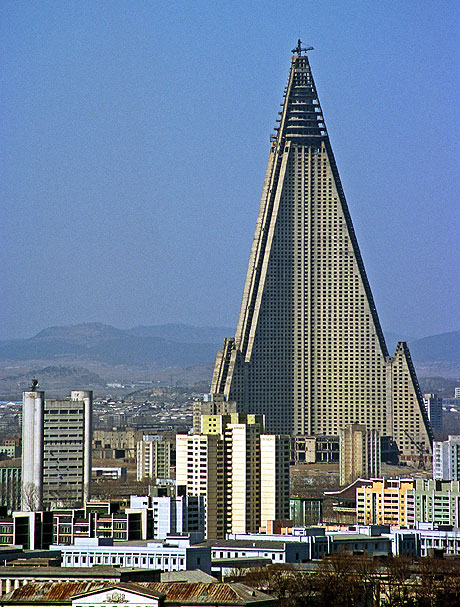
It's the Ryugyong Hotel in North Korea, where the world's 22nd largest skyscraper has been vacant for two decades and is likely to stay that way ... forever.
By Eva Hagberg
A picture doesn't lie -- the one-hundred-and-five-story Ryugyong Hotel is hideous, dominating the Pyongyang skyline like some twisted North Korean version of Cinderella's castle. Not that you would be able to tell from the official government photos of the North Korean capital -- the hotel is such an eyesore, the Communist regime routinely covers it up, airbrushing it to make it look like it's open -- or Photoshopping or cropping it out of pictures completely.
Even by Communist standards, the 3,000-room hotel is hideously ugly, a series of three gray 328-foot long concrete wings shaped into a steep pyramid. With 75 degree sides that rise to an apex of 1,083 feet, the Hotel of Doom (also known as the Phantom Hotel and the Phantom Pyramid) isn't the just the worst designed building in the world -- it's the worst-built building, too. In 1987, Baikdoosan Architects and Engineers put its first shovel into the ground and more than twenty years later, after North Korea poured more than two percent of its gross domestic product to building this monster, the hotel remains unoccupied, unopened, and unfinished.
Ryugyong Hotel North Korea Pyongyang http://jp.youtube.com/watch?v=0r0fM31BXKk A bootleg video of the tower from YouTube. How the brazen videographer escaped without being arrested remains a mystery.
Construction on the Hotel of Doom stopped in 1992 (rumors maintain that North Korea ran out of money, or that the building was engineered improperly and can never be occupied) and has never started back up, which shouldn't come as a shock. After all, who the hell travels to beautiful downtown Pyongyang? It would make sense if the hotel were in South Korea, where Americans are allowed to travel and where projects like the Busan Lotte Tower and the Lotte Super Tower now rise thousands of feet above the formerly modest skyline.
With Pyongyang's official population said to range between 2.5 million and 3.8 million (official numbers are not made available by the North Korean government), the Ryugyong Hotel -- the 22nd largest skyscraper in the world -- is a failure on an enormous scale. To put it in context, imagine if the John Hancock Center (1,127 feet tall) in Chicago (population 2.9 million) was not only completely vacant, but unfinished with zero hope of ever being completed.
You may not be able to actually live there, but the building now has its own virtual real estate managers, Richard Dank and Andreas Gruber, a pair of German architects and self-described "custodians of the pyramid's diverse manifestations." The duo run Ryugyong.org, which they describe as an "experimental collaborative online architecture site." Sad you can't visit the building in real life? Log on, view the detailed 3-D models, and "claim" a subsection for yourself.
The Demolition S How video.
The Demolition S How video by the Italian architects Extraneo might not be as conceptual as Ryugyong.org, but this piece of architectural porn sure is fun to watch. The video (which you can watch above) was mounted as part of the exhibition Fiction Pyongyang, curated in part by Stefano Boeri, who also collected 120 speculative designs for the hotel in the June 2006 domus magazine. The designs, he says, "have forced it to reveal its icy nature, its irresistible fascination as a fragile alien meteorite." The worst building in the world is also, we now know, "the only built piece of science fiction in the contemporary world." And it's true. Demolition S How is all Blade Runner-style flying ads and soaring concrete, and the video reminds us that the worst building in the world is the closest humans have come to building a Death Star.
The latest Bush Administration official to return from Pyongyang empty-handed is Sung Kim, who spent three days in Pyongyang and got no nuclear declaration for his trouble. It’s a well known fact of diplomacy that even when no translation is necessary, it can take 72 hours to comprehend the utterance of the word “no.”
The latest Bush Administration alumnus to denounce its failing last-ditch appeasement of North Korea is former speechwriter Michael Gerson, who writes in the Washington Post about the conflict between Jay Lefkowitz and the State Department establishment:
The East Asia bureau at the State Department, headed by Assistant Secretary of State Christopher Hill, has consistently viewed the raising of human rights as an impediment to the serious work of negotiating with Kim Jong Il. The Korea desk tried and failed to exclude Lefkowitz from important policy meetings with the president. It attempted unsuccessfully to weaken the North Korea section in the State Department’s annual human rights report. Human rights groups generally view Hill with great suspicion. [Washington Post, Michael Gerson]
No shock there. We’ve known for years that State was willing to defy the law to block the North Korean Human Rights Act. The problem is that after Congress expressed its unanimous will, it pretty much forgot the whole thing.
North Korea feels little pressure as a result of its noncompliance. China seems relieved that Kim hasn’t recently misbehaved and urges patience. The South Korean government continues to hold up its end of a protection racket: To keep the peace, South Korea provides North Korea with aid, which is diverted to strengthen North Korea’s military, which threatens South Korea, which gives more aid to keep the peace.
This is the problem of State Department “realism.” Negotiations that begin as a means become the end itself ― a kind of blind and dreamy faith in the magic of the process. Any form of criticism or coercion disappears, because “the North Koreans won’t negotiate under pressure” ― when, in the past, the North Koreans have negotiated only under pressure.
Nail head pounded. Carrots and sticks are perfectly fine for pavlovian beasts of burden, but influencing cunning sociopaths requires methods that are at both more sophisticated and more forceful. Carrots indeed. The man eats caviar.
Lefkowitz’s speech has since been Trostkied from the State Department’s web site, but it’s available here. If you haven’t read it, you should. Lefkowitz may have come into his position with little knowledge of the subject at hand, but something has obviously changed between then and now. His speech shows gravitas and understanding of the topic that his State Department detractors lack. The speech is good enough and brave enough to convince me that Lefkowitz must have really believed – at least when Christopher Hitchens goaded him recently – that he could still have a positive influence on the Administration’s policies from within. I don’t believe that, but no one can deny that Lefkowitz has changed the Administration’s tone. Neither President Bush himself nor the State Department is claiming progress anymore. Now, all they can do is counsel patience.
Ironically, Lefkowitz can thank Condi Rice’s inept and mean-spirited rebuke for the fact that the Russians, the Chinese, and thousands more Americans now know his name. The media, always eager to pry at any split within the Administration, are listening to him again. Almost as one, conservatives rose to defend him against a woman that others had once tried to draft as a presidential candidate. We’ve since learned that Lefkowitz may have tried to resign from the Bush Administration several weeks ago. President Bush, perhaps realizing how much damage Lefkowitz could now do him, convinced him to stay on.