
Pearls look similar at a glance, but anyone who drills them knows each type behaves differently under a tool. Freshwater pearls often have thicker nacre and irregular shapes, Akoya pearls tend to be small and delicate with tighter tolerances, South Sea pearls are larger and more valuable so the risk cost is higher, and Tahitian pearls may show complex surface structures that chip if the setup is wrong. Because of these differences, a “one-configuration-fits-all” drilling machine is rarely ideal. Customizing pearl hole drilling machines for specific pearl types is less about adding luxury features and more about controlling stress, heat, alignment, and repeatability.
The first customization lever is spindle control. Different pearls respond to speed and torque in distinct ways. Higher RPM can reduce cutting force but raises friction heat, which may weaken the nacre or discolor the hole edge. For softer or thinner-nacred pearls, a machine with stable low-torque micro-rotation and minimal runout is essential. For thicker pearls, a higher-torque spindle with smooth acceleration prevents sudden grabs that create radial cracks. A programmable speed curve—starting slow to “seat” the bit, then increasing as the hole stabilizes—often improves yield across batches.
Second, the feed mechanism should match pearl structure and shape. Round pearls benefit from a precise linear feed with micrometer-level step control, while baroque pearls require adaptive clamping and multi-axis alignment. Machines customized for irregular pearls may use a floating chuck or compliant fixture that self-centers without excessive pressure. This reduces point loading, especially important for Akoya, where clamping marks can become visible after mounting. For high-value South Sea pearls, adding force-feedback feed control can stop the advance the moment resistance changes, preventing breakout on the far side.
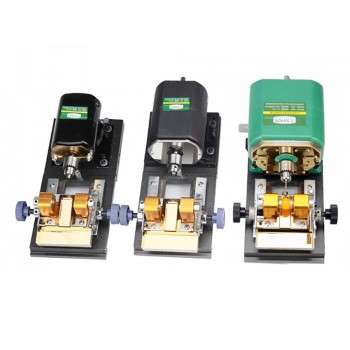
Tooling is the third pillar. Bit geometry matters as much as the machine. Fine diamond-coated bits with optimized flute design evacuate powder rather than tearing nacre. For brittle surfaces, a pilot-drill approach—using a shorter, stiffer bit first—reduces wandering. Quick-change collets are useful when switching between pearl types, but they must maintain concentricity; otherwise, the wobble enlarges holes and creates uneven edges that complicate stringing.
Cooling and debris management are often underestimated. Some pearls drill cleanly dry, but others benefit from mist cooling to control heat and carry away dust. A customizable system should allow adjustable airflow, micro-mist volume, and filtration. This is not only about quality; it protects operators and keeps the work zone clear for visual inspection.
Finally, customization includes measurement and workflow. Integrated cameras, depth stops, and digital counters make it easier to maintain consistent hole diameter and placement across a strand. For Tahitian pearls with darker tones, improved lighting and contrast imaging help detect micro-chips early. In practice, the best machines are built like a platform: stable core mechanics, then configurable fixtures, feed profiles, and tooling packages tailored to the pearl type. The result is higher pass rates, cleaner holes, and far less risk to the most valuable material in the jewelry process.
