
The 2V0-16.25 exam guide is now dated November 2026, and it has one real change: a new Objective 2.5 on vSphere Kubernetes Service (VKS), while Objective 4.4 lost its three hands-on "Deploy" lines. The exam itself is the same: 60 items, 135 minutes, a passing score of 300 and a price of $250.
If you started studying for the VCP-VVF Administrator exam with an older copy of the guide, this entry shows you exactly which lines moved, what that means for Kubernetes topics, and how to change your plan without starting over. We compared the copy we saved on 14 October 2026, which said "Last Updated: 8/15/2025", with the copy Broadcom serves today, 28 November 2026. We cannot tell you the day Broadcom made the switch, only what is different between the two.

What changed in the 2V0-16.25 exam guide?
Kubernetes moved. It used to sit at the end of the blueprint as three "Deploy" tasks, and now it sits in Section 2 as four "Describe" lines. Everything else in the blueprint reads the same, apart from small wording changes.
Here is the full list of differences we found, line by line:
- New Objective 2.5, VMware vSphere Kubernetes Service (VKS). Four lines: describe vSphere Supervisor concepts, infrastructure components and security; describe Supervisor deployment models, networking and storage; describe Supervisor core and optional services; describe VKS deployment and administration.
- Objective 4.4, Consume and Automate, went from 5 lines to 2. The lines on deploying virtual machines with the VM Service, deploying Kubernetes workloads with VMware Kubernetes Services, and deploying vSphere Pods and other services are gone. Two lines stay: describing the deployment of Supervisor-based Services, and the use case for VCF Operations Orchestrator.
- Line count: 49 objective lines in total, up from 48. Section 2 now holds 21 lines (was 17) and Section 4 holds 28 (was 31).
- Wording: the Section 4 lines now say "VVF" where the older copy spelled out "VMware vSphere Foundation". The meaning is the same.
Sections 1, 3 and 5 still say "No testable objectives". So the exam is still about knowing the fundamentals and running VVF, not about design or troubleshooting as separate sections.
What stayed the same on the 2V0-16.25 exam?
All the exam facts on the certification page are unchanged. The VCP-VVF Administrator certification page lists them like this today:
- Exam: VMware vSphere Foundation 9.0 Administrator (2V0-16.25).
- Credential: VMware Certified Professional - VMware vSphere Foundation Administrator (VCP-VVF Admin).
- Questions: 60.
- Time: 135 minutes. The guide says this is enough for all candidates, including non-native English speakers.
- Passing score: 300, on a scaled method.
- Price: $250.
- Languages: English and Japanese.
- Item format: multiple choice and multiple choice, multiple selection.
- Delivery: proctored, through Pearson VUE.
- Required exams: only 2V0-16.25.
135 minutes for 60 items works out at 2 minutes 15 seconds per item. Most items begin with a short scenario, so that time goes faster than it sounds.
The candidate Broadcom describes also stays the same. That person can deploy, configure and manage a VVF solution that runs both Supervisor-based and VM workloads, has at least six months with VVF or its parts, and at least one year in IT. A foundational knowledge of Kubernetes is still part of that profile, which matters for the next section.
What does the new Objective 2.5 ask you to know?
It asks you to explain the vSphere Supervisor and VKS, not to build them step by step. All four lines start with "Describe", and none starts with "Given a scenario".
The best single page to read for this objective is Broadcom's TechDocs article What Is vSphere Supervisor? for VCF 9.0. It covers most of the concept words the four lines use.
These are the points from that page we would make sure you can explain in your own words:
- What the Supervisor is. It puts a Kubernetes control plane directly on vSphere clusters, which gives vSphere a declarative API. A vSphere administrator activates existing clusters for it.
- vSphere Namespaces. These are the resource boundaries where workloads run. The administrator sets memory, CPU and storage on each namespace and hands it to DevOps engineers.
- The four kinds of workload. Containers running inside vSphere Pods, VMs provisioned through the VM Service, Kubernetes clusters deployed with VKS, and applications running inside those VKS clusters.
- Who sees what. The vSphere administrator manages and monitors vSphere Pods, VMs and VKS clusters from the vSphere Client, with full view of where they run and what they use.
- vSphere Zones. They protect workloads on the Supervisor against the failure of a whole cluster.
The second and third lines of 2.5 go one step further: deployment models, networking and storage, and the core and optional services. Read the deployment and services pages linked from that TechDocs section, so you can say which option fits which setup.
Why does the 4.4 change matter for how you study?
It changes the depth, not the topic. In the older guide you had to deploy VMs with the VM Service, deploy Kubernetes workloads and deploy vSphere Pods. In the new guide you have to describe those things and the Supervisor around them.
In practice that means three things for your notes:
- Know the parts and their names. Supervisor, vSphere Namespace, vSphere Pod, VM Service, VKS cluster. A "describe" item often turns on telling two of them apart.
- Know the order things happen in. Objective 4.1 still has a scenario line on configuring Supervisor within a cluster, so the enable-then-namespace-then-workload order is still tested.
- Spend fewer lab hours on Kubernetes YAML. If your plan had a full week of deploying workloads from kubectl, you can cut it to a day of reading plus one walk-through in the vSphere Client.
The topic count for Kubernetes went up slightly. Six lines now name the Supervisor or VKS: the four in 2.5, one in 4.1 and one in 4.4. So do not drop it. Just move it from "build" to "explain".
Where do the 49 objective lines sit now?
Most of the blueprint is still VCF Operations. Objective 4.3, Operate, has 19 of the 49 lines, about 39 percent. Broadcom publishes no weights, so line counts show where the material is, not how many questions each objective gets.
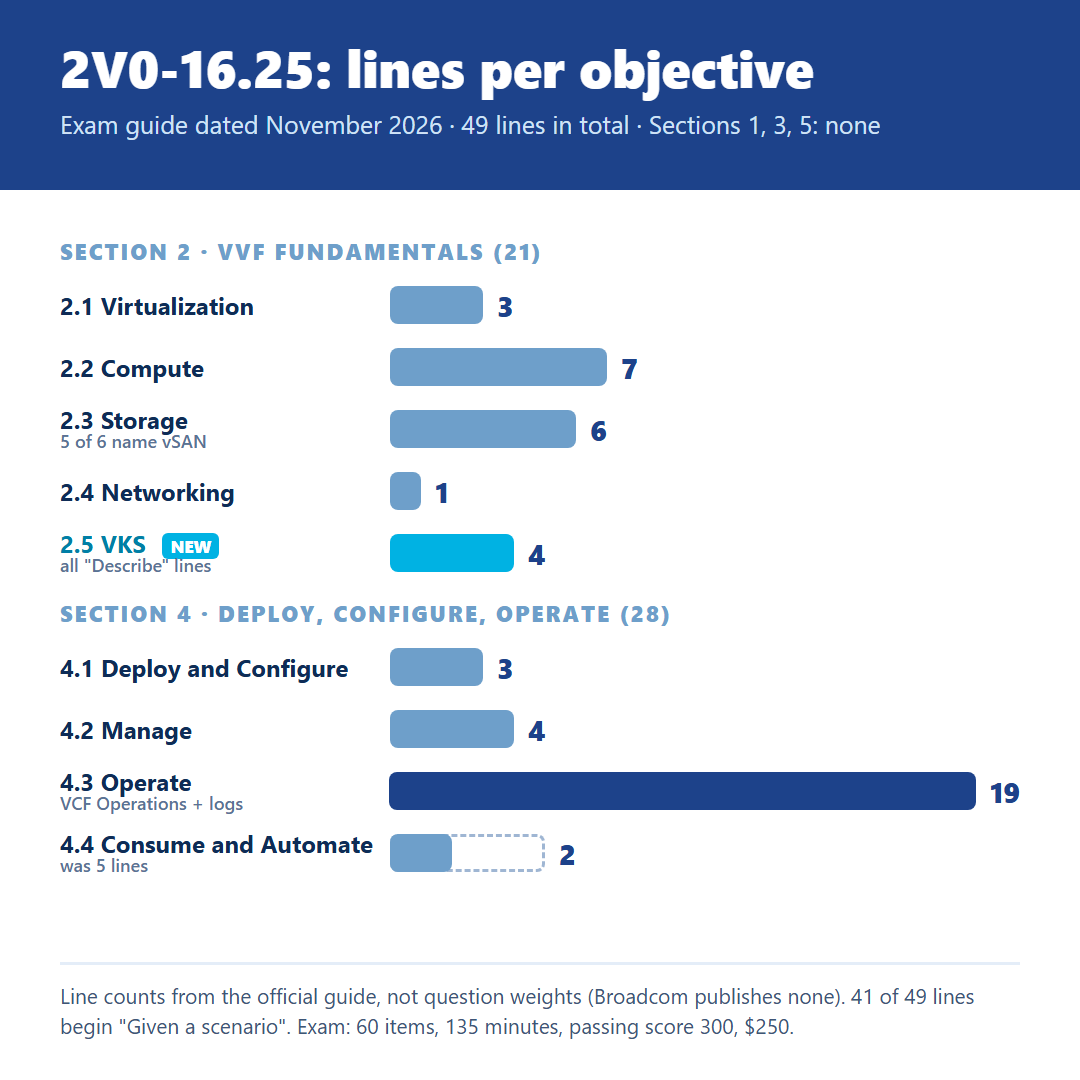
Here is the count for each objective, in the guide's own order:
- 2.1 Virtualization Fundamentals: 3 lines.
- 2.2 VMware Compute Fundamentals: 7 lines, from vCenter and ESX setup to Content Libraries and encryption.
- 2.3 VMware Storage Fundamentals: 6 lines, five of them on vSAN (ESA or OSA, cluster deployment, storage policies, resilience, space efficiency).
- 2.4 VMware Network Fundamentals: 1 line, "differentiate between VVF networking components".
- 2.5 VMware vSphere Kubernetes Service (VKS): 4 lines, all new.
- 4.1 Deploy and Configure: 3 lines.
- 4.2 Manage: 4 lines: identity and RBAC, licensing, certificates, lifecycle.
- 4.3 Operate: 19 lines, one of which is printed twice with a different capital letter.
- 4.4 Consume and Automate: 2 lines.
Three more counts help with planning. 41 of the 49 lines start with "Given a scenario". 17 lines name VCF Operations in some form, including VCF Operations for logs, VCF Storage Operations and VCF Operations Orchestrator. And 6 lines name vSAN.
How should you adjust a six-week study plan?
Keep the weight on VCF Operations and add a short Supervisor block. If you already had a plan from the older guide, only weeks four and five change below. The plan assumes eight to ten hours a week.
- Week 1, compute (2.1, 2.2): vCenter and ESX setup, cluster settings, VM tasks, Day 2 work in vCenter, Content Libraries and encryption.
- Week 2, storage and networking (2.3, 2.4): vSAN ESA against OSA, a small vSAN cluster in a nested lab, storage policies, resilience and space efficiency, then the VVF networking parts.
- Week 3, VCF Operations part 1 (4.3): use cases, cluster components and deployment options of VCF Operations and VCF Operations for logs, metrics against properties against logs, views, reports, dashboards and alerts.
- Week 4, VCF Operations part 2 (4.3): log events and Explore Logs, costing and pricing, policies, vSAN monitoring with VCF Storage Operations, application monitoring, Service Discovery, and compliance.
- Week 5, deploy, manage and Supervisor (4.1, 4.2, 2.5, 4.4): VVF deployment, identity and RBAC, licensing, certificates and lifecycle, then two evenings on the Supervisor concepts from the TechDocs page and one on Supervisor-based Services and VCF Operations Orchestrator use cases.
- Week 6, review: read all 49 lines again and mark each green, amber or red. Spend the week on amber and red, and book the exam once nothing is red.
Tick off objective numbers, not chapters. The guide says the objective numbers may appear on your score report if you need a retake, so the same list becomes your retake plan.
What mistakes do candidates make when a guide is updated?
The biggest one is studying from a saved PDF and never checking for a new edition. These are the others we see:
- Still drilling VM Service and vSphere Pod deployments. They are no longer separate "Deploy" lines. Learn what they are and how they relate instead.
- Skipping 2.5 because it says "Describe". Four lines is more than 2.1, 2.4 or 4.4. Describe items can be tricky, because two answers often use the right words in the wrong place.
- Treating VCF Operations as one topic. Objective 4.3 has 19 lines that cover two products, VCF Operations and VCF Operations for logs. Give each its own lab time.
- Forgetting the repeated line. The "cluster components and deployment options of VCF Operations for logs" line is printed twice in 4.3. Count it once in your tracker, or your progress numbers will be off.
- Mixing up VVF and VCF. This exam is based on VVF. Study material written for full VCF adds NSX and VCF Automation topics that this blueprint does not list.
What does a 2V0-16.25 scenario look like in practice?
Here is a short scenario we wrote ourselves to show the new mix. It is not taken from the exam.
A team runs VVF 9 with one vSAN cluster. The application group wants to run a few containers and two small Kubernetes clusters next to their usual VMs. The vSphere administrator must keep control of how much CPU, memory and storage the group uses, and the operations lead wants one dashboard that shows the cluster and its logs together.
Read it objective by objective. Objective 2.5 and 4.1: the administrator activates the Supervisor on the cluster and creates a vSphere Namespace with set limits. The containers can run as vSphere Pods and the Kubernetes clusters through VKS, and the administrator still sees all of them in the vSphere Client. Objective 2.3: a vSAN storage policy for the namespace decides how resilient that storage is. Objective 4.3: the dashboard means VCF Operations dashboards, with VCF Operations for logs integrated for the log side.
One scenario like this touches four objectives, and that is the style of the exam. Practise reading each scenario for the objective it belongs to before you look at the options.
How does 2V0-16.25 compare with the other VCF 9 exams?
It is the professional exam for VMware vSphere Foundation. The VVF parts the guide names are vSphere (vCenter Standard, ESX and the Supervisor), vSAN, VCF Operations and VCF Operations for logs, and no line mentions NSX or VCF Automation. The sister exam for full VMware Cloud Foundation is 2V0-17.25, VCP-VCF Administrator.
If you are not sure which of the two fits your job, our Weebly notes on how hard the 2V0-17.25 exam is show what the VCF version asks for. If your daily work includes NSX or VCF Automation, compare both blueprints before you choose.
Both exams share a lot of ground: vCenter, ESX, vSAN and VCF Operations appear in each. Passing one first makes the second much shorter to prepare for.
People who design VCF environments often look at the architect track next. Our earlier entry on the 2V0-13.25 VCP-VCF Architect exam topics explains that design-side exam.
The architect exam asks why a design is right, while 2V0-16.25 asks how to run what is already built. If you are newer to VMware platforms, starting with the administrator side gives you the hands-on base the design questions assume.
Once you work with full VCF every day, the advanced administrator exam is the next step. Our entry on the 60 objectives of the 3V0-11.26 VCAP-VCF Administrator exam shows how much wider the VCAP level is.
Is there a short video on the 2V0-16.25 exam?
Yes. The VMExam channel has a short clip on the 2V0-16.25 exam, made to watch before you book.
Watch it once now, then read the official 2V0-16.25 exam guide again from the top. Check the date in its header each time you start a new study block, so you never work from an old edition again.
A fair rule of thumb: if the header date is newer than the copy in your notes, compare the objective lists before you study further. It takes ten minutes and can save you a week on the wrong topics.
In your review week, timed practice shows which lines are still amber. VMExam's 2V0-16.25 practice exam for the VCP-VVF Administrator certification is one way to find them. Use the results to pick what to revise, not as a forecast of your score.
Frequently asked questions
1. What changed in the November 2026 2V0-16.25 exam guide?
A new Objective 2.5 on vSphere Kubernetes Service with four Describe lines was added, and Objective 4.4 went from five lines to two. The exam facts did not change.
2. How many questions are on the 2V0-16.25 exam?
There are 60 items in a 135-minute appointment. The passing score is 300 on a scaled method.
3. How much does the 2V0-16.25 exam cost?
Broadcom lists the price as $250. The exam is offered in English and Japanese and is proctored through Pearson VUE.
4. Do I still need to study Kubernetes for 2V0-16.25?
Yes. Six objective lines name the Supervisor or VKS. The new guide asks you to describe them rather than deploy workloads step by step.
5. Which part of the 2V0-16.25 blueprint is the largest?
Objective 4.3, VVF: Operate, with 19 of the 49 lines. Almost all of them are about VCF Operations and VCF Operations for logs.