
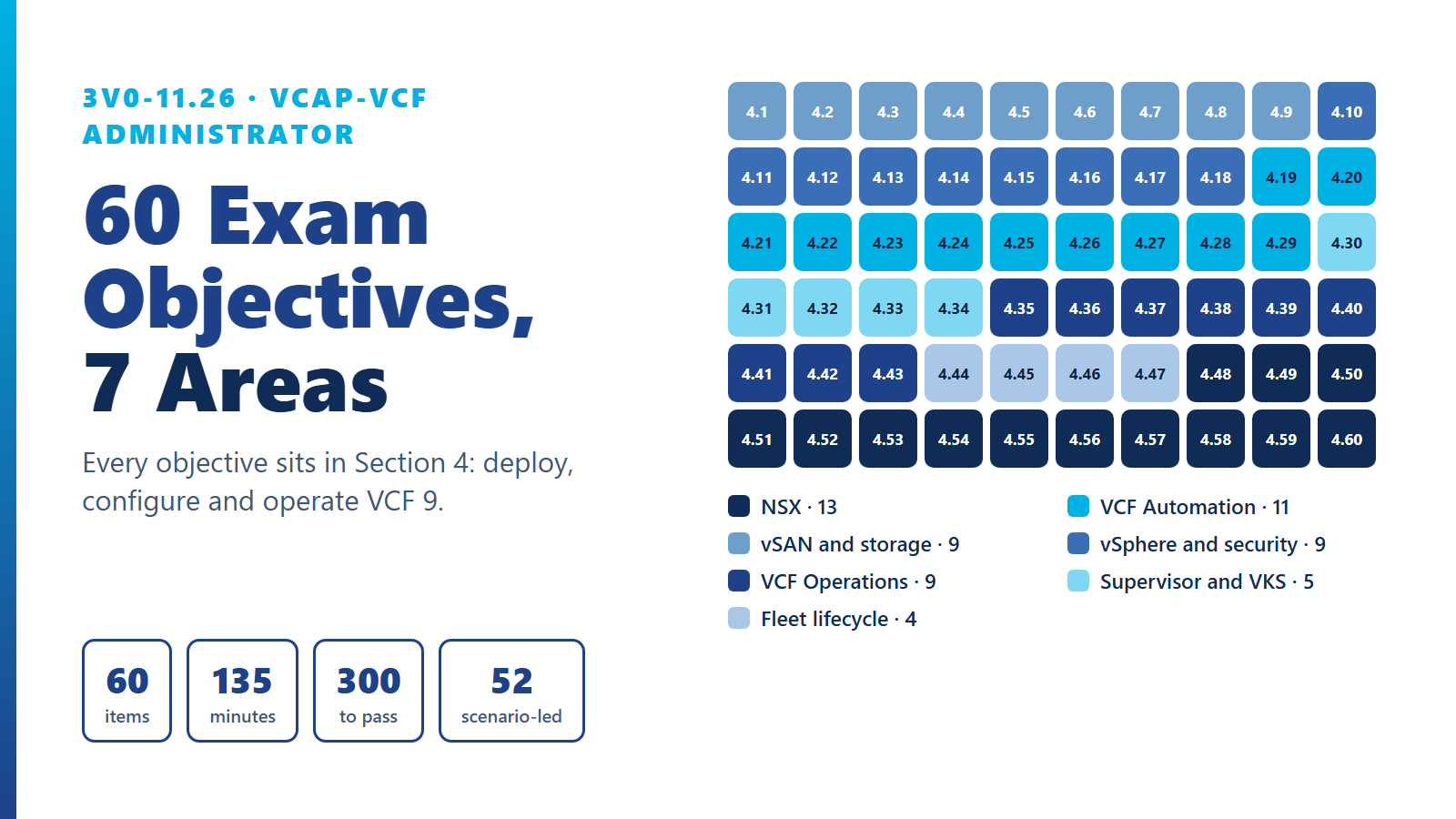
The 3V0-11.26 exam objectives are 60 hands-on tasks, numbered 4.1 to 4.60, and every one of them sits in Section 4, "Deploy, Configure, and Operate VMware Cloud Foundation". Sections 1, 2, 3 and 5 have no testable objectives, so this VCAP exam is about running VCF 9, not designing it.
This entry is for anyone preparing for the VCAP-VCF Administrator certification. It sorts the 60 objectives into seven product areas, shows how many tasks each area holds, and turns that into a seven-week plan. It also covers the exam facts, the mistakes we see most, and a practice scenario we wrote ourselves. Every figure below was read on Broadcom's own pages on 26 November 2026.
What is the 3V0-11.26 exam?
It is the exam for the VMware Certified Advanced Professional - VMware Cloud Foundation Administrator credential, VCAP-VCF Administrator for short. Broadcom's exam name is "Advanced VMware Cloud Foundation 9 Administrator (3V0-11.26)", and the content is based on VCF 9.
The VCAP-VCF Administrator certification page lists one required exam: 3V0-11.26 itself. Broadcom describes the credential as proof that you can operate VCF environments, with an advanced understanding of the Operations, Automation, Networking and VKS parts of the platform.
The candidate Broadcom has in mind already manages a multi-region or multi-organization VCF private cloud. That person scales vSAN and NSX, runs the vSphere Supervisor with add-on services, sets up VCF Automation for tenants, and uses VCF Operations for policies, cost settings, intents and configuration drift. If that is not your job yet, the exam will feel wide, because it touches every one of those products.
How many questions are on the 3V0-11.26 exam, and what is the passing score?
There are 60 items, you get 135 minutes, and the passing score is 300 on a scaled method. The exam costs $250, it is offered in English, and it is proctored.
Here are the facts from the certification page and the November 2026 exam guide in one place:
- Questions: 60 items.
- Time: 135 minutes, which Broadcom says is enough for all candidates, including non-native English speakers.
- Passing score: 300, scaled.
- Price: $250.
- Language: English.
- Item types: multiple choice, multiple selection, build-list, matching, drag-and-drop, point-and-click and hot-area. Other types may appear, but less often.
- Delivery: proctored, through Pearson VUE.
135 minutes for 60 items is 2 minutes 15 seconds each. That sounds generous, but most items start with a scenario you have to read first, so pace yourself from the first question.
What do the 3V0-11.26 exam objectives cover?
All 60 objectives are tasks you do on a running VCF 9 fleet. The official 3V0-11.26 exam guide lists them as one long Section 4, with no sub-bullets and no weights.
Two counts tell you a lot about the style. 52 of the 60 objectives start with "Given a scenario", so most items describe a situation first and then ask what you would do. 10 objectives ask you to "identify the process" or a use case, which usually means putting steps in order or picking the right next step. Expect build-list and sequencing items there.
Sixty items in one list is hard to plan around. So we grouped the objectives by product. The grouping and its names are ours, not Broadcom's. The numbers are the official objective numbers.
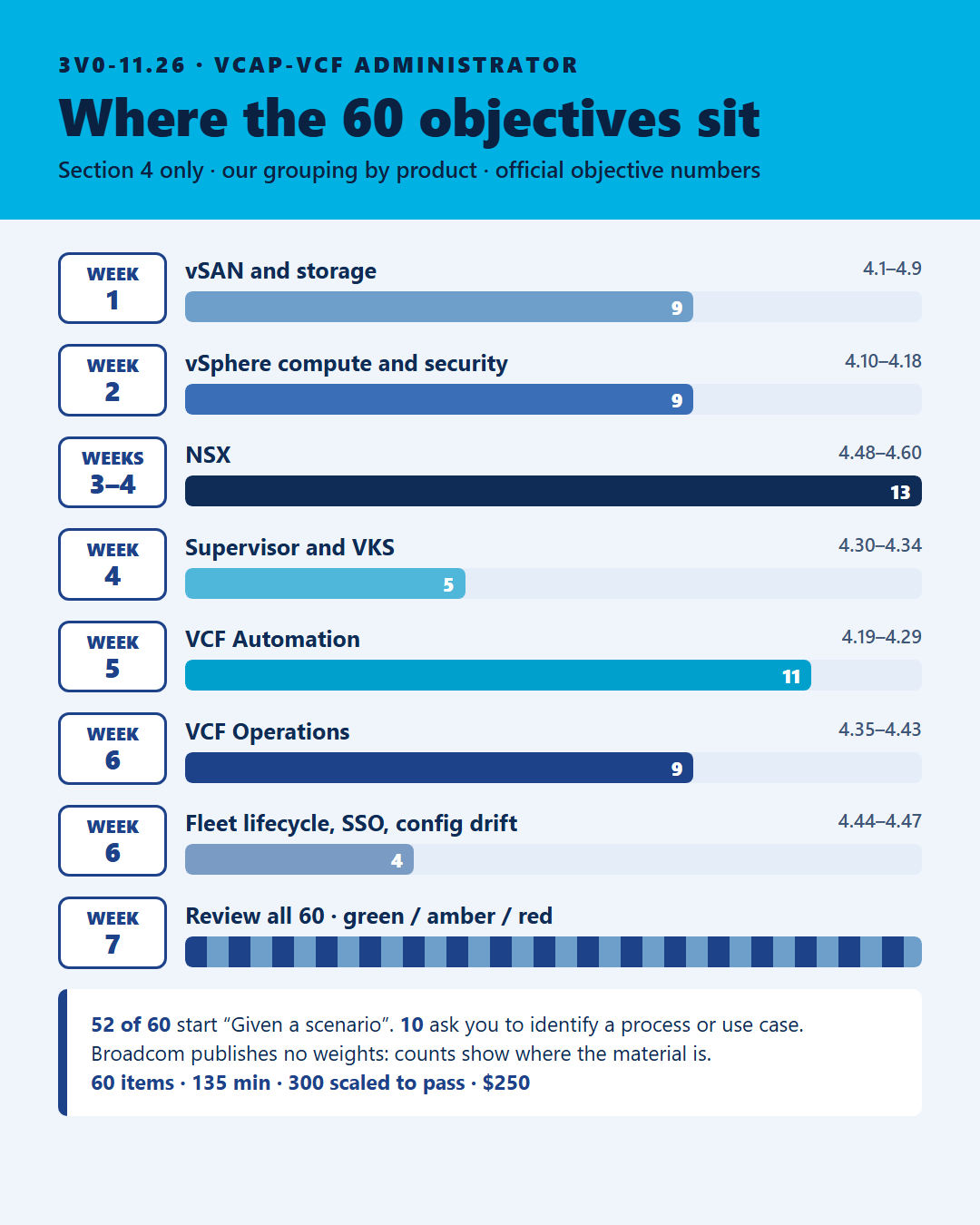
vSAN and storage (4.1-4.9, 9 tasks)
Deploying a vSAN cluster and a vSAN stretched cluster in a workload domain, a cluster with supported non-vSAN storage, vSAN cross-cluster capacity sharing and vSAN storage clusters, vSAN encryption, vSAN data protection, Day 2 tasks on standard and stretched clusters, and vSAN storage policies.
vSphere compute, VMs, performance and security (4.10-4.18, 9 tasks)
vSphere advanced settings, VM management, advanced network operations, CPU and memory performance, vCenter performance, monitoring vSphere components, security and access control, and VM encryption with vSphere Trusted Environments.
VCF Automation (4.19-4.29, 11 tasks)
Five tasks in the Provider Management portal: the identity provider, provider content libraries, access control, creating an organization, and the Provider Consumption Organization (PCO). Six tasks inside a VCF All Apps Organization: identity providers, access control, projects, governance policies, namespace classes, and VPCs with VPC connectivity profiles.
Supervisor and VKS (4.30-4.34, 5 tasks)
Creating Supervisor clusters with NSX VPC, NSX segment, vDS and Avi load balancer options, managing add-on services such as Harbor and external-dns, rolling updates of VKS clusters, package repositories and private registries, and Supervisor Service upgrades. These are the only five objectives in a row that do not start with "Given a scenario".
VCF Operations (4.35-4.43, 9 tasks)
Day 2 operational tasks, reclaiming resources, rightsizing, capacity forecasting with What-If scenarios, cost management, policies, Business Intent versus Operational Intent, business applications, and alerts.
Fleet lifecycle, SSO and config drift (4.44-4.47, 4 tasks)
Scaling VCF Fleet Management lifecycle, upgrading fleet components, VCF SSO through Identity and Access Management, and watching configuration with VCF Operations Config Drift.
NSX (4.48-4.60, 13 tasks)
NSX Federation, NSX components, Edge clusters, Tier-0 and Tier-1 gateways, VRF, logical segments, VPCs, DHCP, the use case for NAT, projects and tenancy, advanced integrations, and operational tasks such as syslog and backup and restore.
NSX is the largest group with 13 tasks, and VCF Automation comes next with 11. Together they hold 24 of the 60 objectives. Broadcom publishes no weights, so these counts show where the material is, not how many questions each area gets.
How should you plan your study around the 60 objectives?
Give time in line with the task count, and do every task in a lab. The plan below assumes eight to ten hours a week next to a full-time job. If you already run VCF 9 every day, you can merge weeks.
- Week 1, vSAN and storage (9): build a stretched cluster in a nested lab if you can, then work through encryption, data protection and storage policies.
- Week 2, vSphere compute and security (9): advanced settings, CPU and memory tuning, vCenter performance, roles and permissions, VM encryption and Trusted Environments.
- Week 3, NSX part 1: Federation, Edge clusters, Tier-0 and Tier-1 gateways, VRF and segments. Write down the order of each build, because several of these are "identify the process" objectives.
- Week 4, NSX part 2 and Supervisor (5): VPCs, DHCP, NAT, projects and tenancy, then Supervisor networking options, add-on services and VKS updates.
- Week 5, VCF Automation (11): the Provider Management portal first, then an All Apps Organization end to end: identity provider, access, projects, governance policies, namespace classes and VPC connectivity profiles.
- Week 6, VCF Operations and fleet (9 + 4): policies, alerts, cost settings, intents, What-If capacity scenarios, then fleet upgrades, SSO and config drift.
- Week 7, review: read the 60 objective lines again and mark each one green, amber or red. Spend the week on amber and red. Book the exam when nothing is red.
Keep the exam guide open while you study and tick off objective numbers, not chapters. The guide says the objective numbering may show up on your score report if you need a retake, so the same numbers become your retake plan.
Which official docs help with the VCF Operations tasks?
The Broadcom TechDocs for VCF 9.0 cover each VCF Operations task in detail, and they are the reference the exam guide points to. Objective 4.38, capacity forecasting with What-If scenarios, is a good example, because it rewards knowing where things are in the interface.
The TechDocs page on What-If analysis for workload, capacity and migration planning explains that you open Plan under Capacity, then choose New in the What-If Analysis tab. You then pick one of seven panes, such as Workload Planning (traditional or hyperconverged), Infrastructure Planning, Migration Planning or Datacenter Comparison. A committed scenario reserves capacity for planned workloads without changing anything in the environment. You can only combine scenarios that apply to the same object.
Details like these are what scenario questions test. Read the page for each VCF Operations objective, then repeat the clicks in your lab.
What mistakes cost 3V0-11.26 candidates marks?
Most lost marks come from studying the products you already use and skipping the rest. These five come up most often:
- Treating it as a design exam. The architect exam, 3V0-12.26, tests design decisions. This one tests doing the task. If you study design patterns only, you will know why but not where to click.
- Skipping VCF Automation. Many admins have never set up a provider portal or an All Apps Organization. That is 11 of the 60 objectives, more than vSAN or vSphere.
- Learning NSX only from the vCenter side. Federation, VRF, Tier-0 gateways and Edge clusters need time in the NSX Manager itself.
- Ignoring process order. Ten objectives ask you to identify a process. Build-list items punish a step in the wrong place, so practise saying each workflow out loud in order.
- Leaving VKS to the end. Supervisor networking options and add-on services are new to many vSphere admins. Give them a full lab session, not a read-through.
What does a 3V0-11.26 scenario look like in practice?
Here is a scenario we wrote ourselves. It is not taken from the exam. It shows how one request crosses four of the seven areas.
A company runs VCF 9 in two regions. A new business unit needs its own tenant. Its developers want Kubernetes clusters on demand, a private network with outbound internet access, and their own sign-in. Finance wants to know whether the current cluster can take the new load for the next six months.
Work through it by area. VCF Automation first: create a new organization in the Provider Management portal, connect its identity provider, and set access control, projects and governance policies inside it. Then the Supervisor: which networking option fits a tenant that needs NSX VPCs, and which add-on services, such as Harbor, should the developers get? Next NSX: the VPC needs a connectivity profile, and outbound access means you need to know when NAT is the right tool. Last, VCF Operations: run a What-If workload planning scenario for the cluster, and commit it if the capacity should be reserved.
Working one scenario like this from end to end in week seven ties together more than ten objectives. That is how the exam asks about them: as one situation, not as separate facts.
Where does 3V0-11.26 fit among the VCF 9 exams?
It is the advanced exam for people who run VCF. The professional-level exam below it is 2V0-17.25, VCP-VCF Administrator. If you have not taken that one yet, our Weebly notes on how hard the 2V0-17.25 exam is show what the step before this one looks like.
Many people take the two in that order. The professional exam builds the habit of working in a running fleet, and the advanced exam stretches that habit across more products: Automation, the Supervisor and NSX in depth.
There are two other VCAP exams for VCF 9 that people often compare with this one. Our earlier entry on the 3V0-12.26 VCAP-VCF Architect exam covers the design track, which has 20 objectives against 60 here.
The architect and administrator exams pair well. Someone who has passed both knows how a design choice plays out on Day 2, which is often the question a customer really asks.
If you work mostly in monitoring and capacity, the operations track overlaps with area 5 above. Our entry on the 3V0-22.25 VCAP VCF Operations exam goes deeper into that part.
Is there a short video on the 3V0-11.26 exam?
Yes. The VMExam channel has a short clip on three things that catch people out on this exam. It makes a quick recap before your review week.
Watch it once at the start, so you know what to look out for, and once more in week seven as a check.
Pearson VUE runs the exam, and its Broadcom exam page is where you check test center and online testing options before you book.
Book a date that leaves the whole review week free. A date set too early turns week seven into cramming, and cramming does not help with scenario items.
In your review week, timed practice shows which objectives are still amber. VMExam's 3V0-11.26 practice exam for the VCAP-VCF Administrator certification is one way to find them. Use the results to choose what to revise, not as a forecast of your score.
Frequently asked questions
1. How many objectives does the 3V0-11.26 exam have?
Sixty, numbered 4.1 to 4.60. They all sit in Section 4, Deploy, Configure, and Operate VMware Cloud Foundation. Sections 1, 2, 3 and 5 have no testable objectives in this exam.
2. What is the passing score for 3V0-11.26?
The passing score is 300 on a scaled method. The exam has 60 items and a 135-minute appointment.
3. How much does the 3V0-11.26 exam cost?
Broadcom lists the price as $250. The exam is offered in English and is proctored through Pearson VUE.
4. Which courses does Broadcom recommend for 3V0-11.26?
Six Advanced Configuration courses: VCF Storage, VCF Automation, VCF Operation, VCF Networking, VCF Compute, and vSphere Kubernetes Service.
5. Is 3V0-11.26 a design exam?
No. It tests deploying, configuring and operating VCF 9. Design is tested in the separate VCAP-VCF Architect exam, 3V0-12.26.