
The 3V0-12.26 VCAP-VCF Architect exam has 60 items in 135 minutes, a scaled passing score of 300 and a $250 fee. On paper that matches the VCP-level 2V0-13.25, but the advanced exam expects you to design a multi-region or multi-organization VMware Cloud Foundation private cloud from end to end.
So the numbers on the booking page will not tell you how hard the step up is. This entry compares the two architect exams line by line, shows what the 3V0-12.26 guide actually tests, and turns that into a six-week plan, a list of common mistakes and one practice question written for this post. Every figure was read on Broadcom's own pages on 29 October 2026.

What is the 3V0-12.26 VCAP-VCF Architect exam?
3V0-12.26 is the exam behind the Advanced VMware Cloud Foundation Architect certification, which Broadcom shortens to VCAP-VCF Architect. It is a design exam: it checks whether you can turn business goals into a VCF design that is available, manageable, fast enough, recoverable and secure.
The VCAP-VCF Architect certification page lists these exam details:
- Items: 60.
- Time: 135 minutes.
- Passing score: 300.
- Price: $250.
- Language: English is the only language listed.
- Formats: multiple choice, multiple choice multiple selection, drag and drop, matching and sequencing. The exam is proctored.
Broadcom describes the certification as proof of "fundamental and advanced design knowledge" of VCF, covering compute, storage, networking and cloud management. It also names the five design qualities you will hear about all through your study: availability, manageability, performance, recoverability and security, or AMPRS for short.
How is 3V0-12.26 different from 2V0-13.25?
The headline numbers are the same, so the difference is in depth and in the item types. Here is how the advanced exam compares with the VCP-VCF Architect exam, side by side.
- Questions, time, pass mark, price: both are 60 items, 135 minutes, 300 to pass and $250.
- Language: 2V0-13.25 is offered in English and Japanese. 3V0-12.26 lists English only.
- Item types: 2V0-13.25 lists multiple choice and multiple choice multiple selection. 3V0-12.26 adds drag and drop, matching and sequencing, and its guide also names build-list, point-and-click and hot-area items.
- Recommended training: 2V0-13.25 points to one course, VMware Cloud Foundation: Solution Architecture and Design. 3V0-12.26 points to six advanced design courses: Storage, Automation, Operation, Networking, Compute and vSphere Kubernetes Service.
- Objectives: both guides have 20 objectives in Sections 1 to 3. The VCP guide splits them 7, 1 and 12. The VCAP guide splits them 5, 3 and 12.
- Scope of the design: the VCP candidate designs a VCF solution that meets stakeholder needs. The VCAP candidate designs a multi-region and/or multi-organization private cloud, including VCF Automation tenancy and VCF Operations policies.
If you already passed the VCP exam, this blog's earlier entry on the 20 objectives of the 2V0-13.25 exam is a good place to see how much of that ground you can reuse.
What does the 3V0-12.26 exam guide actually test?
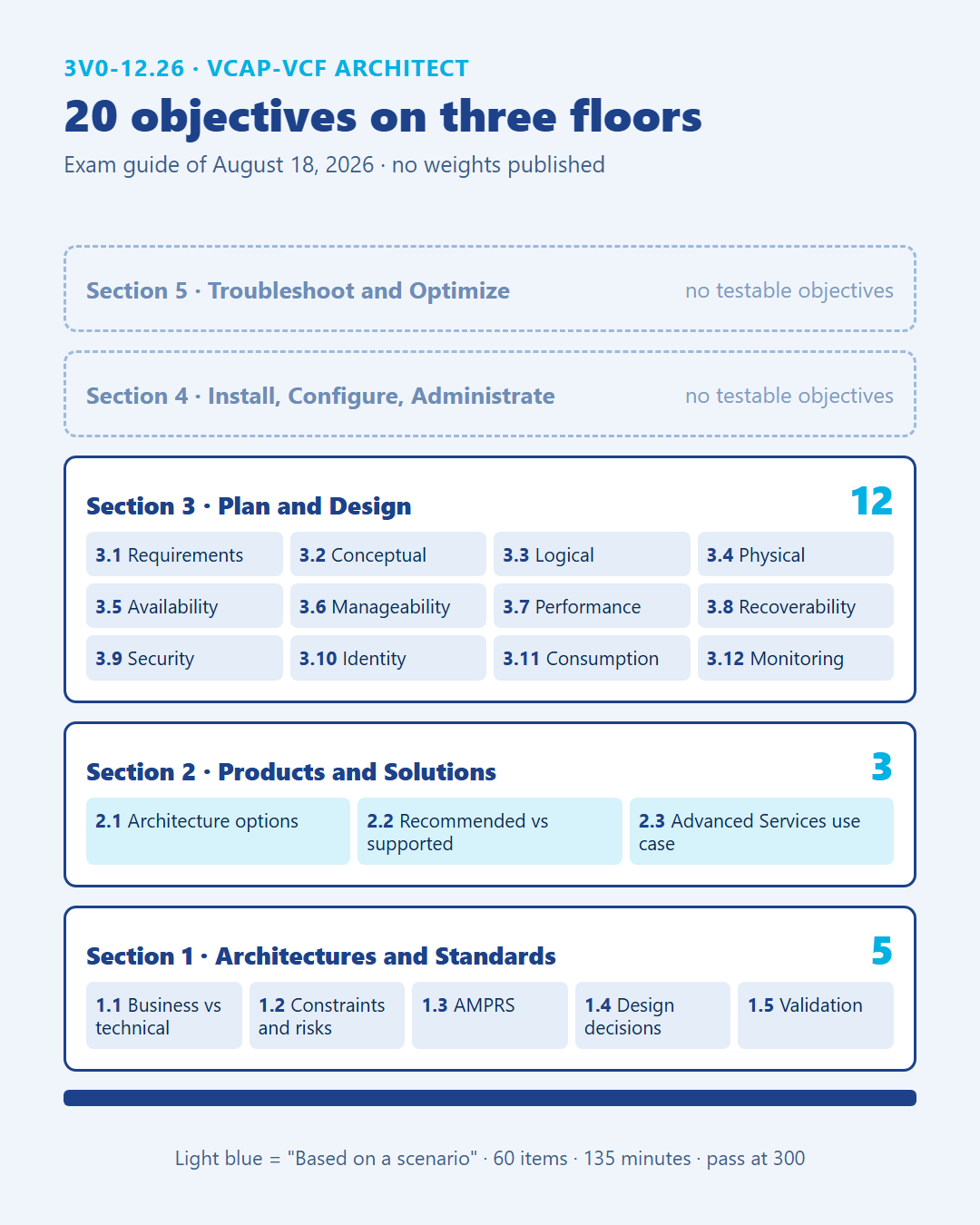
Only three of the five standard sections have anything to test. In the 3V0-12.26 exam guide (last updated August 18, 2026), Section 4 (install, configure, administrate) and Section 5 (troubleshoot and optimize) both say "NO TESTABLE OBJECTIVES THIS SECTION".
That leaves 20 objectives:
- Section 1, IT Architectures, Technologies, Standards (5): business versus technical requirements; requirements, assumptions, constraints and risks; the AMPRS qualities; developing design decisions; and a design validation strategy.
- Section 2, VMware Products and Solutions (3): each starts with "Based on a scenario". You choose between VCF architecture options, weigh recommended against supported design choices, and match VCF Advanced Services to a use case.
- Section 3, Plan and Design the VMware Solution (12): business objectives and requirements, the conceptual model, VCF logical and physical designs, then one objective each for availability, manageability, performance, recoverability, security and identity management, plus a consumption strategy and a monitoring strategy.
Unlike the VCP guide, the VCAP guide lists only the objective headings, with no sub-bullets under them. The detail comes from the candidate profile instead, covered in the next section. Broadcom publishes no weights per section, so treat all 20 objectives as fair game. The guide also says the objective numbers may appear on your score report if you need a retake.
What designs should a 3V0-12.26 candidate be ready to build?
The guide's "minimally acceptable candidate" paragraph is the most useful part for study, because it names the products and features the items are written around. Read it as a checklist.
- Scale: a multi-region and/or multi-organization VCF private cloud, with conceptual, logical and physical design outcomes.
- Components: vCenter, ESX, vSAN, NSX, VCF Identity Broker, VCF Automation, VCF Operations (including Operations for Logs, Fleet Management and Operations for Networks) and the vSphere Kubernetes Service (VKS).
- Storage and networking: storage policies, NSX Virtual Private Clouds (VPCs), and NSX gateways with stateful services.
- Supervisor: a vSphere Supervisor design that supports multi-zonal clusters and add-on services such as VKS.
- VCF Automation: Provider and Organization structures, projects, namespaces, blueprints, content libraries, policies and access controls.
- VCF Operations: policies, monitoring strategies, cost settings, intents and configuration drift baselines.
Notice how much of that list is about tenancy and consumption. A VCP-level design can stop at the infrastructure. A VCAP-level design has to say who consumes it, through which organization and project, and how that use is monitored and costed.
How do the VCF Design Blueprints help you study?
Broadcom's TechDocs already holds the closest thing to a model answer. The VCF 9.0 Design Blueprints section offers five pre-defined fleet topologies, from a single site with a minimal footprint up to multiple sites across multiple regions.
Each blueprint starts with a design profile in six categories: consumption, physical site configuration, availability, isolation, recoverability and expansion. Each one can be used as it is, or as a template where you swap a deployment model for another one from the same category in the design library.
That swap is exactly the skill objective 2.2 asks about: telling a recommended choice from one that is merely supported. Pick the multi-region blueprint, change one model, and write down what the change does to each AMPRS quality. Do that ten times and you have practised the core of the exam.
Should you take 2V0-13.25 before 3V0-12.26?
The certification page lists only one required exam for this credential, 3V0-12.26 itself, so Broadcom does not make the VCP exam a gate. Whether you should take it first depends on your design experience.
The VCP guide's candidate has one to two years of designing VMware-based solutions, including at least six months with VCF. If that is not you yet, the VCP exam is the gentler way to learn Broadcom's design language: requirements, constraints, risks, and conceptual versus logical versus physical. If you design VCF fleets for a living, going straight to 3V0-12.26 is reasonable, but plan extra time for VCF Automation tenancy and VKS design, which each get their own advanced course in the VCAP list.
The short above is about the sibling VCAP-VCF Administrator exam, 3V0-11.26. Its warnings about scenario wording apply to the architect exam too, since both belong to the same VCF 9 advanced level.
What does a six-week 3V0-12.26 study plan look like?
Six weeks of about eight hours each suits someone who already works with VCF. Stretch it to eight or nine weeks if Automation or Kubernetes is new to you.
- Week 1, design method (Section 1): practise sorting statements into requirements, assumptions, constraints and risks. Write ten design decisions, each with a justification and an implication, and a short validation plan for one of them.
- Week 2, architecture options (Section 2): read the design library models for workload domains, clusters, edges and networking. For each model, write one line on when it is recommended and when it is only supported.
- Week 3, logical and physical design (3.1 to 3.4): take one blueprint and draw its conceptual, logical and physical views. Label which business requirement drives each choice.
- Week 4, AMPRS and identity (3.5 to 3.10): for availability, manageability, performance, recoverability, security and identity, write one design decision each for a two-region fleet. Include VCF Identity Broker in the identity design.
- Week 5, consumption and monitoring (3.11 and 3.12): design a VCF Automation provider with two organizations, their projects, namespaces and content libraries. Then design the VCF Operations side: policies, cost settings and a drift baseline.
- Week 6, review: time yourself at 2 minutes 15 seconds per item, which is what 135 minutes over 60 items gives you. Re-read the candidate profile line by line and mark anything you could not design from memory.
If you also run VCF day to day, this blog's notes on what to expect in the 3V0-22.25 VCAP Operations exam show how differently the operations exam is built.
What mistakes cost candidates points?
Most lost points on a design exam come from reading the scenario too fast. These are the patterns to watch.
- Answering as an administrator. Section 4 and Section 5 have no testable objectives, so an answer about how to configure or fix something is usually the wrong kind of answer. Ask what the design decision is.
- Treating "supported" as "recommended". Objective 2.2 exists because many options work. The best answer is the one that meets the stated requirement with the fewest new risks.
- Ignoring the tenant layer. Questions can hinge on Provider versus Organization, projects and namespaces. If your design has no consumption model, it is not finished.
- Mixing up constraints and requirements. A fixed budget or an existing network is a constraint, not a requirement, and the answer options often test exactly that difference.
- Studying the VCP material only. The six recommended courses cover Automation, Operations and VKS design in depth. Skipping them leaves the most VCAP-specific objectives untouched.
Can you try a 3V0-12.26 style practice question?
This question was written for this post from the TechDocs design library. It is not taken from the exam.
A customer wants VPC networking on a new workload domain with no NSX Edge nodes. Later, they add a requirement: every VPC must have outbound NAT and a centralized firewall at the edge. Which design change meets the new requirement?
- A. Keep the Distributed Transit Gateway and turn on Auto-SNAT in the default VPC connectivity profile.
- B. Add more CIDRs to the external IP block.
- C. Move to a design that uses NSX Edges with a centralized transit gateway.
- D. Extend the external VLAN to more ESX hosts.
The answer is C. In the VPC Getting Started networking model, NAT rules, centralized firewall and NAT, and Auto-SNAT are all unavailable. The page says that if north-south services are required, an alternative with NSX Edges and a centralized transit gateway should be used. Options B and D change addressing and reach, not services. This is the kind of recommended-versus-supported judgement objective 2.2 describes.
How do you book the 3V0-12.26 exam?
The exam is proctored and delivered through Pearson VUE. Start from the "Register for Exam" button on the certification page, or go to the Broadcom exam page at Pearson VUE to find a test centre or an online appointment.
Before you pay the $250, check two things on the day you book: that the guide date is still August 18, 2026, and that English is the language you want, since no other language is listed for this exam.
Frequently asked questions
1. How many questions are on the 3V0-12.26 exam?
The 3V0-12.26 exam has 60 items. You get 135 minutes, which already includes extra time for candidates who are not native English speakers.
2. What is the passing score for 3V0-12.26?
The passing score is 300, using a scaled method. Broadcom does not publish a percentage or per-section weights.
3. Is 2V0-13.25 required before 3V0-12.26?
No. The certification page lists 3V0-12.26 as the only required exam for VCAP-VCF Architect. Taking 2V0-13.25 first is optional but helps if you are new to VCF design.
4. Which sections of the 3V0-12.26 guide are tested?
Sections 1, 2 and 3, with 20 objectives in total (5, 3 and 12). Sections 4 and 5 have no testable objectives in this version of the exam.
5. How much does the 3V0-12.26 exam cost?
The exam costs $250, according to Broadcom's certification page checked on 29 October 2026.