
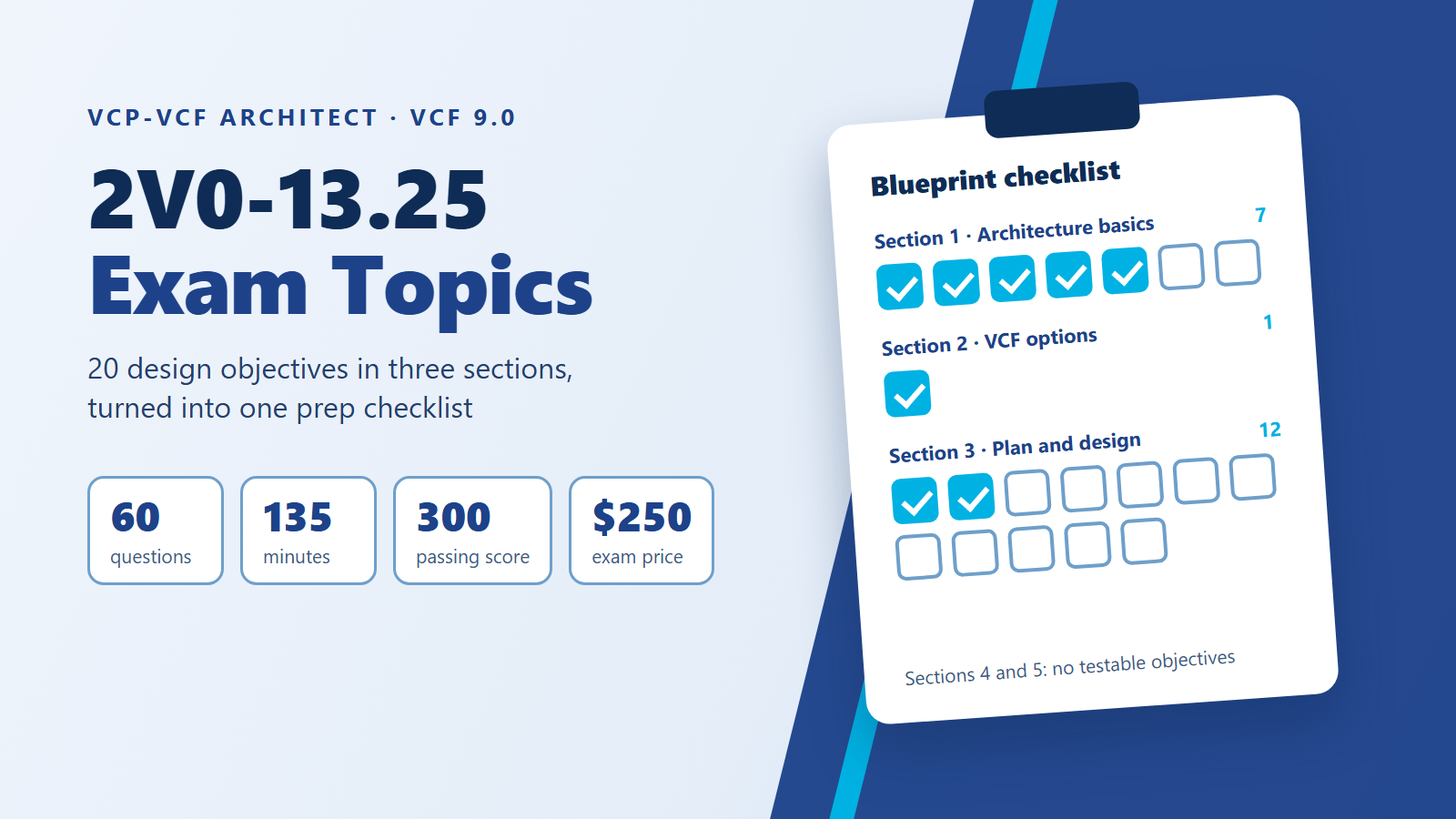
The 2V0-13.25 exam topics are 20 objectives in three sections, and all of them are about design. Section 1 has seven objectives on architecture basics, Section 2 has one on VCF architecture options, and Section 3 has twelve on planning and designing a VMware Cloud Foundation 9.0 solution. Install, configure and troubleshoot topics are not tested at all.
This entry lists what the VCP-VCF Architect exam actually tests and turns each of the 20 objectives into one checklist item with a clear "done when" test. If you can tick all 20, you have covered the whole blueprint. Every exam figure below was read on Broadcom's own pages on 22 October 2026.
What is the 2V0-13.25 exam, in short?
2V0-13.25 is the exam behind the VMware Certified Professional - VMware Cloud Foundation Architect credential, or VCP-VCF Architect. On the VCP-VCF Architect certification page, Broadcom says it validates skills in designing VCF solutions, including manageability, availability, performance, recovery and security, as well as monitoring, capacity planning and migration. The job roles it names are infrastructure architects and consultants.
The exam details on that page:
- Questions: 60 (the count is given for the English exam).
- Time: 135 minutes.
- Format: multiple choice and multiple choice, multiple selection.
- Passing score: 300, on a scaled method.
- Price: $250.
- Languages: English and Japanese.
- Recommended course: VMware Cloud Foundation: Solution Architecture and Design.
135 minutes for 60 questions gives you 2.25 minutes per question. The exam guide says the appointment time already includes extra time for non-native English speakers, so plan on that time and no more.
Which sections does the 2V0-13.25 blueprint test?
Only Sections 1, 2 and 3 are tested. VMware blueprints now use five standard sections, and the 2V0-13.25 exam guide (last updated 15 August 2025) marks Section 4 (install, configure, administrate) and Section 5 (troubleshoot and optimize) with "no testable objectives".
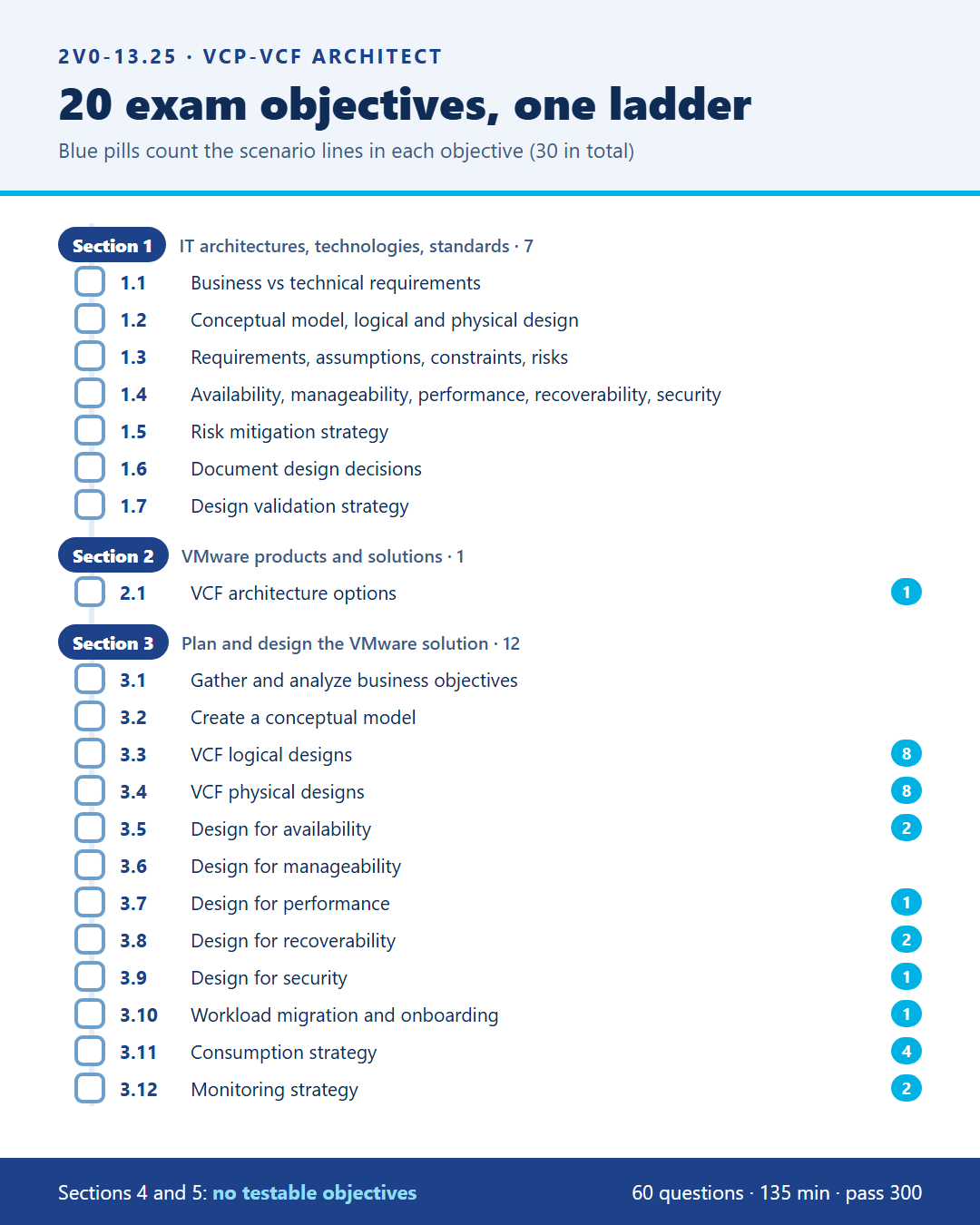
- Section 1, IT Architectures, Technologies, Standards: 7 objectives (1.1 to 1.7).
- Section 2, VMware Products and Solutions: 1 objective (2.1).
- Section 3, Plan and Design the VMware Solution: 12 objectives (3.1 to 3.12).
Broadcom does not publish a weight for each section, so nobody outside Broadcom knows how the 60 questions are split. What you can count is the wording. By my count, 29 lines in the guide start with "Given a scenario", and objective 2.1 starts with "Based on a scenario". So 30 lines ask you to read a customer situation and pick a design decision. Expect long question stems, and practise reading them fast.
One more point from the guide: your score report may list objective numbers. If you ever need a retake, those numbers point straight back to this checklist.
What do the seven Section 1 objectives ask you to do?
Section 1 tests the language of design, not any product. Four objectives start with "differentiate", which means the questions give you statements and ask you to sort them. Here are the first seven checklist items:
- Item 1, objective 1.1: Business vs technical requirements. Done when you can take a customer brief and mark each line as a business requirement (an outcome the business wants) or a technical one (how the system must behave).
- Item 2, objective 1.2: Conceptual model, logical design, physical design. Done when you can explain one VCF design at all three levels, from "what it must achieve" to "which hosts, networks and versions".
- Item 3, objective 1.3: Requirements, assumptions, constraints, risks. Done when you can sort ten sample statements into these four boxes without hesitating.
- Item 4, objective 1.4: AMPRS. Done when you can label any requirement as availability, manageability, performance, recoverability or security.
- Item 5, objective 1.5: Risk mitigation strategy. Done when you can write a risk, its impact and one mitigation in a single line.
- Item 6, objective 1.6: Document design decisions. The guide adds two points here: link each decision to a requirement, and state its implications. Done when every decision you write has both.
- Item 7, objective 1.7: Design validation strategy. Done when you can say how you would prove a design meets each requirement, for example with a test or a review.
These seven items take less study time than Section 3, but they sit under every scenario question. If you mix up a constraint and an assumption, a correct technical answer can still be the wrong option.
What does objective 2.1 cover?
Objective 2.1 has one line: based on a scenario, differentiate between VCF architecture options. It is the only product-level objective outside Section 3.
- Item 8, objective 2.1: VCF architecture options. Done when you can read a short scenario and say which VCF 9.0 deployment option fits it and why the others do not.
The VCF 9.0 concepts pages on TechDocs are the place to learn the terms these scenarios use. Read them before Section 3, because the logical and physical design objectives use the same words.
What are the twelve Section 3 objectives?
Section 3 is the core of the exam: 12 of the 20 objectives and 29 of the 30 scenario lines. The first four items take you from business goals to a full design:
- Item 9, objective 3.1: Gather and analyze business objectives and requirements. Done when you can turn an interview note into a list of numbered requirements.
- Item 10, objective 3.2: Create a conceptual model. Done when you can draw a one-page model from a set of business objectives, with no product names on it yet.
- Item 11, objective 3.3: Logical designs. Eight scenario lines: prerequisites, Fleet topologies, network infrastructure, the management domain, workload domains, networking, VCF Automation and VCF Operations. Done when you can name the logical design decision for each of the eight.
- Item 12, objective 3.4: Physical designs. The same eight areas again, at the physical level. Done when you can turn each logical decision from 3.3 into a physical one.
The next five items cover the design qualities:
- Item 13, objective 3.5: Availability. Two lines: availability within one availability zone and across availability zones. Done when you can give one design decision for each case.
- Item 14, objective 3.6: Manageability. Three lines: lifecycle management, scalability and capacity management. Done when you can say how a design grows and stays up to date.
- Item 15, objective 3.7: Performance. Done when you can pick a design decision that meets a stated performance requirement.
- Item 16, objective 3.8: Recoverability. Done when you can tell business continuity from disaster recovery, for management components and for workloads, and pick a decision for each.
- Item 17, objective 3.9: Security. Done when you can name design decisions that secure the VCF management components and the workloads.
The last three items are about running the platform:
- Item 18, objective 3.10: Workload migration and onboarding. Done when you can choose a migration approach for a given set of workloads moving into VCF.
- Item 19, objective 3.11: Consumption strategy. Four lines: VCF Automation tenant design, self-service and governance, automating infrastructure components, and support for modern applications. Done when you can make one decision for each.
- Item 20, objective 3.12: Monitoring strategy. Two lines: monitoring the management components and monitoring workloads. Done when you can say what you would watch in each.
How should you study the 2V0-13.25 topics week by week?
A six-week plan works for someone who already has some VCF experience. The guide's minimally qualified candidate has one to two years of designing VMware-based solutions, including at least six months with VCF. If you have less, stretch each week.
- Week 1: Section 1 vocabulary. Work through items 1 to 7. Write ten requirement, assumption, constraint and risk examples of your own and sort them.
- Week 2: Architecture options and concepts. Item 8, plus the TechDocs concepts pages. Make a one-page glossary of VCF 9.0 terms.
- Week 3: Logical design. Items 9 to 11. Use the VCF 9.0 Design Library and write a logical decision for each of the eight areas in 3.3.
- Week 4: Physical design. Item 12. Take your Week 3 decisions and turn each into a physical one. This pairs the two objectives that share the same eight areas.
- Week 5: Design qualities. Items 13 to 17. For each, write one requirement and the decision that answers it, and link the two as objective 1.6 asks.
- Week 6: Operations and review. Items 18 to 20, then a timed review. Go back to any item you could not tick and redo its "done when" test.
The exam guide also says the content is based on VCF 9.0 and asks you to review all 9.0 release notes and material. Keep a little time each week for that.
What mistakes do 2V0-13.25 candidates make?
Most of the mistakes come from treating a design exam like an admin exam.
- Studying install steps. Sections 4 and 5 have no testable objectives. Knowing every click in the installer will not earn marks here.
- Ignoring Section 1. Its seven objectives are short, so people skip them. But every scenario question depends on telling a requirement from a constraint.
- Learning 3.3 and 3.4 separately. They cover the same eight areas. If you study them on different days, you miss how a logical choice becomes a physical one.
- Picking the "best" technology instead of the one the scenario asks for. A scenario with a tight budget constraint may want the simpler option, even when a richer one exists.
- Reading stems too slowly. At 2.25 minutes a question, long scenarios eat time. Practise reading the last sentence first, so you know what is being asked.
What does a 2V0-13.25 style question look like?
Here is a practice question I wrote myself to show the style. It is not from the real exam.
A customer says: "Our two data centers are 40 km apart, and the payroll system must keep running if one site is lost." The project team also notes that "the customer's network team will provide the stretched networking". Which statement is an assumption?
- A. The payroll system must keep running if one site is lost.
- B. The data centers are 40 km apart.
- C. The customer's network team will provide the stretched networking.
- D. The design must use availability zones.
The answer is C. It is something the team believes will be true but has not confirmed, which makes it an assumption. A is a requirement. B is a fact about the sites that limits the design, so it acts as a constraint. D is a design decision, not a statement from the customer. This one question touches objectives 1.3 and 3.5, which is typical: Section 1 skills sit inside Section 3 scenarios.
How do you book the 2V0-13.25 exam?
The exam is proctored and delivered through Pearson VUE, as the exam guide says. Broadcom's certification page has a "Register for Exam" button, and the Pearson VUE page for Broadcom exams is where you schedule, reschedule or cancel. That page also reminds you to read Broadcom's testing policies, because you must accept the candidate confidentiality agreement before the exam starts. Book a date once you can tick at least 15 of the 20 items, so the last weeks have a fixed target.
Watch: a short video on the 2V0-13.25 exam
This short video from the VMExam channel goes over the VCP-VCF Architect exam.
Frequently asked questions
1. How many questions are on the 2V0-13.25 exam?
The 2V0-13.25 exam has 60 questions in English, and you get 135 minutes. The questions are multiple choice and multiple choice with multiple selection.
2. What is the passing score for 2V0-13.25?
The passing score is 300, using a scaled method. Broadcom does not publish how many correct answers that equals.
3. Are installation and troubleshooting tested on 2V0-13.25?
No. The exam guide marks Section 4 (install, configure, administrate) and Section 5 (troubleshoot and optimize) as having no testable objectives. All 20 objectives are in Sections 1, 2 and 3.
4. Can I take the 2V0-13.25 exam in Japanese?
Yes. Broadcom's certification page lists the exam languages as English and Japanese. The 60-question count on that page is given for the English exam.
5. How much does the 2V0-13.25 exam cost?
Broadcom lists the price as $250. Check the certification page again before you book, since a listed price can change.