
Expect 60 items in 135 minutes, a scaled passing score of 300, and a $250 fee. On the 3V0-22.25 VCAP Operations exam, everything Broadcom tests sits in one section of the exam guide, and 76 of its 83 lines start with "Given a scenario".
So this is a hands-on operations exam, not a theory test. This entry walks through the exam as a candidate meets it: the format, where the questions come from, which objectives carry the most lines, a six-week plan, the mistakes that cost points, and one practice question written for this post. Every figure was read on Broadcom's own pages on 27 October 2026.

What does the 3V0-22.25 exam look like on test day?
3V0-22.25 is the exam for Advanced VMware Cloud Foundation 9.0 Operations. Passing it earns the VMware Certified Advanced Professional - VMware Cloud Foundation Operations credential, which the exam guide shortens to VCAP - Operations. The VCAP VCF Operations certification page lists these exam details:
- Items: 60.
- Time: 135 minutes.
- Passing score: 300, scaled.
- Price: $250 USD.
- Languages: English and Japanese.
- Formats: multiple choice, multiple choice multiple selection, drag and drop, matching, build-list and sequencing. The exam is proctored.
The exam guide adds point-and-click and hot-area items to that list, and says other item types may appear less often. Delivery is through Pearson VUE.
Do the time maths before you book. 135 minutes for 60 items is 2 minutes and 15 seconds per item. The guide says the appointment already includes enough time for candidates who are not native English speakers, so there is no extra time to count on.
Why does only one section of the exam guide count?
The exam guide lists five standard sections and marks any section that has nothing to test in this version of the exam. In the 3V0-22.25 exam guide (last updated 11/11/2025), Sections 1, 2, 3 and 5 each say "NO TESTABLE OBJECTIVES THIS SECTION".
That leaves Section 4, "Install, Configure, Administrate the VMware Solution". It holds 16 objectives, numbered 4.1 to 4.16, with 83 statement lines between them. Every item on your exam maps to one of those lines.
The guide also says the objective numbers may appear on your score report if you need a retake. Learn the numbering now, because it turns a failed attempt into a list of exactly what to fix.
Which objectives carry the most lines?
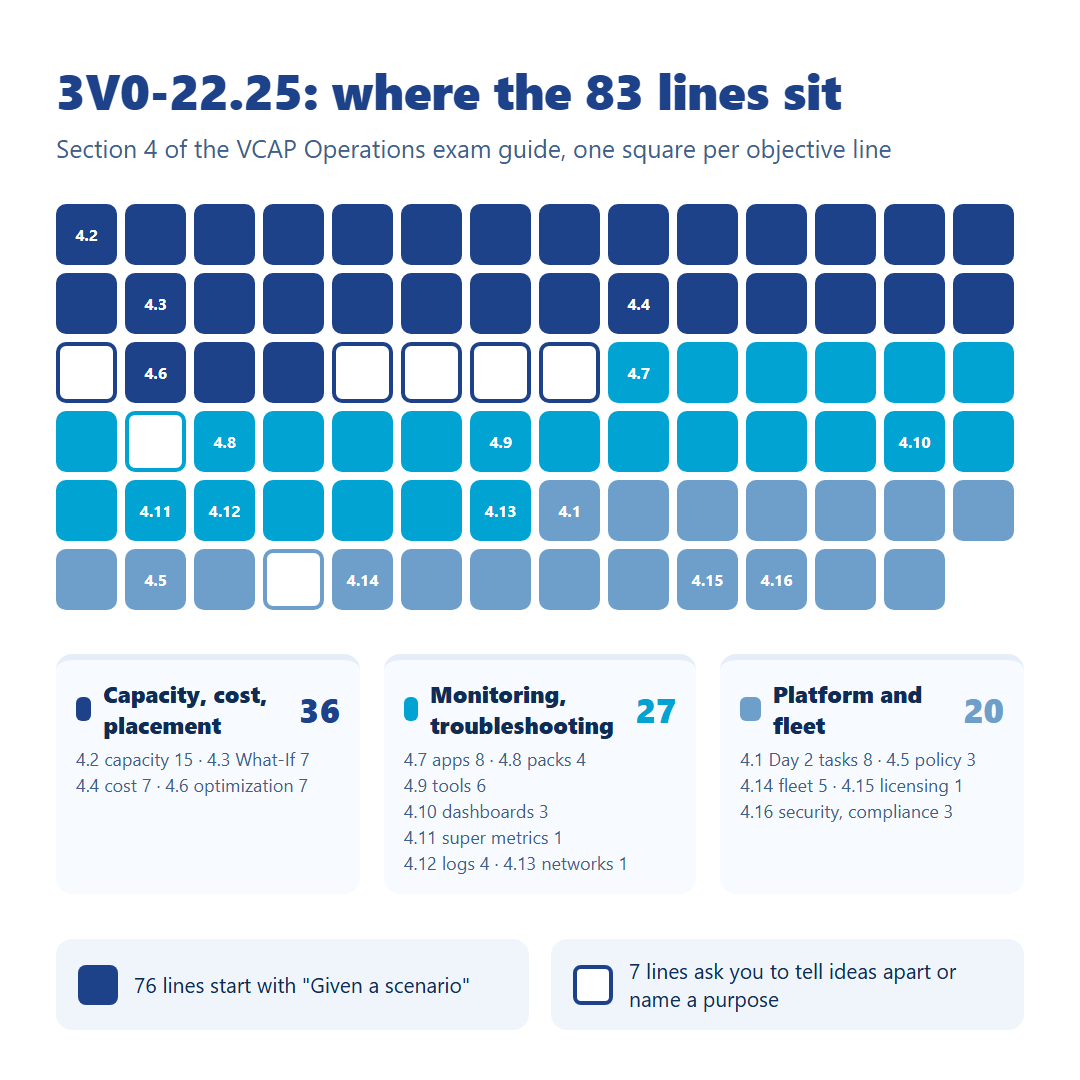
Objective 4.2, Manage VCF Capacity with VCF Operations, is the biggest, with 15 lines. That is 18% of the 83. Broadcom publishes no percentage weights for this exam, so line counts are the best guide to where the questions cluster.
Grouped by theme, the 16 objectives fall into three blocks. These groups are our own reading of the guide, not official domains:
- Capacity, cost and placement (36 lines): 4.2 capacity (15), 4.3 forecasting with What-If scenarios (7), 4.4 cost management (7) and 4.6 workload optimization (7).
- Monitoring and troubleshooting (27 lines): 4.7 applications (8), 4.8 management packs (4), 4.9 troubleshooting tools (6), 4.10 dashboards, views and reports (3), 4.11 super metrics (1), 4.12 logs (4) and 4.13 networks (1).
- Platform and fleet (20 lines): 4.1 Day 2 tasks (8), 4.5 policy (3), 4.14 fleet management (5), 4.15 licensing (1) and 4.16 security, compliance and configuration (3).
The capacity block alone is close to half of the exam's lines. If your daily job is mostly monitoring, that block is where your study time should go first.
How is VCAP Operations different from a VCP exam?
The short answer: this exam checks that you can run VMware Cloud Foundation day to day inside VCF Operations. The candidate the guide describes is a systems administrator, cloud operations engineer or virtualization specialist with 6 to 12 months of hands-on work in VMware Cloud Foundation, doing monitoring, optimization and capacity planning.
Compare it with the design exam in our earlier entry, the 20-item checklist for the 2V0-13.25 VCF Architect topics. There, every objective is about design choices. Here, the verbs are configure, reclaim, rightsize, commit, deploy and troubleshoot.
That changes how you study. Reading about a feature is not enough when a line says "Given a scenario, exclude Virtual Machines from reclamation". You need to have done it in VCF Operations, so you know which screen, which setting and which order of steps the task needs.
What do the seven lines without a scenario test?
Seven of the 83 lines are not scenarios. They ask you to tell two ideas apart or to name a purpose, and they are easy marks if you prepare for them on purpose:
- Provider/Consumer, and Cost vs Price (4.4).
- The policy hierarchy in VCF Operations (4.5).
- Host-based vs cluster-based business intent (4.6).
- The Operational Intent modes: Moderate, Consolidate and Balanced (4.6).
- The purpose of Buffer in Operational Intent (4.6).
- The benefit of Advanced Workload Placement with VCF Automation (4.6).
- Service Discovery vs Managed Telegraf vs Opensource Telegraf (4.7).
Four of the seven sit in objective 4.6. Write each pair as a two-column table in your notes, with one line on when you would pick each side.
What does a six-week study plan look like?
Six weeks fits a candidate who already works in VCF every day, which is the person the guide has in mind. Give each week one block of objectives and finish each week by doing every line of that block in a lab.
- Week 1, platform basics (4.1, 4.5): Day 2 tasks, Unified Cloud Proxies and Collector Groups, scaling VCF Operations and its logs and networks components, Automation Central jobs, role-based access, integrations, and policy create, apply and assign.
- Week 2, capacity (4.2): allocation vs demand, the reclaim process for powered-off VMs, idle VMs, snapshots and orphaned disks, exclusions, rightsizing oversized and undersized workloads, and custom profiles.
- Week 3, forecasting and cost (4.3, 4.4): run each What-If scenario type, then commit more than one. Then cost drivers, currency, rate cards, chargeback and billing.
- Week 4, placement and applications (4.6, 4.7, 4.8): business and operational intent, custom groups, Service Discovery, the Managed Telegraf agent for OS and application metrics, business applications and management packs.
- Week 5, troubleshooting and reporting (4.9 to 4.13): alert definitions, outbound plugins, notifications, the troubleshooting workbench, Log Assist, dashboards, views, reports, super metrics, log queries and content packs, and network monitoring.
- Week 6, fleet and review (4.14 to 4.16): fleet lifecycle and upgrades, certificate and password management, VCF SSO, licensing, compliance benchmarks, config drift and user audits. Then sit two timed sets at 2 minutes 15 seconds per item.
For week 3, the TechDocs page on What-If analysis in VCF Operations explains two details worth knowing. You do not have to carry out the changes a committed scenario represents, and you can only combine scenarios that belong to the same object.
Which mistakes cost candidates points?
Most lost points come from preparing for the wrong kind of exam. These are the traps to plan around:
- Studying by reading only. 76 lines start with "Given a scenario". If you have never clicked through a task, a build-list or sequencing item on its steps will be hard.
- Giving every objective the same time. Objective 4.2 has 15 lines; 4.11, 4.13 and 4.15 have one each.
- Expecting a percentage pass mark. Broadcom prints only "300 (Scaled)". Do not try to turn it into a number of correct answers.
- Missing old product names. In objective 4.12, the first line says Aria Operations for Logs and the next three say VCF Operations for logs. Expect both names on screen.
- Studying a different release. The guide says the content is based on VCF 9.0. If your lab runs another build, check the release notes for features that moved.
- No timed practice. At about two minutes an item, a slow drag-and-drop question eats the time of the next one.
Can you try a practice question?
Here is one question in the style of objective 4.2. It was written for this post and is not taken from the exam.
Scenario: An operations team wants VCF Operations to show a cluster as having no capacity left once vCPU allocation passes a 4:1 ratio, even if the real CPU demand on that cluster stays low. What should they do?
- A. Switch the cluster's Operational Intent to Consolidate.
- B. Turn on the allocation model in the active policy and set a CPU overcommit ratio of 4:1.
- C. Commit a What-If scenario that adds the planned VMs.
- D. Exclude the cluster's VMs from rightsizing.
Answer: B. The TechDocs page on the allocation and demand model in VCF Operations says only the demand model is used by default, and the allocation model is turned on in the active policy. Its allocation values are the overcommit ratios, and once utilization goes over the ratio you set, Capacity Remaining becomes zero. Option A changes how workloads are placed, C reserves capacity for planned work, and D only affects rightsizing advice.
What does the VMExam short video cover?
This 38-second VMExam short is titled "3 Things Before You Book" and covers this exact exam. Watch it as a quick reminder once your study plan is set.
How do you book the 3V0-22.25 exam?
You book through Pearson VUE, which delivers Broadcom's proctored exams. Start from the Broadcom exams page at Pearson VUE, find 3V0-22.25 and pick a date.
Before you pay the $250, check three things: that you can do every line of Section 4 in a lab, that you have finished two timed sets, and which language you will sit the exam in. Broadcom lists English and Japanese.
Frequently asked questions
1. How many questions are on the 3V0-22.25 exam?
The 3V0-22.25 exam has 60 items in a 135-minute appointment, and the passing score is 300 on a scaled method.
2. How much does the 3V0-22.25 exam cost?
Broadcom's certification page lists the price as $250 USD.
3. Is there a prerequisite certification for 3V0-22.25?
Broadcom's page names no prerequisite certification; the only required exam it lists is 3V0-22.25 itself. The guide describes the target candidate as someone with 6 to 12 months of hands-on VCF experience.
4. Which VCF version does the 3V0-22.25 exam cover?
The exam guide says the content in this exam is based on VCF 9.0.
5. Can I take the 3V0-22.25 exam in Japanese?
Yes. Broadcom's certification page lists the exam languages as English and Japanese.