
フィルムカメラがまた増えた。
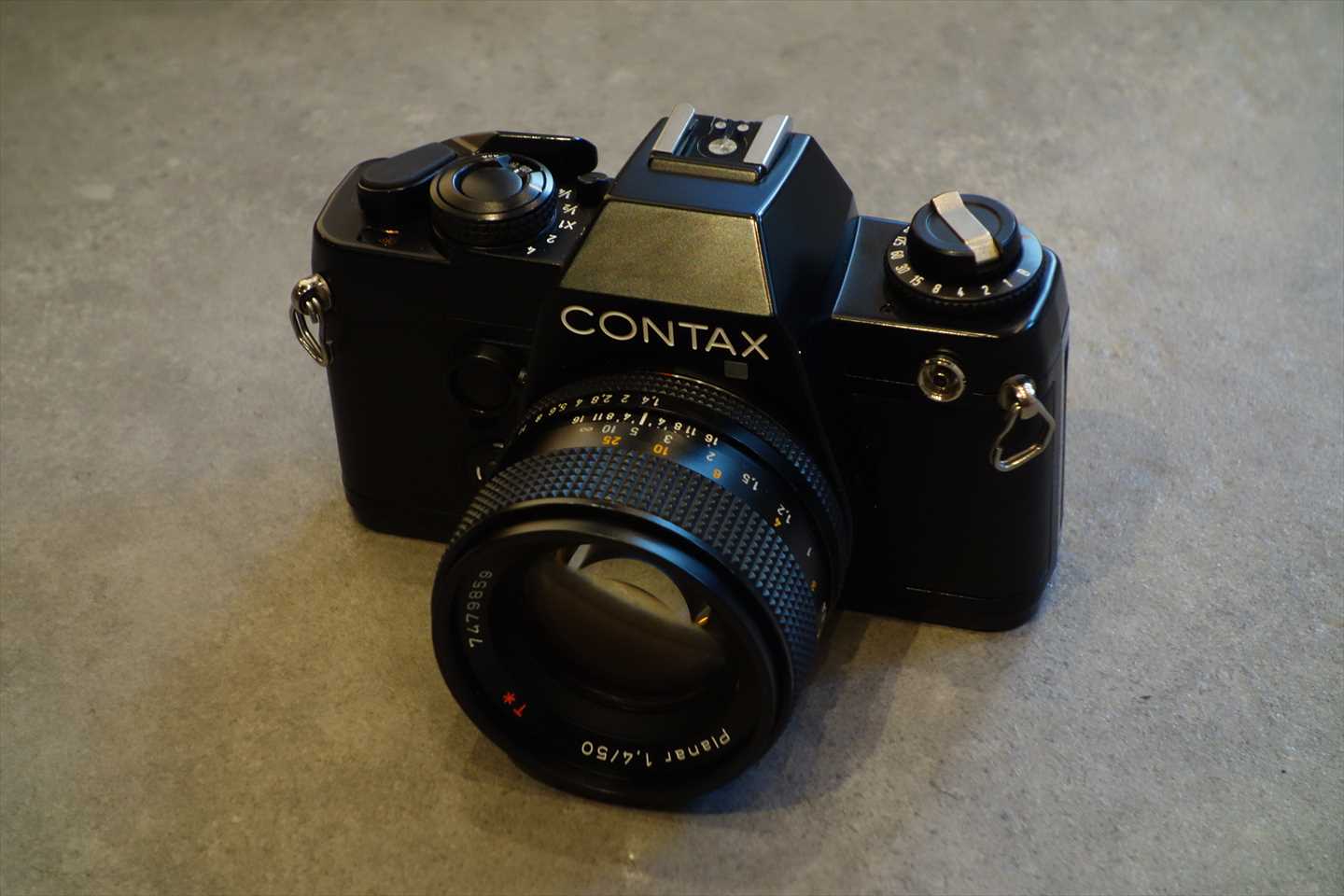
コンタックス139クォーツ。
世界初、クォーツ制御シャッター搭載のカメラである。
1979年発売で、ヤシカコンタックスマウントのコンタックス一眼レフとしては1975年発売のRTS(初代)に続く二番目の発売だ。
RTSに続いてこのカメラもポルシェデザインである。そして一眼レフとしては最後のオリジナルポルシェデザイン。
(1984年発売のコンパクトカメラのCONTAX Tもポルシェデザインである。)
当時の定価は66800円。RTSⅡの半額である。
フィルムコンタックス一眼レフカメラとしては入門機にあたるのだろう。
最高シャッター速度も1/1000秒なので現在の基準から考えるとあまりにも遅いが、当時の入門機は1/1000秒が当たり前だった。
オリンパスOM10やニコンEM、キヤノンAE-1のみならず、上級機で139Quartzより高価だったキヤノンA-1もそうだった。
しかし、ボディ価格が4万円だったOM10やEMの1.5倍以上する139Quartzのボディ価格はさすがに高価で、コンタックスカメラが収入が高い医師向けだったなんて当時の印象にも納得してしまう。
このカメラの当時の最大の特徴は、カールツァイスレンズが使えるコンタックス一眼レフとして手が届く価格設定だった。
そして発売以来の実績は故障の少なさ。
コンタックス一眼レフカメラは、残念ながら故障しやすいという評価が絶えずつきまとう。
一番有名なのがミラーずれ。ミラーボックスのミラーが両面シールで接着してあるだけなので数年たつとずれてくる(AXは2年おきに修理が必要だった一方、167MTはフィルム給送モード切替レバーが壊れるまでの15年以上ミラーずれどころか無故障だった)。
そんな評価の中でこの139Quartzは故障が少なく、ネットの情報ではあるものの京セラがコンタックス事業をやめる2005年までの25年以上京セラで修理対応可だったとの話もある。中には139Qを「不死身」とするサイトもあった。
この139Qの後継機は1985年発売の159MMである。しかし159MM発売後も139Qは併売され、販売終了は同じ1987年のようだ。1987年に167MTが発売されたので、人気はあったものの159MMは短命だった。その後159MMに人気が出て中古価格が高騰したが、短命だった理由はシャッターに難があったからなのだろうか。ところで139Qと159MMの裏蓋は互換性がある。
直接の後継機は159MMになるのだろうが、以前アサヒカメラのヤシカFX-3スーパー (2000の前のモデル)の記事で139Qのサイズがコンタックスとヤシカ系一眼レフカメラの基本的な大きさになったと書いてあって、FX-3スーパーはサイズだけでなく基本的構造も139Qに倣ったと書いてあったと記憶している。AEカメラと機械式カメラなのに構造が似ているのは興味深い。
また、139QのTTLストロボダイレクト測光、赤いLED発光の電子式セルフタイマー、AEロック機構はRTSⅡにも引き継がれている。
CONTAX 139 Quartzは、1982年発売のRTSⅡに先立つ1979年に発売されたが、絞り優先AEとマニュアル露出、クォーツ制御、TTL自動調光、連続AEロック機能とRTSⅡの基本的な機能をほとんど備えている。小型軽量で手の中に納まり使い勝手が良いコンパクトさとすぐれた機能を備え、故障も少なくコストパフォーマンスが高いカメラだ。また、測光用に二つのSPDセンサーを備え、一般撮影用とストロボ撮影用とを使い分けるという凝った造りになっている。
ここで疑問。ヤシカFX-3スーパー2000はコシナのカメラのOEMという話がほぼ定着しているが、この話の流れだと少なくともFX-3スーパー(2000の前のモデル)は京セラもしくはヤシカのオリジナル商品と読めてしまう。真実はどうなのだろうか。
139Qも中古ではなかなかでてこないカメラだった。
写真家の林忠彦氏が茶色のトカゲ革の139Qを愛用し、織作峰子氏も二眼レフミノルタオートコードと愛用していた記憶がある。
自分が今一番使っているRTSⅡ(後2021年5月故障)と比較してみる。
定価が倍のプロ用RTSⅡと入門機の139Qを比較するのは、酷かもしれない。
まず視野率。RTSⅡの97%に対し139Qは95%である。初代RTSは92%、RTSⅢは100%、その他のコンタックス一眼レフは95%なので初代RTSより良いことを考えると評価できる。ファインダー倍率もRTSⅡの0.87倍に近い0.86倍で遜色なく、他の機種より高いほどだ。
ピントの合わせやすさは、発売当時の標準装備だったスクリーンではプロ機のRTSⅡより139Qの方が合わせやすいという奇妙な経験をしていて自分もなぜだかよくわからない。RTSⅡはFS-1とFS-2を使っているが、139Qの方が良い。
重さではRTSⅡの735グラムに対し500グラムという軽さ。アリアの460グラムにはかなわないがかなり軽い方で持ち運びの負担が少なくて済む。RTSⅢの電池無し1150グラムと比べると感涙ものだ。
多重露光もできる。ミラーアップはできないが、自分は滅多に使わないので問題ない。
プレビューレバー(絞り込みレバー)がついているので実際どのくらいのボケになるのか確認できる。一般的に中級機以上のカメラにある機能だ。これは優先AEでの撮影を念頭におくコンタックス一眼レフカメラの思想の反映か。
そして、さすが!と感動したのは、ミラーの裏。植毛されているのだ。植毛によって内面反射が抑えられている。値段が高いコンタックスと言えども、値段的に入門機の本機にここまでやってくれるのはうれしい。ちなみに翌年発売のプロ機ニコンF3にはこのような処理はされていない(中級機のFE2は植毛されている)。この植毛は後継機159MMにも引き継がれている。
コンタックス139Qは、基本性能が高いのだ。
うれしいのがCONTAXのAとXの下にある採光窓。ファインダーを覗いたとき絞り値を表すためのものだが、今やすべて電気仕掛けのミラーレスカメラにはない機械仕掛けが感じられエコでもある。外の光を取り入れるので夜中だと真っ暗で見えないが。
夜中や暗いところでの撮影だとシャッタースピードの確認が難しい。RTSⅡだとシャッタースピードも絞り値もLEDで光るので苦労しない。
カタログには表れない感覚的なものはどうだろうか。
ボディはトップカバー(軍艦部)が樹脂製で底カバーは金属製だ(アリアは逆)。底カバーは金属が薄いのか爪の部分でコツコツするとまるで昔のトタン屋根に雨が当たるような安っぽさを感じてしまう。RTSⅡは金属製でしっかりしていて感触が良い。しかし139Qのトップカバーはさすがである。使い込むとテカリがでてきて金属製だと思いこんでしまう。樹脂の上に金属メッキをした上に黒塗装をするという、手間暇をかけているのが普及機といえどもさすがコンタックス品位があると思えてしまう。
感心したのが巻き上げレバーを下から見たとき。

コスト削減の普及機なら、一般的に巻き上げレバーの金属製の芯は塗装しないことがあるが、このカメラはしっかりと塗装されている。
意外に気がつかないのがフィルム巻き上げのスムーズな感触。使っていて楽しい。RTSⅡより良く、ニコンF3に勝るとは言えないが、いい勝負だ。
レリーズボタンや露出計ボタンの感触はRTSⅡにかなわない。安っぽい。レリーズボタンの感触は167MTやRXの方が良いと思う。
セルフタイマー部は1982年発売のRTSⅡと同じデザインになっているが、作動の際の感触は安っぽい。
しかし、139QもRTS(リアル タイム システム)の思想を受け継いでいる。その思想に基づき初代RTSにはメインスイッチがなかった。シャッターボタンさえ押せば撮影できる仕様だが、139Qにもメインスイッチがない。RTSⅡにはメインスイッチが設けられたので139Qが純粋な意味での最後のRTS思想を受け継いだ機種(ヤシカのカメラは除く)になる。
実際、自分が写したい被写体に突然でくわしたときは、即撮影できるか否かで秒単位を争う。そんな時に電源を入れるためにスイッチレバーを動かすことさえ時間のロスに感じる。そういう点でライカM3がスナップ写真に向いていたと評価されるのは理解できる。
反面、フィルムを巻き上げた状態でうっかりシャッターボタンに触れてしまっただけで撮影されてしまうという「暴発」を経験した所有者も多いだろう。
139Qは、RTSシリーズ同様に絞り優先AEでの使用を念頭に設計されたようで、露出補正ダイヤルが大きく使いやすい。シャッターボタンを囲んでいる。そのおかげかRTS初代より暴発しにくいと思う。
シャッター音は安っぽい。機械式カメラのヤシカFX-3スーパー2000と同じような印象。しかしミラーショックはよく抑えられている。
電池室の蓋は、FX-3スーパー2000と同じく大部分が樹脂でできているので安っぽい。
しかしながら、なによりも軽量と故障の少なさから毎日持ち運びできる点で本機は優れている。カメラで一番大事なのは故障しないことだ。撮れなかったら話にならない。頑丈に作っているプロ機なら壊れないのが当たり前だが、プロ機でない本機の軽さと故障の少なさはうれしい。
現在の中古市場ではフィルムコンタックス一眼レフはアリア以外動きがない。そしてアリアは高値安定である。程度の悪いものは3万5千円程度の良いものは7万円の値をつける。
139Qは一万円前後で買える。
アリアより139Qの方をおすすめする。もし壊れても安価なのであきらめがつく。なんてったって正真正銘のポルシェデザインだ。
ちなみに、コンタックスカメラの修理専門店が長野と札幌にある。カメラによって担当が違うようだ。
手になじんだ感じ、使ってみて五感に訴える道具としてのモノづくりの良さを感じるのはRTSⅡだ。RTSⅢは確かに堅牢だが重過ぎるし電化されすぎかも。
この139Qは東京の有名カメラ店で並品5800円だった。
シボ革の部分は劣化しているが作動面に問題なしとのことで購入した。
受け取ってびっくり。ミラーずれしていてレリーズするとミラーが引っ掛かって戻らない。モルトプレーンも痛んでいるどころか「消失」していて以前あったことすらわからない部分もあった。
札幌のコンタックス専門修理店でしっかり修理してもらった。
受け取るまで一か月半以上かかったが、コンタックスカメラの修理を専門にしているところでモルトを交換してもらい、ミラーずれも直してもらい、シボ革まで交換してもらった。
並品が良品以上になって戻ってきた。
実は、最初に戻ってきたときカメラ内部から音がして部品が落ちてきてびっくりした。またすぐ送って再修理してもらった。
40年以上前のカメラ、しかも酷使されるプロ機ではなく入門機なのでこんなこともあるのかと思う。
お店としては赤字だったかもしれないが、以前も同様なことがあったのでしっかり対応してくれたのだと思う。
フィルムも種類が少なくなり値上げが相次ぐが、楽しめるうちに楽しんでおきたい。
注意:CONTAX純正ストロボTLA280を使用する際に139Quartz、137MA、137MDではTTL自動調光が適正にはならないのでマニュアルでストロボ撮影すること。
CONTAX 139 Quartz
撮影モード:絞り優先、マニュアル
測光方式:中央部重点開放測光
シャッター:クォーツ制御電子制御式縦走り 1~1/1000秒、B(バルブ)
ストロボ同調:1/100以下で同調
モータードライブ:専用ワインダー139 WinderⅡ
視野率:95%
ファインダー倍率:0.86倍(50㎜レンズ)
質量:500グラム
電源:SR44またはLR44
その他:多重露出可
2021年11月14日 後継機 CONTAX 159MMを掲載
I bought another film camera.
Contax 139 Quartz.
It was the world's first camera with a quartz-controlled shutter.
Released in 1979, it was the second Contax SLR with Yashica Contax mount, following the first Contax RTS (released in 1975).
Following the RTS, this camera was also Porsche-designed. And the last original Porsche design as SLR.
(CONTAX T. a point and shoot camera released in 1984 was Porshe-designed as well.)
The list price at the time was 66800 Japanese yen, half the price of the RTS II.
This camera was an entry-level model as a film Contax SLR camera.
The maximum shutter speed was 1/1000 second, which is too slow by today's standards, but 1/1000 second was the norm for entry-level cameras at that time.
This was the case not only with the Olympus OM10, Nikon EM, and Canon AE-1, but also with the Canon A-1, an advanced model that was more expensive than the 139 Quartz.
However, the body price of the 139Quartz, which was more than 1.5 times more expensive than the OM10 and EM, which were priced at 40,000 Japanese yen, was indeed expensive, which explains the impression at the time that Contax cameras were for medical doctors with high incomes.
The most important feature of this camera at that time was its affordable price as a Contax SLR that could use Carl Zeiss lenses.
And its track record since its launch has been that it has had few breakdowns.
Unfortunately, Contax SLR cameras have always had a reputation for being prone to breakdowns.
The most famous example is mirror misalignment. (The AX required repairs every two years, while the 167MT was trouble-free for more than 15 years until the film feed mode switch lever broke.)
The 139Quartz had few failures, and according to some information on the Internet, it was repairable by Kyocera for more than 25 years until 2005, when Kyocera ceased its Contax business. Some websites even referred to the 139Q as an "immortal" model.
The successor to the 139Q was the 159MM, launched in 1985. However, even after the 159MM went on sale, the 139Q was sold side by side with the 159MM, and the end of sales seems to have been in 1987, the same year that the 167MT went on sale. The 159MM later became popular and used prices soared, but I wonder if the reason for its short life was because of the difficulty with the shutter. By the way, the back covers of the 139Q and 159MM are interchangeable.
The direct successor would be the 159MM, but I remember an article in Asahi Camera about the Yashica FX-3 Super (the model before the Super 2000), which said that the size of the 139Q became the basic size of Contax and Yashica SLR cameras, and that the FX-3 Super followed the 139Q not only in size but also in basic construction. It is interesting to note the similarity in structure between the AE and mechanical cameras.
Also, the TTL strobe direct metering, electronic self-timer with red LED flash, and AE lock mechanism of the 139Q are carried over to the RTS II.
The CONTAX 139 Quartz was released in 1979, prior to the RTS II released in 1982, and has most of the basic functions of the RTS II, including aperture priority AE, manual exposure, quartz control, TTL auto exposure, and continuous AE lock function. It is a compact, lightweight camera that fits in the hand and is easy to use, has excellent functionality, is trouble-free, and offers excellent cost performance. The camera is also equipped with two SPD sensors for metering, one for general photography and the other for strobe photography.
Here is a question. The story that the Yashica FX-3 Super 2000 is an OEM of a Cosina camera is almost firmly established, but this storyline reads that at least the FX-3 Super (the model before the Super 2000) is an original Kyocera or Yashica product. I wonder what the truth is.
The 139Q was another camera that was hard to find used.
I remember that photographer Tadahiko Hayashi loved his brown lizard skin 139Q, and Mineko Orisaku also used it with her twin-lens reflex Minolta Autocord.
Let me compare it with my current most-used RTS II (later broken down in May 2021).
It may be harsh to compare the professional RTSII, which is twice the price of the RTSII, with the entry-level 139Q.
First of all, the field of view is 95% for the 139Q compared to 97% for the RTSII. The first generation RTS was 92%, the RTS III was 100%, and other Contax SLRs are 95%, so it is commendable considering that it is better than the first generation RTS. The viewfinder magnification is also comparable at 0.86x, close to the RTS II's 0.87x, and even higher than other models.
The ease of focusing is also a strange experience, as the 139Q is easier to focus than the RTS II, which was a professional model with a screen that was standard equipment when it was launched, and I myself don't know why.
In terms of weight, it is light at 500 grams compared to RTS II's 735 grams. Compared to the RTS III's 1150 grams without batteries, the 139Q is a tearjerker.
Multiple exposures are possible. The mirror up function is not available, but I rarely use it, so it is not a problem for me.
It has a preview lever (aperture lever) so you can check how much bokeh will actually be produced. This is a feature that is generally found on mid-range and higher-end cameras. This may be a reflection of the Contax SLR cameras' philosophy of shooting with priority AE.
And, as one would expect! What impressed me was the back of the mirror. It is hair-planted. The hairs suppress internal reflections. Even for a high priced Contax, it is nice to see that they have gone to such lengths for this entry-level model. Incidentally, the Nikon F3, a professional model released the following year, does not have this kind of treatment (the FE2, an intermediate model, does). This hair-planting was carried over to its successor, the 159MM.
The Contax 139Q has a high basic performance.
A pleasing feature is the lighting window under the A and X on the CONTAX. It is used to show the aperture value when looking through the viewfinder, but it is also an eco-friendly mechanical device that mirrorless cameras, which are now all electrically operated, do not have. It is also eco-friendly. Since it lets in outside light, it is pitch-black and invisible at night.
It is difficult to check the shutter speed when shooting at night or in the dark, but with the RTS II, both the shutter speed and aperture value are illuminated by LEDs, so there is no difficulty.
How about the features that could not be expressed in the catalog?
The top cover of the body is made of plastic and the bottom cover is made of metal (the opposite is true for the Aria). The RTS II is made of metal and feels solid. However, the 139Q's top cover is as good as it gets. After using it for a long time, it becomes shiny and you would think it is made of metal. The black coating on top of the metal plating on top of the plastic is a time-consuming process, which is a quality of Contax, even for a popular model.
I was impressed when I looked at the winding lever from below.
In general, the metal core of the winding lever is not painted on popular models to reduce costs, but this camera is painted.
Surprisingly, what one does not notice is the smooth feel of the film winding. It is a pleasure to use; better than the RTS II, not quite as good as the Nikon F3, but a good match.
The feel of the release button and exposure meter button is not as good as the RTS II. Cheesy. The feel of the release button is better on the 167MT and RX.
The self-timer section has the same design as that of the RTS II released in 1982, but the feel of the self-timer when activated is cheap.
However, the 139Q also inherited the RTS (Real Time System) philosophy. Based on this philosophy, the first RTS did not have a main switch. The 139Q also does not have a main switch, although it is possible to take a picture as long as the shutter release button is pressed, and since the RTS II has a main switch, the 139Q is the last model (excluding Yashica cameras) to inherit the RTS concept in a pure sense.
In fact, when you suddenly come across a subject you want to photograph, you fight for seconds to be able to take a picture immediately. Even moving the switch lever to turn on the camera feels like a loss of time. In this respect, it is understandable that the Leica M3 is regarded as being suitable for snapshots.
On the other hand, many owners may have experienced the "outburst" of having a picture taken simply by inadvertently touching the shutter release button with the film wound up.
Like the RTS series, the 139Q seems to have been designed for use in aperture-priority AE, and the exposure compensation dial is large and easy to use. It surrounds the shutter release button. This may be the reason why it is less prone to violent shooting than the first generation of RTS.
The shutter sound is cheesy. It is similar to that of the Yashica FX-3 Super 2000, a mechanical camera. However, the mirror shock is well controlled.
The battery compartment lid is made mostly of resin, like the FX-3 Super 2000, and looks cheap.
However, above all, this camera is excellent in that it can be carried around every day due to its light weight and low failure rate. The most important thing in a camera is that it does not break down. If it can't take pictures, it's useless. It is a matter of course that a professional camera made with a sturdy construction will not break down, but I am glad that this non-professional camera is lightweight and has few malfunctions.
In the current second-hand market, there is no movement in film Contax SLRs except for Aria. And the price of Aria is stable at a high level. The price of a poor one is 35,000 Japanese yen, and a good one is 70,000 yen.
The 139Q can be bought for around 10,000 Japanese yen.
I recommend the 139Q over the Aria. Even if it breaks, you can give up because it is inexpensive. After all, it is a genuine Porsche design.
By the way, there are repair stores for Contax cameras in Nagano and Sapporo.
The RTS II feels comfortable in my hand, and when I use it, I feel the quality of manufacturing as a tool that appeals to my five senses, while the RTS III is certainly robust but too heavy and too electrified.
This 139Q was priced at 5800 Japanese yen at a popular second hand camera store in Tokyo.
I bought it because I was told that the grained leather part was deteriorated but there was no problem in operation.
I was surprised when I received it. The mirror was out of alignment, and when I released the camera, the mirror was stuck and would not return. The moltplane was not only damaged but had "disappeared" and I couldn't even tell that it had been there before.
It took more than a month and a half to receive it, but the shop, which specializes in Contax camera repair, replaced the mortise, fixed the mirror misalignment, and even replaced the grained leather.
The ordinary product came back as more than good condition.
In fact, when I first got it back, I was surprised when I heard a noise from inside the camera and a part fell out. I sent it back again immediately to have it repaired.
I was surprised that such a thing could happen to a camera that is more than 40 years old, and it is not a professional camera that is heavily used, but an entry-level camera.
The store may have lost money, but I think they handled the problem well because they had done the same thing before.
The number of film types is decreasing and the prices are going up one after another, but I would like to enjoy them while I can.
Note: When using the genuine CONTAX electronic flash TLA280, the TTL automatic flash adjustment is not proper for the 139Quartz, 137MA, and 137MD, so strobe photography should be done manually.
CONTAX 139 Quartz
Shooting mode: Aperture priority, manual
Metering: Center-weighted open metering
Shutter: Quartz electronically controlled vertical run, 1 to 1/1000 sec., Bulb.
Strobe synchronization: 1/100 or less
Motor Drive: Dedicated Winder 139 Winder II
Field of view: 95%
Viewfinder magnification: 0.86x (50 mm lens)
Weight: 500 grams
Power source: SR44 or LR44
Other: Multiple exposures possible
English text added 27/07/2022.