
Prepositions of Place in English
above / on top of / on
Use above when the two objects are not touching.
Use on or on top of when the two objects are touching.
- The pictures are above the couch. The pillows are on the couch.
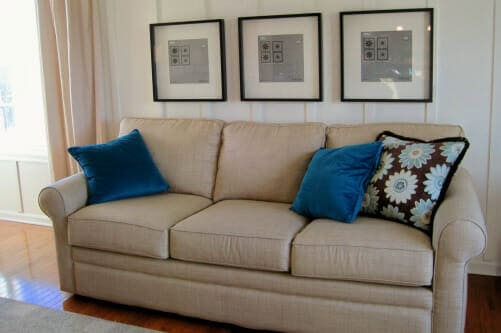
The pictures are ABOVE the couch. The pillows are ON the couch.
Difference between “on” and “on top of”?
Generally, we use “on” when it is a normal place to put something:
- The keys are on the table.
- The keys are on top of the refrigerator.
under / below / underneath / beneath
Use under when one object is covered by another.
Use below when one object is in a lower position than the other.
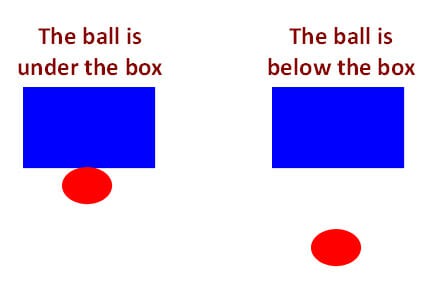
Difference between under and below
Underneath and beneath are more formal words for “under” and “below.”
behind / in front of
These words are opposites. Use behind when object A is farther away from you than object B, and in front of when object A is closer to you than object B.
- In the first picture, the mouse is in front of the box.
- In the second picture, the mouse is behind the box.
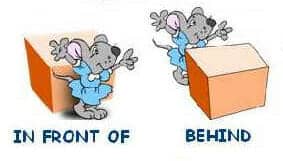
Difference between “behind” and “in front of”
What about “in back of”?
Some people say “in back of” for “behind.” Note that it’s always “in back of” and never “back of:”
We can also say “in the back of” to describe the back part of a space:
- Jonas and Gabriel like to sit in the back of the classroom so that the teacher can’t see them.
between / beside / next to
Beside and next to are the same, but beside is a little more formal. In everyday English we usually say “next to.” Between means that the object is in the middle of two other objects.
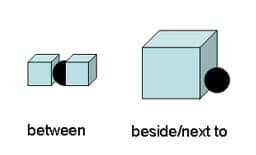
Between, beside, and next to
near / close to / by
These words all mean the same thing – that the distance between the two objects is small. Be careful not to confuse them. “Close to” is the only one that uses the word “to.”
- The ball is near to the box.
The ball is close to the box.
The ball is near the box.
The ball is by the box.
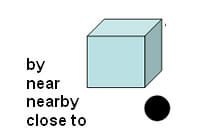
Nearby is used without a direct object. It is generally used at the end of a sentence or phrase.
- The ball is nearby the box.
There’s a box with a ball nearby.