


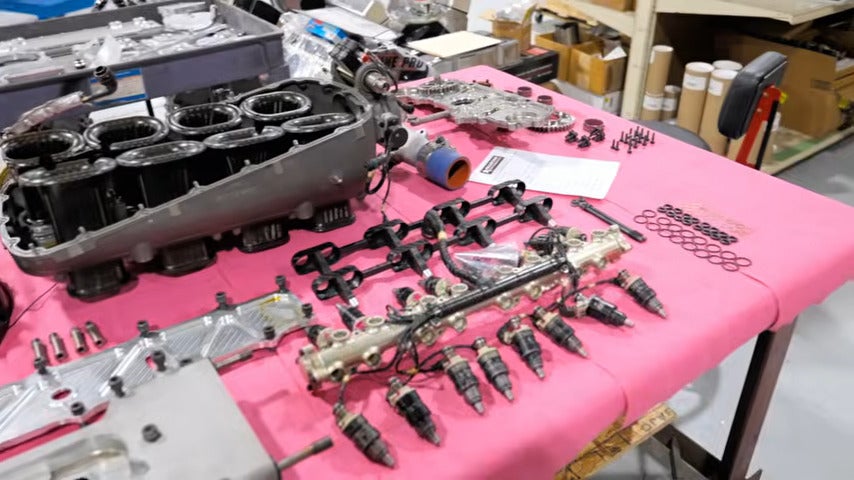


NAで1000馬力超え、ターボで3000馬力クラスのドラッグレース用のV8エンジンを構築している、レースエンジン屋によるコスワースXFEエンジンの分解および解説。
コスワースは、レース界の縁の下の力持ち。
コスワースXFEエンジン(V型8気筒ターボ2,650cc)
・吸気のインマニがスロットルを兼ねる
・インジェクターはツイン(各気筒2本)
・ストローク:ザックリ実測1.924インチ(48.87mm)⇒ 49.8mm
・ボア:ザックリ実測3.621インチ(91.97mm)⇒ 92mm
・ロッカーアームホルダー(カム山)とケースにオイルジェット(ピストン裏)
・ロッカーアームにはDLCコーティング
・コンロッドはH断面(チタン?)
・クランクシャフトはフラットプレーンで削り出し
第一印象、カムシャフトの軸が太い。
ヘッドガスケットではなく、吹き抜け防止の金属リングとOリング仕様。
パノス・DP01用(2007年)と言っているので、コスワースXFEの最終型。
エンジンのライフサイクルは、2,300kmのようです。
@Junkpusher77
The camera man and the engine guy are the perfect people for this. I could listen to this all day. They both know what they are looking at and they can speak to each other perfectly.
カメラ担当とエンジン担当の二人は、この企画にうってつけの組み合わせだね。ずっと聴いていられるよ。二人とも何を見ているのかをしっかり理解しているし、意思疎通も完璧だ。
The camera man and the engine guy are the perfect people for this. I could listen to this all day. They both know what they are looking at and they can speak to each other perfectly.
カメラ担当とエンジン担当の二人は、この企画にうってつけの組み合わせだね。ずっと聴いていられるよ。二人とも何を見ているのかをしっかり理解しているし、意思疎通も完璧だ。
@patrickkennedy2533
one of if not the best videos of any kind I've seen this year
今年見たあらゆる動画の中で、最高、あるいは最高クラスの1本。
one of if not the best videos of any kind I've seen this year
今年見たあらゆる動画の中で、最高、あるいは最高クラスの1本。
@jtrill2
It would be cool to watch Cosworth take apart an SMX engine and see their reaction! 😀
コスワースがSMXエンジンを分解するところを見てみたい!彼らがどんな反応をするのか気になるな!😀
It would be cool to watch Cosworth take apart an SMX engine and see their reaction! 😀
コスワースがSMXエンジンを分解するところを見てみたい!彼らがどんな反応をするのか気になるな!😀
@sheldonshogrin6736
The bolts in the counterweights are actually for heavy metal (tungsten) slugs to balance the crankshaft. The bolts in the journals are oil passage cleanouts since the crankshaft itself is a pressurized oil passage. It serves to be able to clean out any debris in those passages that might build up between rebuilds. The crank itself is "gun drilled" to lighten the rotating assembly and the part itself. Those are part of the gun drilling process, that ends up also hitting the oil passages within the crank.
(yes, I had to look it up online)
カウンターウェイトのボルトは、クランクシャフトのバランスを取るための重金属(タングステン)のスラグを取り付けるためのものです。ジャーナルのボルトは、クランクシャフト自体が加圧されたオイル通路になっているため、オイル通路の清掃用ボルトです。これにより、オーバーホールの合間に通路内に蓄積する可能性のある異物を取り除くことができます。クランクシャフト自体は、回転部品と部品自体を軽量化するために「ガンドリル加工」されています。これらの穴はガンドリル加工の一部であり、クランクシャフト内部のオイル通路にも影響を与えます。
(はい、ネットで調べました)
@AliasTekTV
F1 engineering is BIG money. Some of the engines are so top secret/trade secret that they aren't even repaired on site, and instead replaced and re-crated back to home base for refurbishment. They are very close to todays sport bike engines and have almost all the main features. The few key differences are the racing specific additions like the intake plenum, throttle body system, and valvetrain. This doesn't rev as hard as a true F1 engine so it retains valve spring actuation. F1 and now MotoGP use pneumatic bellows that are pressurized with compressed gas (probably nitrogen) and in individual cylinders for each valve. The cylinder stud angle I believe is for triangulated clamping force over the cylinders themselves and keep them from lifting the head under pressure (I believe this engine is boosted). The pistons have significant reinforcement around the pins because the expected G-force on the pins is extreme and it's the most stressed part of the piston. F1 engines of the V10 and V8 era were 1 to 2 MILLION per unit. I believe each individual piston could have been around $80,000 in material/machining and full X-ray quality control for structure. Some materials used in the past were actually radioactive and toxin emitters (beryllium) and eventually banned. Camshafts also another significant item of cost because of high-speed tortional loads and apparently can be extraordinarily brittle (hence why he was careful to remove the caps).
We are talking 12k rpm here, but F1 while F1 for a while didn't have a specific rule for RPM limit, the real limit was physical at about 20k for 2.4-3L engines. Model 2 stroke Glow engines can run about 30-50k RPMs with no valves and ignition system and use aluminum rods and pistons without rings to do it and make about 3-5 horsepower out of 3.5cc of displacement.
F1のエンジニアリングには莫大な資金が投じられています。エンジンの中には、極めて厳重な企業秘密として扱われているものがあり、現場で修理されることはありません。代わりに交換され、梱包し直されて本拠地へ送り返され、そこでオーバーホール(改修)が行われます。これらは現代のスポーツバイク用エンジンと構造が非常に近く、主要な機能のほとんどを共有しています。数少ない大きな違いは、インテークプレナム、スロットルボディシステム、バルブトレインといった、レース専用のコンポーネントが追加されている点です。このエンジンは、本物のF1エンジンほど超高回転まで回るわけではないため、バルブスプリングによる駆動方式が維持されています。一方、F1や現在のMotoGPでは、各バルブに対して個別のシリンダー(ベローズ)を設け、そこに圧縮ガス(おそらく窒素)を充填する「ニューマチック(空気圧式)バルブ駆動」が採用されています。シリンダースタッドの角度は、シリンダー全体に対して三角形のクランプ力を働かせ、高圧下でシリンダーヘッドが浮き上がるのを防ぐためのものだと思われます。(このエンジンは過給仕様のはずです)ピストンは、ピン周辺が大幅に補強されています。ピンには極端なGフォース(加速度)がかかるため、ピストンの中で最も負荷がかかる部位だからです。V10やV8時代のF1エンジンは、1基あたり100万〜200万ドル(約1億5000万〜3億円)ものコストがかかっていました。ピストン単体で見ても、材料費や加工費、そして構造の健全性を確認するための徹底的なX線検査などを含めると、1個あたり8万ドル(約1200万円)ほどかかっていた可能性があります。過去には、放射性物質や毒性物質(ベリリウムなど)を含む材料が使われていたこともありましたが、後に禁止されました。カムシャフトも非常にコストがかかる部品です。高速回転時に大きなねじり荷重がかかるため、非常に脆い性質を持つことがあり、それゆえに(動画内で)キャップを外す際に細心の注意が払われていたのです。
ここで話題にしているのは1万2000回転(rpm)という領域ですが、F1では一時期、回転数制限に関する明確な規定がありませんでした。しかし、2.4〜3.0リッターのエンジンでは、物理的な限界として約2万回転が上限となっていました。一方、ラジコン用の2ストローク・グローエンジンは、バルブや点火システムを持たず、ピストンリングのないアルミ製コンロッドとピストンを使用することで、3万〜5万回転に達することもあります。この場合、わずか3.5ccの排気量から3〜5馬力を発揮します。
Ford Cosworth Part 2(字幕版)
Ford Cosworth Part 1(オートダビング版)
00:00 エンジンの開梱
04:30 エンジンスタンドへの設置と準備
11:18 「ブリット」ウォッチの紹介(CM)
13:56 初期分解
21:12 バルブトレインの点検
FormulaDrift用V8エンジン↓
@AdamLZ 向け「ビッグブロック・ドリフト」マシン、準備万端だぜ!……クリータスには運転させるなよ!!(なんてな!)
(オートダビング版)
Cosworth… All The Insides Revealed!
https://www.youtube.com/watch?v=yLCxQl88Mac
Is This The Ultimate Engine? Ford Cosworth Part 1
https://www.youtube.com/watch?v=nAIzZC0OOew
The Big Block Drift Is READY TO ROCK For @AdamLZ Don't Let Cleetus Drive It!! (I'm Just Kidding!)
https://www.youtube.com/watch?v=HScXUf88GPU


https://www.wikiwand.com/ja/フォード・コスワース・インディV8エンジン
「コスワースは、レース界の縁の下の力持ち」と検索すると↓
コスワースDFVは、タイレル6輪にも搭載。


