
For many jewelry makers, polishing is one of the most time-consuming and skill-dependent steps in the entire workflow. As jewelry magnetic tumblers become increasingly popular in small studios and growing workshops, one question comes up again and again: Can a magnetic tumbler truly replace hand polishing? The short answer is not entirely—but it can dramatically reduce manual labor and elevate overall efficiency. Understanding where it excels and where hand polishing still wins will help you get the best results from both methods.
Magnetic tumblers use tiny stainless-steel pins and a rotating magnetic field to burnish metal surfaces. Because the pins reach deep into places that traditional tools struggle to access—like prong bases, filigree patterns, and small crevices—they are extremely effective for cleaning, smoothing, and brightening intricate jewelry parts. A cycle often takes just 10–30 minutes and requires almost no supervision, making it ideal for busy workflows.
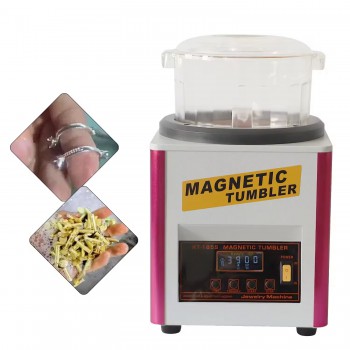
Where magnetic tumbling shines is speed and consistency. It produces a uniform finish, removes light scratches, and strengthens metal surfaces through cold-working. For small components, castings with complex geometry, and pieces that need quick pre-polish brightening, a magnetic tumbler can cut hours of work down to minutes. Many jewelers rely on it as the first step before final finishing.
However, magnetic tumblers do have limitations. They cannot create the high-mirror finish that skilled hand polishing achieves with wheels, compounds, and precise pressure control. The finish they produce is more of a bright burnish rather than a reflective shine. Deeper scratches, file marks, and uneven surfaces still require traditional sanding and buffing. And for flat surfaces, magnetic pins tend to round edges slightly, which may be undesirable for geometric or modern designs.
In other words, a magnetic tumbler is best viewed as a powerful assistant, not a full replacement. It speeds up preparation work, cleans hard-to-reach areas, and gives pieces a clean, professional baseline polish. The jeweler then steps in for the final artistic touches—mirror finishing, edge definition, and intentional texture control.
For beginners, a magnetic tumbler can make polishing less intimidating. For professionals, it increases throughput without sacrificing quality. But in both cases, hand polishing remains essential for achieving the highest-quality finish and precise detail control.
So, can a magnetic tumbler replace hand polishing? Not fully—but it can transform your polishing workflow. By integrating the strengths of both methods, jewelry makers can achieve faster, cleaner, and more consistent results while still maintaining the craftsmanship that defines handmade jewelry.
