
A jewelry rotary tumbler may appear to be a simple machine: a barrel turns, finishing media moves around the jewelry, and repeated contact gradually improves the surface. In practice, the sound and vibration produced during this process can reveal quite a lot about the machine, the load inside the barrel, and the condition of its mechanical components. Learning to distinguish normal operating noise from unusual vibration helps workshops maintain consistent finishing results and avoid preventable repairs.
Some noise is unavoidable. Tumbling media, metal parts, and the barrel wall are constantly moving against one another, creating a mixture of rolling, sliding, and occasional impacts. The sound usually changes according to the type and quantity of media. Ceramic cones, stainless steel pins, plastic media, and other materials have different densities and shapes, so each produces a distinct acoustic pattern. A barrel filled with heavier media will naturally sound different from one containing lightweight plastic pieces.
The amount of material inside the barrel also has a major influence on vibration. An uneven load can cause the barrel to rotate with an irregular distribution of weight. Instead of maintaining a balanced movement, the machine may rock or shake more strongly at certain points in the rotation. Overloading can create a similar problem, particularly when the motor is forced to work against excessive resistance.
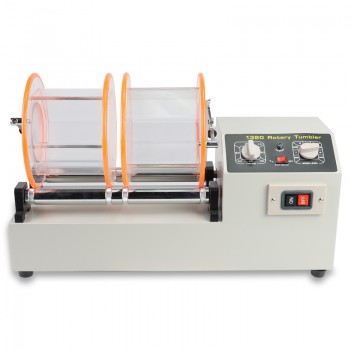
The condition of the drive system should not be overlooked. Belts, gears, shafts, bearings, and rollers all contribute to the smoothness of operation. A worn bearing may produce a rough humming or grinding sound, while a damaged roller can create a repetitive vibration that becomes more noticeable as rotational speed increases. Loose mounting screws can also turn a minor mechanical movement into a surprisingly loud resonance.
The placement of the tumbler matters as well. A machine standing on an unstable bench can transfer vibration into the entire worktable. Hollow metal tables may amplify low-frequency movement, making the tumbler sound much louder than it actually is. A solid, level surface can reduce this effect. In some workshops, suitable vibration-isolating pads can further limit the transmission of movement.
Operators should pay attention to changes rather than focusing only on absolute noise levels. A jewelry rotary tumbler that has sounded essentially the same for months but suddenly develops a clicking, knocking, scraping, or pulsing noise deserves inspection. Checking the barrel, rollers, fasteners, belt tension, and bearings before continuing production can prevent a small defect from becoming a larger mechanical problem.
Correct loading is another simple way to keep operation smooth. Jewelry should be distributed reasonably evenly, and the recommended media-to-workpiece ratio should be respected. Running the machine with too little material can sometimes produce harsh impacts because individual pieces have more room to strike the barrel and each other.
Noise and vibration are therefore more than workshop annoyances. They are useful indicators of how a jewelry rotary tumbler is behaving. By understanding the relationship between load balance, finishing media, machine placement, and mechanical wear, jewelers can create a quieter working environment while protecting equipment and maintaining more predictable finishing performance.
