
Stone setting demands a rare balance of delicacy and control. Even the slightest miscalculation can compromise both the appearance and security of a gemstone. In recent years, jewelry micromotors have become indispensable in this field, not merely as convenience tools but as instruments that expand what setters can realistically achieve.
A jewelry micromotor’s strength lies in its consistency. Unlike traditional rotary tools, it delivers stable torque across a wide speed range, allowing for predictable cutting behavior. This becomes especially valuable when preparing seats for stones. Instead of relying on intermittent pressure, the setter can maintain a steady hand while the tool performs with quiet precision. The result is cleaner cuts and tighter tolerances, particularly in pavé and micro-setting work.
One advanced approach involves controlled seat cutting using specialized burs. Rather than cutting the entire seat in one pass, experienced setters work incrementally, adjusting depth and angle with each movement. A micromotor’s smooth response makes it easier to “feel” the metal being removed. This tactile feedback is subtle but crucial; it helps prevent overcutting and ensures the stone sits flush without unnecessary gaps.
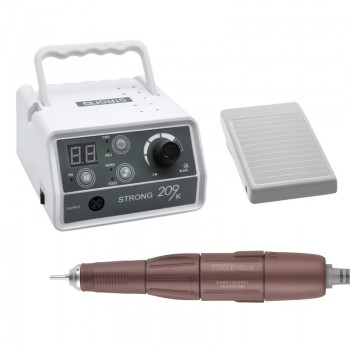
Speed modulation is another technique that separates refined work from routine execution. High speeds are useful for bulk material removal, but as the tool approaches the final dimensions, reducing speed allows for greater control. This transition is not abrupt but gradual, almost intuitive. Skilled setters often adjust speed continuously during a single operation, matching the tool’s behavior to the evolving geometry of the setting.
Micromotors also excel in pre-polishing and finishing tight areas that would otherwise be difficult to reach. After setting the stone, small abrasive tips can be used to refine prongs or bezels without disturbing the gemstone. This requires a careful choice of attachments and a light touch, as excessive pressure can generate heat or cause unintended contact. When done correctly, the finish appears seamless, as though the metal formed naturally around the stone.
Another advanced application is in channel setting, where uniformity is critical. Here, the micromotor enables precise groove cutting along a straight line, ensuring each stone aligns perfectly with the next. Any deviation becomes immediately visible, so consistency is paramount. By maintaining a steady hand and letting the tool’s motor do the work, setters can achieve a level of regularity that would be difficult to replicate manually.
Ergonomics often go unnoticed but play a significant role in advanced techniques. The lightweight handpiece of a micromotor reduces strain, allowing for longer working periods without loss of accuracy. This is particularly important in detailed settings that require sustained concentration. Fatigue can lead to small errors, and in stone setting, small errors are rarely forgivable.
Ultimately, mastering advanced techniques with jewelry micromotors is less about speed and more about control. The tool amplifies the setter’s intent, but it does not replace judgment or experience. Each cut, each adjustment, reflects a decision made in real time. With practice, the micromotor becomes an extension of the hand, enabling a level of precision that transforms careful workmanship into refined artistry.