
量子コンピュータの入門書
”渡邊靖志 量子コンピュータ”
は日本語でもあるが
(渡邊さんは優等生らしく
そつなくまとめているが
本質的な理解に届いていない印象がある。
)
きっと英語版の方がわかりやすいだろう。


その中でも2番目の
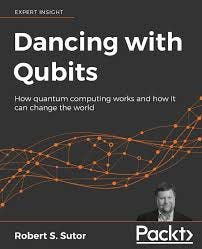
2. DANCING WITH QUBITS: HOW QUANTUM COMPUTING WORKS AND HOW IT CAN CHANGE THE WORLD (PACKT PUBLISHING) 2019
The next between the books on quantum computing is Dancing with Qubits: How quantum computing works and how it can change the world by Robert S. Sutor, a man who needs no introduction. Sutor, a mathematician by profession who gained a Ph.D. from Princeton University, has been a leading light in innovative industries for more than three decades, while for twenty of those he has been working at IBM Research on several different areas of technology, including research on AI, the blockchain and mathematical computation. His best work, though, can be seen in what he has contributed to QC over the last decade.
If you want to learn, then you should learn from the best, and there is no better teacher than Sutor in the industry.
The first thing I should state about the book is the introduction is as clear as it can be, giving precise but simply presented information on the basic principles of mathematics and physics and how they correlate to quantum computing.
The book’s preface begins with the great Danish quantum physicist Niels Bohr’s proclamation that ‘everything we call real is made of things that cannot be regarded as real.’ It’s a taste of things to come. Divided into two main parts, ‘Foundations’ and ‘Quantum Computing’, which have their respective subsections including the aptly titled ‘moving to two dimensions’, ‘the fundamental functions’, ‘matrix algebra’, and ‘the quantum z gate’, Sutor runs the whole gamut of theoretical implications and practical applications for QC in an easily accessible narrative.
Like Bernhardt’s book, the author assumes the reader has fundamental knowledge of the basics of physics and mathematics, at least to the level demanded by a first-year university student or a high-end high school geek.
This book would be good as a coursebook as well as for the student who prefers learning independently.
Black and white diagrams abound (there’s even a photo of Richard Feynman), clearing up, via visual models, some of the more difficult concepts.
If Sutor ever gets fired from his job at IBM, he could quite easily take up a career as a writer. His style is tight, entertaining and philosophically weighted while devoid of any of the patronizing bile that is common in many of the academic books and Ph.D. papers.
You can read Matt Swayne’s review after speaking with Sutor here.