
The ACA-100 exam format is simple on paper: Appian's Analyst exam gives you 50 items in 60 minutes, costs $250, and you need 70% to pass, with no prerequisite certification. What makes it different from Appian's developer exams is the content. Most of the blueprint asks how a business analyst works inside an Appian project, not how to build one.
This entry walks through that format from the analyst's side: what the six sections ask, how requirements turn into user stories, how Ready and Done are judged, how booking and retakes work, and a five-week plan. Every exam figure below was read on Appian Academy's own pages on 12 November 2026.

What is the ACA-100 exam format?
The Appian Analyst exam page sets out the whole format in one short block. ACA-100 is the code VMExam and most candidates use; Appian itself just calls the exam "Appian Analyst".
- Items: 50.
- Time: 60 minutes, so a little over a minute per item.
- Price: $250 per attempt.
- Minimum passing score: 70%, which means at least 35 of the 50 items.
- Requirement: none. The Analyst credential is entry-level, like the Associate Developer one.
- Delivery: proctored by Prometric, either online or at a test centre.
- Blueprint: last updated in January 2023.
The program rules add that exams run in English unless the exam page says otherwise, and the Analyst page names no other language. If you book the online version, you also talk to the proctor in English.
Who is the ACA-100 exam written for?
It is written for the person who sits between the business and the build team. Appian describes the candidate as someone who works with clients to gather, interpret and document requirements, writes user stories, and knows the Software Development Lifecycle and Agile practice well.
The candidate also draws future-state process diagrams in Appian, spots new use cases, and understands at a high level how Appian connects to third-party systems. Appian adds that this person takes part in every phase of delivery: requirements, story writing, prioritization, refinement, testing and user guides.
So the exam does not expect you to write expression rules or configure a record type. It expects you to know what those objects are for, and when a business need calls for one.
How are the 50 items spread across the six sections?
Appian lists six sections with a weight each: Introduction to the Appian Platform 24%, Appian SDLC 22%, Requirements Gathering 20%, Business Process Management 20%, Extending Appian 18% and User Story Creation 14%.
Those six weights add up to 118%, not 100%. Appian says the weight "illustrates the approximate size of each section", so read them as relative sizes. If you scale them down to 50 items, the platform section works out to about 10 items, SDLC about 9, requirements and BPM about 8 or 9 each, Extending Appian about 8 and User Story Creation about 6. That is our own arithmetic, not an Appian figure, but it shows how evenly the exam is spread.
One more thing to know when you read the page: the bullets printed under "Extending Appian" are about user stories, and the bullets under "User Story Creation" are about performance and load testing. Study by the bullets, not by the heading names.
What does the SDLC section expect from an analyst?
It expects you to know your job in each phase of an Appian project and the Scrum rules the team works by. The SDLC section is the second largest, and it is the one people with a pure process-mapping background find hardest.
The objectives name the four phases the analyst works across: initial, build, release and optimize. Around them you need:
- Team roles: who does what in an Appian delivery team, and where the analyst's work stops and the developer's starts.
- Definition of Ready (DoR): the checks a story must pass before the team takes it into a sprint.
- Definition of Done (DoD): the checks a story must pass before it counts as finished.
- Scrum ceremonies: what each Agile meeting is for, such as planning, the daily stand-up, the review and the retrospective.
- Environments: which work belongs in which environment, from development through test to production.
- UAT: evaluating a test scenario before user acceptance testing begins.
The DoR and DoD pair is worth real attention. Both apply to every story, while acceptance criteria belong to one story only. Many wrong answers on Agile items come from mixing those three up.
How do requirements turn into user stories on the exam?
Requirements gathering and user stories together make up a large part of the blueprint, and the exam treats them as one chain: you hear a need, you check whether Appian can meet it, and you write it as a story the team can build.
On the requirements side, the objectives ask about the purpose of requirements gathering, the important elements of a first conversation, how Appian features meet common business needs, how to solve common gathering problems, and when a given UI component fits an interface.
On the story side, they ask about the standard story format, sorting stories into categories and collecting the right details for each, working with the Product Owner on the backlog, story statuses such as Draft, Defined and Done, and the parts of a story: description, acceptance criteria and dependencies.
What does a worked example look like?
Here is a small scenario, written for this entry and not taken from any exam. A claims manager tells you: "My team re-keys every claim from email into a spreadsheet, and we lose track of who is handling what."
A good analyst response runs in four steps:
- Find the real need. The problem is not the spreadsheet. It is the lack of one place that shows each claim and its owner.
- Map it to Appian. That points to a record for claims, an interface to enter them, and a process that assigns an owner.
- Write the story. "As a claims handler, I want to enter a new claim in one form so that it is assigned to a team member straight away."
- Add acceptance criteria. For example: the form rejects a claim with no policy number, the new claim shows in the claims list, and the assigned person sees it in their task list.
Before the story enters a sprint, check it against the team's Definition of Ready: it has a clear description, testable acceptance criteria and no open dependency. When it is built, it is checked against the Definition of Done before anyone calls it finished. That separation is exactly what the SDLC and story objectives test.
How does ACA-100 compare with the Appian developer track?
Appian runs two tracks. The Analyst exam stands alone, while the developer track climbs from Associate to Senior to Lead, each level requiring the one before. Both entry exams need no prerequisite, but they are not the same size. The Analyst exam has 50 items and a 70% pass mark; the Associate Developer exam has 60 items and a 73% pass mark.
If you want the developer side in the same detail, this blog's entry on the ACD-101 Associate Developer requirements covers that exam's seven objectives and its candidate profile.
The VMExam video below looks at the developer track's next step, the Senior Developer exam. It is here for readers who plan to move from analysis into building later.
How should you study for ACA-100 in five weeks?
Plan on about 30 to 40 hours, built around Appian's free learning path. The Appian Analyst learning path holds about twelve and a half hours of courses, ending with Appian's own timed sample-item course of 1 hour 15 minutes.
- Week 1: the platform. Take Appian Essentials and the two "for Analysts" design and application courses. Write down, in one line each, what every Appian object is for.
- Week 2: delivery method. Take Plan and Build a Simple App, the delivery methodology course and the Initiate and Build course. Write your own one-page summary of DoR, DoD and each Scrum ceremony.
- Week 3: stories. Turn three real requests from your own work into user stories with acceptance criteria, then sort them into categories.
- Week 4: processes. Take the BPMN course and the automation course. Draw one future-state process with swimlanes, two gateways and one integration point.
- Week 5: review. Take the UI design course, then Appian's timed course. Go back to the section where you hesitated most.
In week 5, a second set of untimed items helps you see whether your weak spot has moved. The ACA-100 sample questions on VMExam are one option for that last review, after the official material.
What are the common mistakes on the ACA-100 exam?
The easiest way to lose marks is to study the wrong half of the blueprint. These are the traps the exam page itself points to:
- Studying like a developer. Spending weeks on expression syntax, when the exam asks what objects are for and when to use them.
- Mixing up Ready, Done and acceptance criteria. Two apply to all stories; one applies to a single story.
- Trusting the heading names. Two headings sit above the wrong bullets, so study the bullet text.
- Skipping BPMN. Gateways, user roles in a diagram and which nodes fit a scenario sit in a section weighted at 20%.
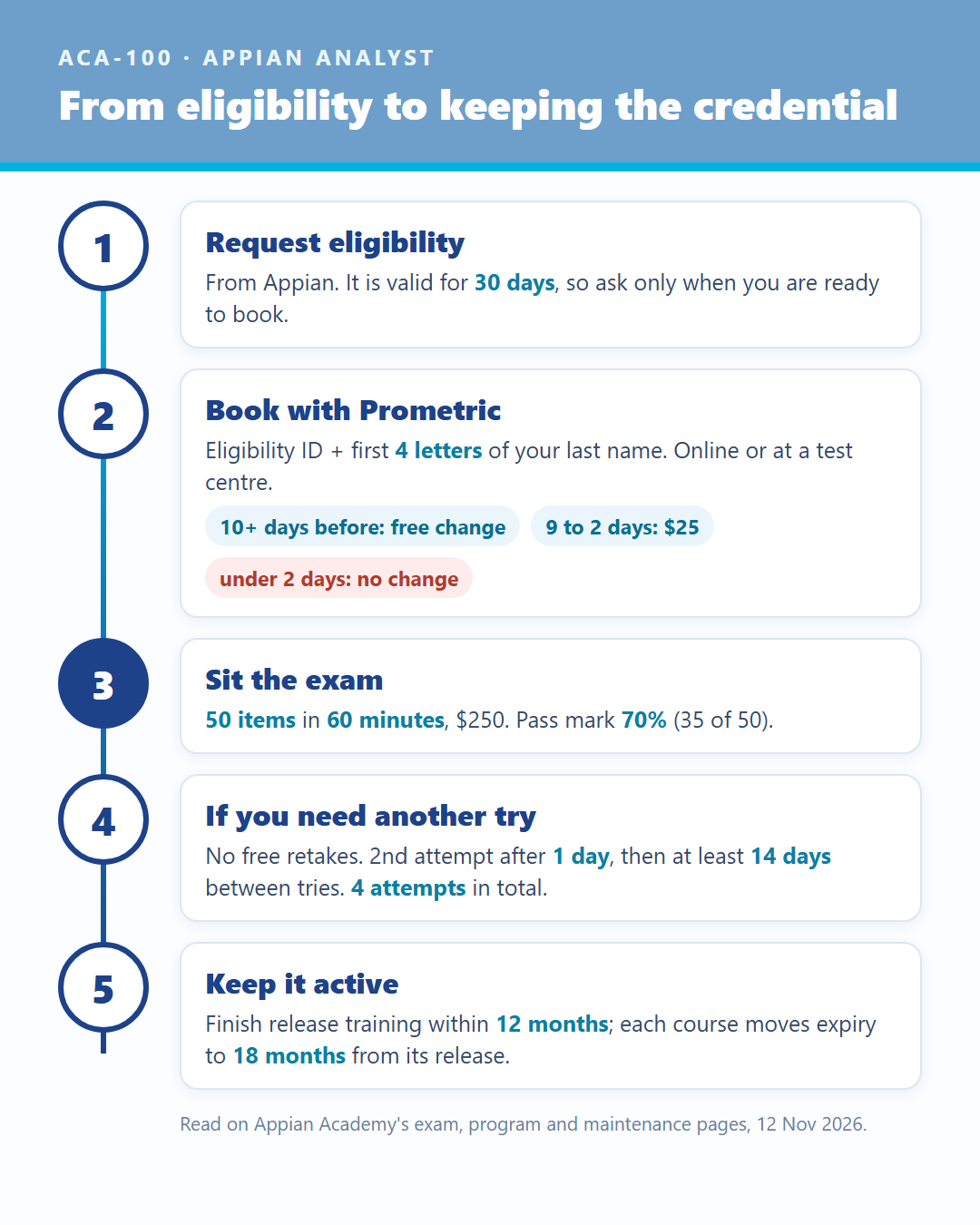
- Booking too early. Eligibility lasts only 30 days, so request it when you are ready to book.
How do booking, retakes and rescheduling work?
You request eligibility from Appian, then book through Prometric within 30 days. At booking you enter your Eligibility ID and the first four letters of your last name, which must match your Appian account name exactly.
The Appian certification program rules set the rest:
- Retakes: there are no free retakes, and you can make four attempts in total. A second attempt can be booked after one day; after that, you wait at least 14 days.
- Rescheduling: free 10 or more calendar days before the exam, $25 between 9 and 2 days before, and not possible in the last 2 days.
- Remote rules: you must be alone, at a desk, with no phone, smartwatch, headphones, second monitor, notes or scratch paper.
- Japanese ID holders: book at least 5 days ahead and email Appian to validate your ID.
How do you keep the Appian Analyst certification?
You keep it by finishing Appian's quarterly release training. Under the Appian certification maintenance rules, you have 12 months from your first certification to complete the required Release Showcase training, and each completed course moves your expiry date to 18 months from that course's release date.
The courses must be done in order, oldest first. Passing another Appian exam at your level, or the next one up, before your expiry date also keeps the credential active.
Frequently asked questions
1. How many questions are on the ACA-100 exam?
The ACA-100 Appian Analyst exam has 50 items, and you have 60 minutes to answer them.
2. What is the passing score for ACA-100?
Appian sets the minimum passing score at 70%, which is at least 35 correct items out of 50.
3. Does ACA-100 have any prerequisites?
No. Appian lists the requirement as none, and the Analyst exam is an entry-level credential.
4. How much does the ACA-100 exam cost?
The exam costs $250 per attempt, and Appian does not offer free retakes.
5. Can I take the ACA-100 exam online?
Yes. Prometric proctors the exam online or at a test centre, and online candidates talk to the proctor in English.