
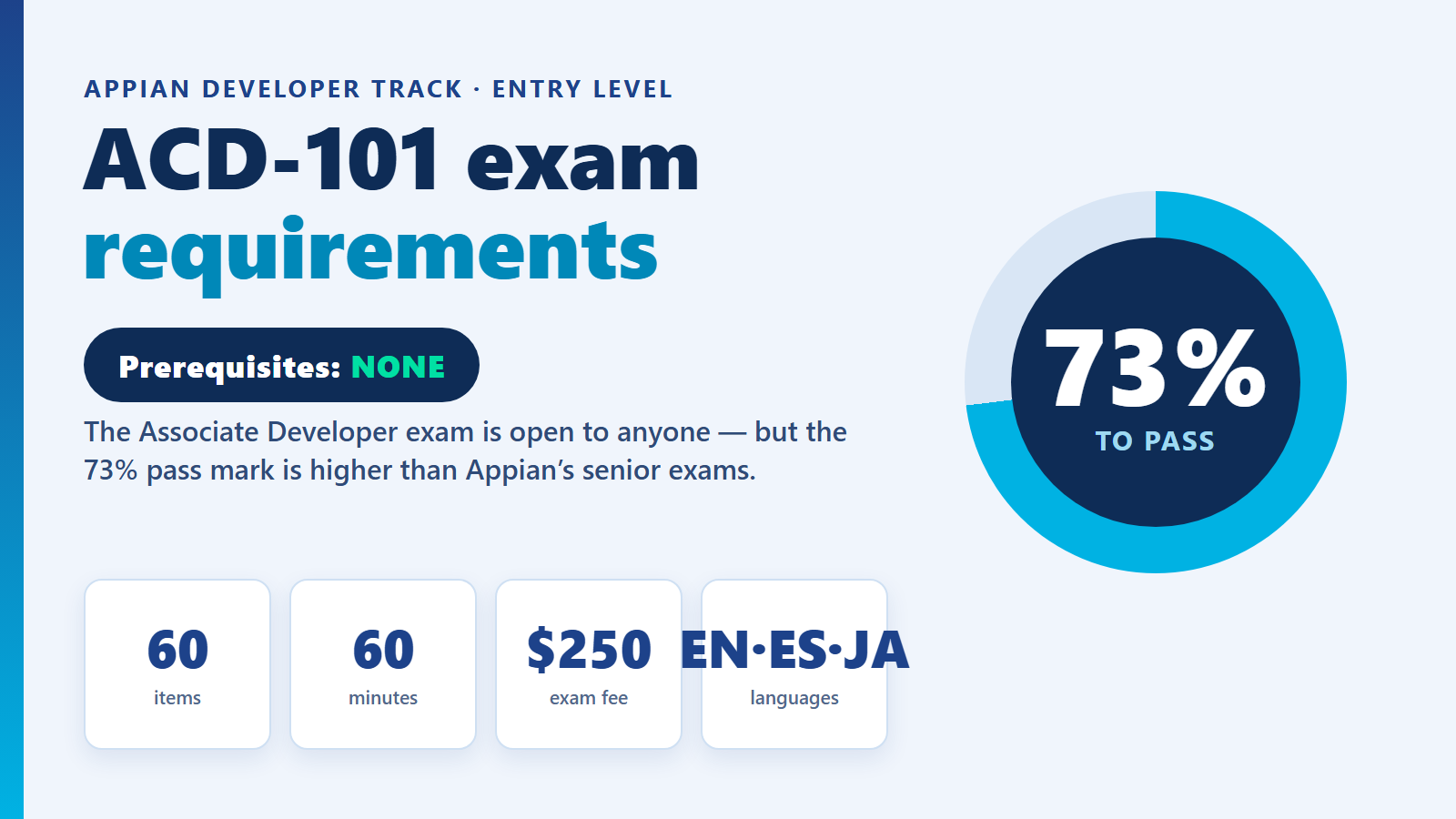
The ACD-101 exam, Appian's Associate Developer certification, has no prerequisites: anyone can request eligibility and sit it. It is 60 items in 60 minutes, costs $250, and you need a 73% score to pass. That 73% cut is the part people underestimate, because it is much higher than the pass marks on Appian's senior exams.
This entry is for the candidate who is new to Appian and wants a plain checklist: what the exam actually requires, who it is built for, what the seven objectives test, and a four-week plan to get ready. Every exam figure here was read on Appian Academy's own pages on 5 November 2026, not from memory.
What are the requirements for the ACD-101 exam?
There is no certification or experience you must hold first. The Appian Associate Developer exam page lists the requirement as "None" and sets out the exam itself:
- Exam name: Appian Associate Developer (the credential is Appian Certified Associate Developer; ACD-101 is the code used for it).
- Requirement: none. It is the entry-level developer credential.
- Items: 60.
- Duration: 60 minutes.
- Price: $250.
- Minimum passing score: 73%.
- Languages: English, Spanish and Japanese.
- Blueprint: last updated on 2 October 2023.
So the only hard requirement is the booking and the $250. The real work is matching your skills to the candidate profile below, because the exam assumes a specific starting point even though it demands no paperwork.
Who is the ACD-101 exam designed for?
Appian describes the candidate it expects, and reading that description honestly is the best readiness test you can take. An Associate Developer, in Appian's words, has:
- one to three months of Appian-specific experience, and roughly 80 hours of training on the platform;
- some software development and relational-database background, and a high-level grasp of how a database maps to an application;
- hands-on familiarity with the core objects: records, process models, data types, interfaces and expression rules;
- the habit of treating records as the main object and source of data; and
- at least one small use case they have built themselves, not just watched in a lesson.
If that sounds like you, you are in range. If you have only watched tutorials and never built a working interface or process, the 73% bar will be hard, and the fix is build time, not more reading.
How much does the 73% passing score really ask?
More than most entry exams. If every item counted equally, 73% of 60 items is about 44 correct answers, so you can miss roughly 16. Appian does not publish how items are scored, so treat 44 as a planning target rather than a guarantee.
The practical message is that there is little slack. On an exam with a 54% or 62% pass mark you can have a weak area and still pass; at 73% a single objective you skipped can sink you. That is why the study plan below touches all seven objectives rather than betting on the big ones.
Which ACD-101 objectives carry the most weight?
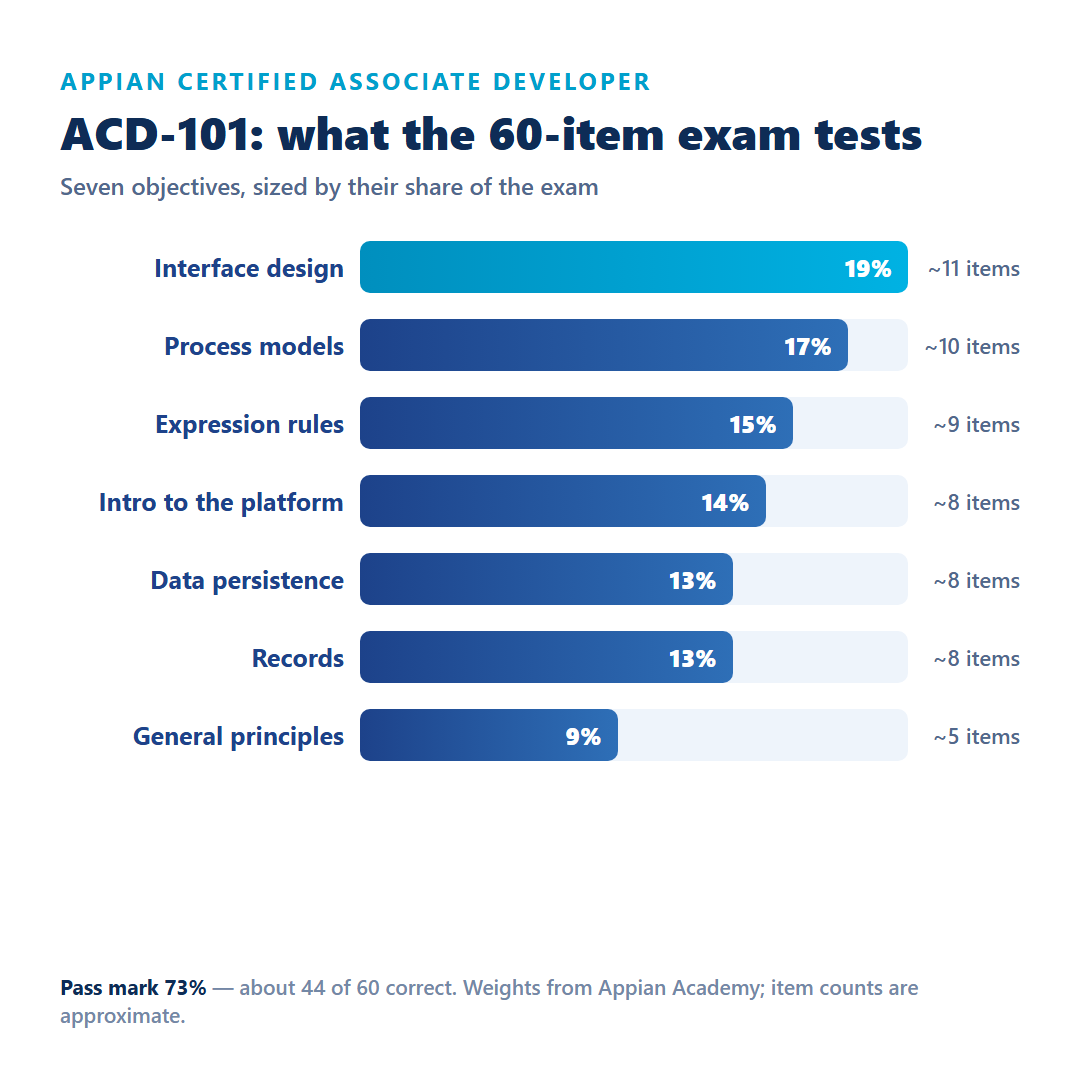
The seven objectives are not evenly sized, and building skills dominate. Here they are with a rough item count; Appian gives percentages, not counts, so the counts are simple arithmetic on 60 items:
- Appian development: interface design, 19%: about 11 items. Build interfaces, use local variables and rule inputs, configure components such as grids and validations, test and troubleshoot.
- Appian development: process models, 17%: about 10 items. Start, create, debug and publish process models, configure common nodes and smart services, trace the flow of data.
- Appian development: expression rules, 15%: about 9 items. Read a rule's purpose and output, build a basic function rule, use test cases.
- Introduction to the Appian platform, 14%: about 8 items. Find Appian resources, organise an application's structure, describe use cases such as process mining and RPA.
- Data persistence, 13%: about 8 items. Manage relational data, use CDTs and query entities, read and write through record types, update the data model.
- Appian development: records, 13%: about 8 items. Configure a record from a data source or codeless data model, design views and lists, set up record actions and relationships.
- General Appian principles, 9%: about 5 items. Role-based security, the difference between design objects, and the purpose of each environment.
Add the three development sections and you get 47% of the exam on building interfaces, processes and expression rules. That is where your hands-on hours pay off.
How do you register and schedule the ACD-101 exam?
You do not book ACD-101 directly with a testing centre. You first request eligibility from Appian, then schedule through its testing partner. The Appian certifications hub describes four steps:
- Choose your exam. Associate Developer is the entry-level option, so there is no prerequisite check to fail here.
- Schedule it. Select Request Eligibility with Appian, then book your seat through Prometric once your eligibility is issued.
- Take it. The exam is proctored by Prometric and can be taken online or in person.
- Get certified.
Two details save people trouble. First, eligibility is valid for only 30 days, so request it when you are nearly ready, not at the start of your study. Second, if you plan to test in Japanese, book at least five days ahead and e-mail academy@appian.com to validate your ID; the name on your Appian Community profile must match your identification exactly.
What does a four-week ACD-101 study plan look like?
This plan suits someone with a little Appian exposure who can put in about an hour a day plus a longer weekend session. It leans on the official Appian Developer learning path and pairs every week with building, because this exam rewards practice over reading.
- Week 1: platform and principles. Work through the introductory courses on the developer path. In a free Appian Community Edition site, create an application and set up its folders and groups, and note which security role can see what. This covers the Introduction (14%) and General Principles (9%) objectives.
- Week 2: data and records. Build a simple data model, create a record type from it, and add a list, a view and a record action. Write down how a query entity differs from a record type when you read data. This is the Data persistence (13%) and Records (13%) ground.
- Week 3: interfaces and expression rules. Build two or three interfaces with grids, drop-downs and validations, backed by local variables and rule inputs. Write a few expression rules and test each with a test case. These are the two biggest scored areas after process models.
- Week 4: process models, then review. Create, debug and publish a short process model with a script task and a sub-process, and follow the data through it. Then take Appian's Associate Developer practice test, listed on the exam page, and spend the rest of the week on the objectives where your score was lowest.
A worked example: why does an interface show no data?
This example was written for this entry to show the kind of reasoning the interface and data objectives test. It is not taken from the exam.
You build an interface with a read-only grid that should list customer records. The interface saves without an error, but the grid is empty, even though you can see rows in the record type. What is the first thing to check?
A new developer often rebuilds the grid. An Associate-level answer looks at the data path instead:
- The source expression. The grid's data needs to point at the record type or a query that returns rows. If it points at an empty local variable, or a query with a filter that matches nothing, the grid is correctly showing zero rows.
- Security. Records honour role-based security. If your test user is not in a group that can view the record type, the interface returns nothing rather than an error.
- The rule input. If the grid depends on a rule input that was never passed a value, it has nothing to display.
The lesson is method: on an Appian interface, "no data" is usually a data or security question, not a layout bug. Learning to check the source, the security and the inputs in that order is exactly what the development objectives reward.
What mistakes slow people down on ACD-101?
Most wasted attempts come from a few avoidable habits:
- Underrating the 73% cut. Plan to be comfortable across all seven objectives, not just the big three.
- Studying by watching, not building. The candidate profile assumes you have built at least one small use case. If you have not, that is your real gap.
- Requesting eligibility too early. It lasts 30 days; ask for it near the end of your plan.
- Skipping General Principles because it is only 9%. Security roles and environments are quick wins that are easy marks.
- Ignoring the language and ID rules. If you test in Japanese, the five-day booking and ID-validation steps are not optional.
For the full syllabus, the exam pattern and sample-question formats in one place, see the Appian Associate Developer certification overview on VMExam.
What comes after the Associate Developer exam?
Associate Developer is the first rung of Appian's developer ladder. Once you hold it, Senior Developer becomes available, and Senior Developer in turn unlocks Lead Developer. If you want to see where the path leads, the ACD-301 Lead Developer requirements on this blog lay out the senior end of the same track and the two years of delivery it expects.
Is there a video on preparing for the Appian Associate Developer exam?
Yes. This VMExam video walks through how to get ready for the Appian Associate Developer certification:
Frequently asked questions
1. Does the ACD-101 exam have any prerequisites?
No. Appian Associate Developer is the entry-level developer credential and lists its requirement as "None". Anyone can request eligibility and schedule it, though Appian expects one to three months of Appian experience and about 80 hours of training.
2. How many questions are on the ACD-101 exam and what is the passing score?
The exam has 60 items in a 60-minute time limit, and Appian lists the minimum passing score as 73%. That works out to roughly 44 correct answers if every item counts the same.
3. How much does the Appian Associate Developer exam cost?
The exam costs $250, as listed on Appian Academy on 5 November 2026. You pay when you schedule your seat with Prometric after Appian issues your eligibility.
4. In which languages is the ACD-101 exam offered?
English, Spanish and Japanese. You must still communicate with the proctor in English for an online-proctored session, and Japanese-ID candidates must book at least five days ahead and validate their ID by e-mail.
5. How long is Appian exam eligibility valid?
Eligibility expires 30 days after Appian issues it, so request it only when you are nearly ready. You then use it to schedule the exam with Prometric, online or in person.