
Linear motor — I used to think they were exotic. Something you'd find in a maglev train or a high-end research lab, not on a factory floor. Then I started seeing them everywhere: in semiconductor manufacturing equipment, in CNC machining centers, in robotics and automation systems. The technology that once seemed futuristic has become the standard for applications that demand speed, precision, and reliability.
From Spin to Straight
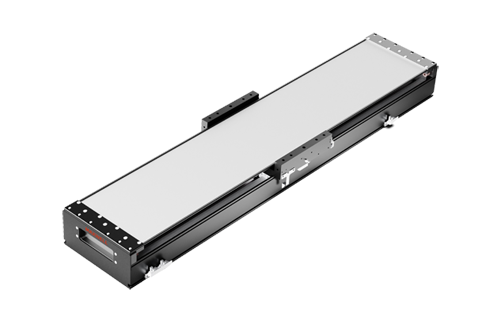
A linear motor is essentially a rotary motor that has been "unrolled" and laid flat. Instead of a rotor spinning within a stator, a linear motor features a carriage that moves back and forth along a track. The construction is the same as a rotary three-phase motor, but configured linearly.
The principle is elegantly simple. The motor consists of permanent magnets alternating in polarity and a moving carriage with three phases of coils. Running a current through the linear motor coil creates alternating magnetic fields, generating a straight driving force through repulsion and attraction. By controlling the current in the primary coils, the motor can precisely control position, speed, and acceleration along a linear path.
The difference from a rotary motor is profound. Rotary motors produce rotation—torque. If you need straight-line motion, you must add mechanical components: screws, belts, pulleys, or rack and pinion systems. These parts translate the spin into a push or pull. A linear motor, by contrast, delivers linear motion directly. There's no need for these intermediate mechanical translators.
Why Direct Drive Changes Everything
The "direct drive" nature of a linear motor is a game-changer for linear applications. Here's why.
Simplicity. A linear motor system aiming for linear motion is mechanically simpler. Fewer parts converting rotation means fewer things to align, maintain, or potentially break.
No backlash. Mechanical converters like gears, belts, and screws can introduce backlash—a tiny play or looseness in the mechanism that reduces positioning accuracy and repeatability. Direct-drive linear motors eliminate this entirely.
Less wear. Fewer moving mechanical contact points mean less friction and wear compared to a rotary-to-linear conversion system.
Higher speed. The speed of a ball screw drive is limited by the DN value and critical speed of the screw shaft. Linear motors don't face these restrictions, enabling high-speed motion even over long strokes.
Low noise and vibration. Thrust is generated through a contactless drive structure, so there is no vibration caused by the rotation of a ball screw or the recirculation of rolling elements. This produces low levels of noise and vibration.
Long stroke. The linear motor can handle long strokes by connecting magnets together. They can even be connected to form strokes that exceed 2 meters in length.
Multiple sliders. Multiple sliders can be set on a single-axis base and controlled individually. Even six different sliders could be set on a single-axis base, all operated independently.
Precision and Speed, Together
A linear motor is for fast motion, acceleration, and very high accuracy. When a load is attached to the carriage that moves along the permanent magnets, the direct-drive system gives it incredible responsiveness and speed with no backlash.
The numbers are striking. Linear motors can achieve very high acceleration—up to 10g—and sub-micron positioning accuracy. In one example, a linear motor accelerated a ball and cup to 4 meters per second in only 12 centimeters—a speed and acceleration probably not possible with a ball screw or linear actuator.
This combination of precision and speed is why linear motors are used in direct drive applications where the speed and accuracy requirements exceed what a rotary motor and mechanical actuator can provide.
The Three Main Types
There are three main types of linear motors: induction linear motors, synchronous linear motors with permanent magnets, and reluctance motors.
Linear Induction Motors (LIM) were the first invented, patented in 1905. They consist of a "primary" composed of a stack of electrical steel laminations and copper coils, and a "secondary" made of a steel plate with a copper or aluminum layer. The advantage is low cost because the secondary does not use expensive permanent magnets. The downside is that drives for induction motors are harder to find than for permanent magnet motors.
Permanent Magnet Linear Synchronous Motors (PMLSM) have essentially the same primary as linear induction motors, but the secondary is composed of permanent magnets mounted on a steel plate. These are the most commonly used linear motors in high-performance applications.
Linear Switched Reluctance Motors (LSRM) have emerged as a promising alternative to LIM and LSM, offering cost-effectiveness, fail-safe operation, and a simple, robust structure.
Where They're Used
Linear motors are widely used in semiconductor manufacturing equipment, CNC machining centers, robotics and automation, medical devices and imaging systems, and packaging and material handling. In Japan, the linear Chuo Shinkansen is a maglev train that uses superconducting magnets.
The technology is also expanding into new applications. Linear motors are being used in machine tools, positioning and handling systems, and machining centers where the dynamics of a rotating servomotor are insufficient. They're also used in electromagnetic pumps where the rotor consists of a conducting fluid, such as a liquid metal.
What I Wish I'd Known
I wish I'd known that a linear motor could handle heavy loads. I wish I'd understood that the elimination of mechanical components doesn't just improve performance—it reduces maintenance and extends service life. I wish I'd recognized that the technology had advanced enough to become the standard in precision automation.
The linear motor is no longer a niche product. It's a robust, reliable, and efficient solution for applications that demand speed, precision, and reliability. It's the motor that doesn't spin—and that's exactly why it works.