
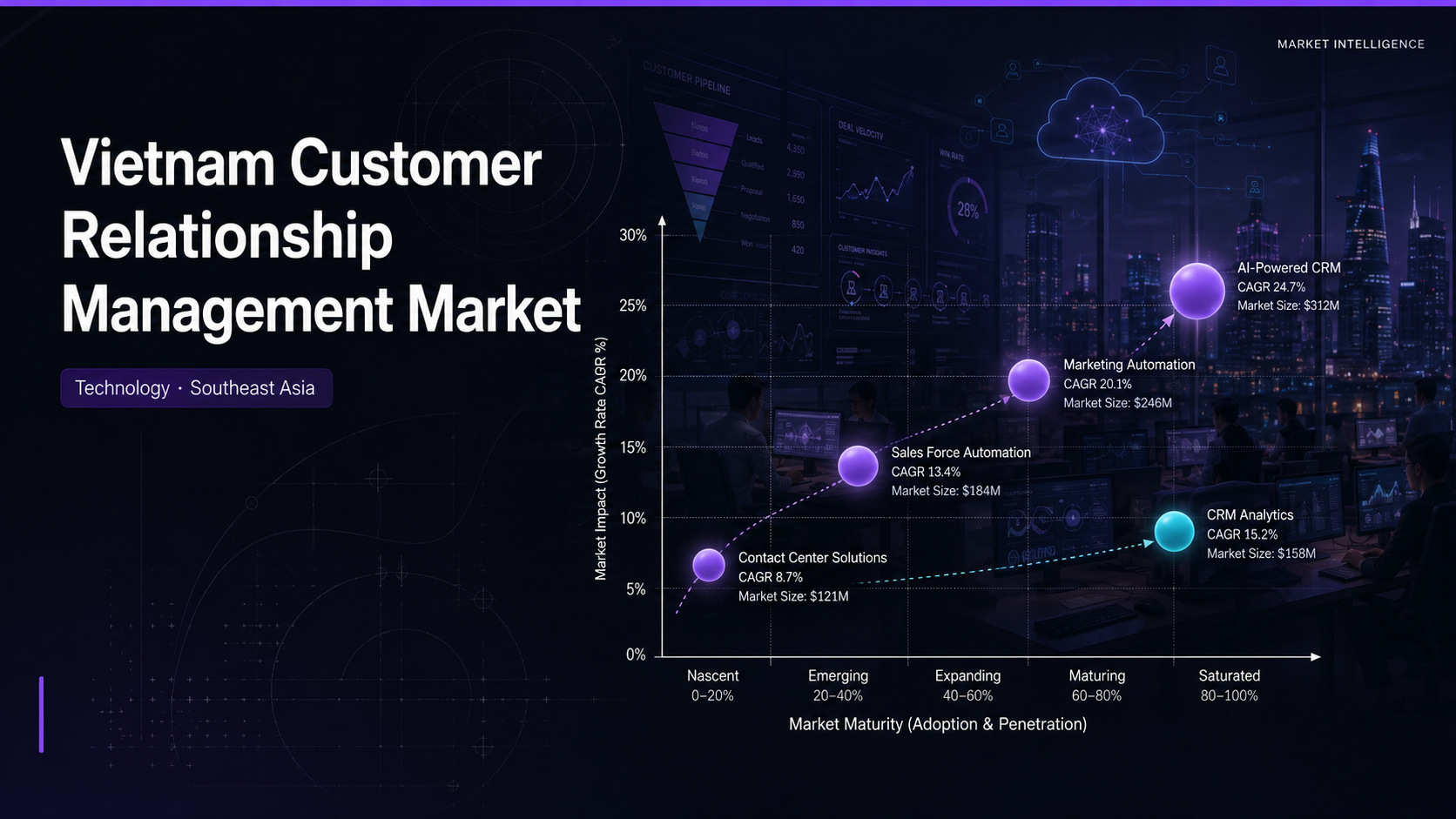
Vietnam Customer Relationship Management Market Outlook 2024-2030: Growth and Forecast
Executive Summary
Vietnam's CRM market reached USD 120 million in 2024, and the growth engine is not big enterprise. It is SMEs moving to affordable cloud tools as e-commerce and digital transformation reshape how Vietnamese firms manage customers.
Key Market Velocity Data
- Current Market Value: USD 120 million in 2024
- Projected Market Value: approximately USD 270 million by 2030
- CAGR: about 15% during 2025 to 2030
- Dominant Segment: cloud-based CRM, SME-led adoption
- Primary Growth Catalyst: SME digital transformation and the e-commerce boom
What Is Driving the Market?
Digital transformation is the core pull. About 70% of Vietnamese businesses are investing in digital technologies, and 80% of consumers now prioritize personalized experiences. The market sits at USD 120 million in 2024 and is projected toward USD 270 million by 2030 at roughly 15% CAGR.
E-commerce is the accelerant. Vietnam's online retail market is heading toward USD 23 billion at 25% annual growth, forcing retailers to manage customers across channels. Cloud-based CRM dominates because it is cheaper and faster to deploy than on-premise suites, which suits a SME-heavy economy. Startups and mid-market firms, growing fast, are the main new buyers rather than large corporates.
- Digital push: 70% of businesses are investing in digital tools, lifting CRM from optional to essential
- Customer experience: 80% of consumers expect personalization, rewarding data-driven CRM
- E-commerce surge: a USD 23 billion online market growing 25% annually drives multichannel CRM need
- Cost barrier: 45% of SMEs cite high cost as the main blocker, favoring affordable cloud tools
Which Entities Are Shaping the Market?
Global suites lead the high end. Salesforce, HubSpot, Zoho CRM, Microsoft Dynamics 365, Oracle, and SAP anchor enterprise demand, while Freshworks, Pipedrive, Bitrix24, and SugarCRM compete on price and simplicity across the USD 120 million market, where 45% of SMEs cite cost as the barrier. Bundling CRM with marketing and commerce tools is becoming standard to lift account value.
Vertical demand is concentrated. Retail, financial services, telecommunications, and healthcare are the heaviest CRM adopters, mirroring where customer data and competition are densest. Cloud-based deployment holds the dominant share by type, reflecting the 15% CAGR shift away from on-premise across the USD 120 million market. Local integrators and resellers localize these suites for Vietnamese workflows and pricing.
Compliance is now a real factor. Decree 13/2023/ND-CP on Personal Data Protection, effective 2023, requires consent for data collection, security measures, and 72-hour breach notification. CRM vendors handling customer data must build these controls in, raising the bar for global and local providers alike.
How Do Segments and Verticals Split?
Deployment and user mix are clear. Cloud-based CRM leads on cost and flexibility, while on-premise fades to regulated niches. SMEs are the largest end-user group, ahead of large enterprises, and retail plus financial services lead verticals across the USD 120 million market in 2024. AI-enabled CRM is the fastest-rising sub-segment. Mobile-first access matters because Vietnamese field-sales teams operate largely on smartphones.
- By deployment: cloud-based dominates, on-premise shrinks to regulated and legacy use
- By user: SMEs lead, with large enterprises a smaller but higher-value tier
- By vertical: retail, financial services, and telecom drive the densest CRM demand
- By technology: AI and analytics features rise fastest, automating sales and service
What Does This Mean for B2B Decision-Makers?
Win on affordability and localization, not feature bloat. The USD 120 million market is SME-led, and 45% of those firms cite cost as the blocker, so priced-right cloud tools beat enterprise suites. Vendors capturing this base will ride the 15% CAGR toward USD 270 million by 2030. Distribution through local partners and marketplaces shortens the path to SME buyers.
Compliance and AI are the new differentiators. Decree 13 makes data protection table stakes, while AI-driven automation is where vendors create visible ROI. Local language support and integration with Vietnamese platforms feeding a USD 23 billion e-commerce market separate winners from imported defaults. Switching costs stay low for SMEs, so onboarding speed and support quality drive retention.
- For CRM vendors: price for SMEs and localize, since 45% cite cost as the main barrier
- For enterprises: prioritize AI-enabled CRM to capture the 80% consumer demand for personalization
- For investors: back affordable cloud CRM riding a 15% CAGR and a USD 23 billion e-commerce wave
- For compliance teams: build Decree 13 data-protection controls into every CRM rollout
Ken Research Strategic Outlook
Ken Research sees Vietnam CRM as an SME-and-cloud story, not an enterprise one. The next phase rewards affordable, AI-enabled, locally compliant tools that convert e-commerce growth into retained customers. Expect the USD 120 million market to more than double toward USD 270 million by 2030 as cloud adoption deepens and Decree 13 standardizes data handling.
Data Source and Full Analysis
For deeper segment-level analysis, access the full Ken Research report here: Vietnam Customer Relationship Management Market Report