Foreign correspondents can be a pretty jaded lot. Particularly when around one another, we tend to be full of an "If it's Tuesday it must be Tehran" sort of world-weariness that's partly feigned, but partly real. As a chartered Asiana Airlines 747 from Beijing bore down on Pyongyang, the capital of North Korea, on Feb. 25, carrying the New York Philharmonic orchestra and 80 journalists, that ennui pretty much went out the window. Television cameramen and photographers jostled for position in window seats to capture images of the brown, frozen landscape as it came into view below. Reporters brought out their small digital cameras to try to get the same photos for their scrapbooks, even as flight attendants frantically tried to shoo everyone back to their seats.
For many of us, if there is a dark side of the moon here on earth, North Korea is it. On and off for the better part of 20 years, from postings in Tokyo, Moscow, Beijing and now Shanghai, I have been covering North Korea ― to the extent that a journalist can cover a place he has actually never been to. Three times previously, I had applied for an official journalist's visa to do reporting in the North ― to no avail. Partly, I've always assumed, that's because I'm a U.S. citizen, and we have been technically at war with the North since a 1953 armistice. Partly it may be because some of the things I've written over the years haven't exactly been flattering to the family dynasty that runs the place: the late Kim Il Sung (the "Great Leader") and now his son, "Dear Leader" Kim Jong Il. But mostly it's because the North Koreans, in their bull-necked isolation, pretty much don't give a damn what the outside world thinks of them.
Even from afar, North Korea is rarely dull. In the course of writing about the place, I have interviewed government spooks who track the country's illicit arms trade, as well as its counterfeiting and drug-running businesses. I have also written about legitimate South Korean businessmen who have invested there, hoping it's a low-wage alternative to China. And I have followed the seemingly endless permutations of Washington's fitful efforts to convince Pyongyang to give up its nuclear program. When, defiantly, North Korea set off a nuclear device in October 2006, I wrote a cover story for TIME on the pre-eminent security threat of the 21st century: nukes getting into the hands of guys like the Dear Leader and the terrorist groups and other rogue nations he does business with.
The most gripping ― and painful ― North Korea story that I have followed over the years is the plight of the country's refugees, who escape by the thousands to neighboring China, hoping desperately for a better life, and for a chance to get into South Korea. Only a very lucky few do. At safe houses run by Christian missionaries in northeastern China, in refugee camps in Thailand and in the jungles of Vietnam and Laos, I have heard tales of bloodcurdling anguish ― stories that defy belief, except that there's simply no way in hell these people could be making them up. A young woman who became pregnant in China is captured by Beijing's security services and returned to North Korea. She is sent to prison and allowed to carry her pregnancy for a few more months. Then her sister is arrested and brought into the same prison, for one purpose: to watch as guards kick and beat her sister in the abdomen until the unborn child is dead. The guards then stomp off, braying that it's what you get for marrying a dirty Chinese dog. Journalists, I know, are supposed to be objective. Here's objectivity for you: North Korea is the most barbaric regime on the planet.
Now, thanks to the historic concert by the New York Phil, coming amid a slow-motion diplomatic thaw already underway between Pyongyang and Washington, I would finally get to see a little of the place for myself. The North Koreans, to say the least, are control freaks, and hordes of minders immediately surrounded us on the tarmac as we waited for the orchestra leader, Lorin Maazel, and his musicians to follow us down and take a "class photo" in front of a beaming mosaic of the Great Leader. The deputy minister of culture, Song Sok Hwan, stepped forward to greet Maazel ― Monday's money shot for the cameramen among us ― so as one they surged forward to surround the two men, leaving the spot where we all had been instructed to wait. We'd been on North Korean soil for all of 20 minutes, and already the handlers were frantic. "Please, we are all your friends here," one beseeched the mob, "but you must move back behind the yellow line." Ignored and increasingly flustered, the poor guy then blurted out one of the other foreign words he knew ― one that might have betrayed what he was really thinking. "Au revoir!" he bellowed.
On the Empty Streets
We boarded eight buses for an approximately 15-mile (25 km) journey into town, and some of the North Korea I'd read about, and talked to diplomats and refugees and defectors about, started to become real. In the late-afternoon gloom, we passed apartment buildings and office buildings, row after row, that were unlit. Outside town, people either trudged along the side of the road or rode bikes ― many stopping to stare at our convoy. And every kilometer or so, there stood in the middle of the road a female traffic cop. Each wore an aqua-blue uniform and a fur-lined hat, stood ramrod straight and wielded a baton to point the way to drivers; all of them seemed tall, young and attractive ― "a James Bond fantasy come to life," cracked one colleague on our bus. Whoever they were, they had one of the world's easiest jobs, because there was no traffic to direct.
The entire group was deposited in a 47-story hotel that sits on Pyongyang's Daedong River. It is one of two hotels in Pyongyang that foreigners stay in. The other one is on a central street, with plenty of pedestrian traffic outside and even some vehicular traffic. It's possible to walk out the front door, see people and try to talk to them. Not from our hotel. It's isolated and difficult to walk to or from. And that was the point. There hadn't been this many Americans on North Korean soil since the Korean War, and our hosts plainly didn't want us mingling. When I later groused about it to a colleague posted to Pyongyang for the Russian wire service Itar-Tass, he chuckled: "Do you know what foreigners here call your hotel? Alcatraz. It's difficult to get into ― and even harder to leave."
Mind Your Minder
While the orchestra rehearsed, the government minders took the 80 mostly American journalists on a whirlwind tour of Pyongyang. Kim Il Sung, the late Great Leader, is still the dominant figure in the intense cult of personality that is North Korea. His image is everywhere, most prominently on an overlook where a gigantic bronze statue stands in front of the Korean Revolution Museum. After we boarded the buses, a group of about 40 North Koreans walked up and made their way to the statue. We were just about to leave, but again there was a journalists' revolt. A few of us sprinted off the bus to get a better look at the scene unfolding before us, and once we went, the whole pack followed, as our minder-translators stewed helplessly. We watched the farm workers, as one hesitantly described himself to us, gather to walk in orderly rows, approach the statue reverently and then bow deeply before it.
This didn't seem to be an act for our benefit; this appeared real. Before the mob of journalists could pepper them with questions about what Kim Il Sung meant to them, their handler hustled them into the museum. When we got back on the bus, we got a tongue-lashing; a handler screaming at us in Korean to behave. My group's translator, a decent enough guy named Mr. Kim, sheepishly translated: "He says we have to stick to the schedule. Otherwise, you'll never be able to see everything and you'll get in trouble."
As hard as the government tried to prevent it, some reality seeped out that day. At the People's Study House, a sort of public library that also conducts classes, a colleague accidentally opened a door and found herself in a classroom; it was dimly lit and at least "15 degrees colder than the ones we're being shown," she said. The students sat huddled in winter jackets, some wearing hoods or hats. Sadder was the breakfast room at the hotel that morning, just after a complimentary ― and lavish ― buffet had been served to us. A friend of mine, from the orchestra's delegation, arrived after 9 a.m., when the buffet had closed. As she entered she saw a couple of the waitresses at work. They weren't clearing the mountains of food away; they were taking pictures of it. It has been 10 years since the great famine ended, killing more than a million North Koreans. Suffice to say the waitresses who worked at "Alcatraz" had never seen a spread quite like the one served to us that morning.
Let the Music Begin
The swings between humor and pathos ended that evening at the East Pyongyang Grand Theater, an ornate, three-tier orchestra hall that had been recently fitted with a new acoustic shell around the stage to make the hall worthy of the New York Philharmonic. Some 1,400 people were present ― mostly North Koreans, and a few dozen foreign diplomats and businesspeople. Who the North Koreans were, exactly, was maddeningly vague. Maazel had said before the concert that he hoped "ordinary" Koreans would be among those attending, but no one from the orchestra had a clue who the tickets had been given to. Our handlers never gave me anything approaching a straight answer to that question. Random members of the audience interviewed by journalists included middle-level government workers and some music teachers. (The seniormost North Korean official present was the Minister of Culture.)
But when Maazel took the podium, to prolonged applause, it became quickly clear that the evening would be one of rare power and emotion. North Korean and U.S. flags stood at either end of the stage, and the entire audience rose as both nations' anthems were played. From that point on, for the next two hours, it was hard to remember that during the bus ride that afternoon, we had passed a poster of a giant fist slamming a helpless little Uncle Sam that read, "Smash the USA." When he introduced George Gershwin's An American in Paris, Maazel told the audience that perhaps one day another composer would write a symphony entitled "An American in Pyongyang." Whatever ambivalence the North Korean audience may have felt until then evaporated. The crowd laughed ― and applauded long and hard. "From that point on," Maazel later said, "you could just feel the warmth in the room."
The orchestra's last piece was, for the audience, the most poignant. It played Arirang, a traditional Korean folk anthem loved in both North and South. Koreans have sung versions of the song for 600 years, and it speaks to a longing in both countries to become a whole nation again. As the orchestra began to leave the stage, several members turned and waved goodbye, and many in the audience reciprocated. Bassist Jon Deak later said he was near tears. So too was a young Korean-American assistant concertmaster, Michelle Kim, a descendant of a North Korean family who lived in Seoul until she was 11. "Tonight I didn't feel South Korean or North Korean but Korean," she said. "It was very emotional."
At a dinner after the concert, an emotionally spent New York Philharmonic president Zarin Mehta said, "I'm over the moon right now." He said he had "misted up" at the playing of the U.S. national anthem in Pyongyang, and that the emotional power of the evening only grew from there. He was right. Several hard-bitten journalists, myself included, choked up at various points, and several orchestra members spoke of breaking down in the wings after leaving the stage as the audience continued to stand and applaud. U.S. diplomats, current and former, were euphoric. Donald Gregg, a former State Department and CIA official, who diplomats say has played a quiet but influential role in getting the Bush Administration to engage with North Korea, said he "has rarely seen North Korean officials seem more friendly and flexible."
Reality Check
"A Momentous Journey" is how the Phil's p.r. director Eric Latzky had called it in Beijing the day before the flight to Pyongyang. Immediately after the concert, he had seemed prescient. But momentous things sometimes last just a moment. This is still North Korea we're talking about. Kim Jong Il has run the place now for nearly 14 years. He has not, to date, shown himself to be an agent of change. He still runs a rogue regime, suspected recently of aiding Syria in building what Israeli intelligence believes to have been a nuclear-weapons facility before the Israelis destroyed it with air strikes last year. It exports narcotics, has been accused of counterfeiting $100 bills, hasn't come clean about the Japanese citizens it kidnapped ― kidnapped! ― over the decades, and still isn't living up to all the terms of last February's nuclear deal. Largely lost, moreover, amid the American euphoria over the concert was the fact that it came less than two weeks after Kim's 66th birthday ― a day when the national cult of personality goes into overdrive. No one should be surprised if the regime's message to its populace is, Look, even a famous American orchestra plays for the Dear Leader.
That's the reality of how the North Korean government operates. About a year and a half ago, at the behest of another acquaintance who helps aid refugees, I sat in a small apartment outside the town of Yanjie in northeast China. There sat two people ― two among thousands ― who had fled Kim Jong Il's North Korea in recent years. The mother of one young woman, Park Dae, had been taken to a political prison, gotten ill and died about three years ago, she said. Another, a young man, said he was simply tired of the poverty he faced in a small village in the northeast corner of the country. Both hoped to make it to Seoul. "There is no future in our country," the young man told me. Can a single, scintillating concert help change that? After a euphoric evening in the unlikeliest of places, that's still up to Kim Jong Il. And he, alas, wasn't there.
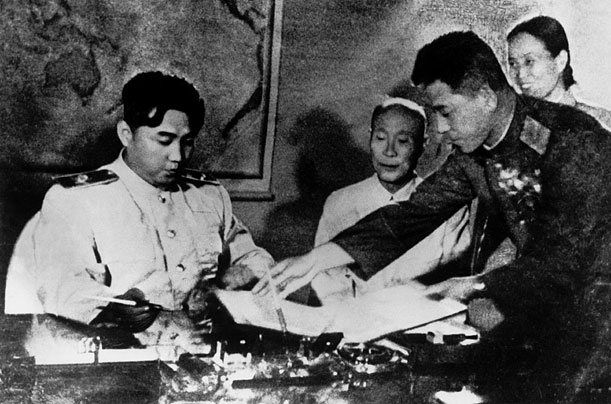
PHOTO July 1953 Kim Il Sung, North Korea's founder and Great Leader, signs the armistice agreement that ends the hostilities of the Korean War, leaving the peninsula divided into North and South Korea.