
Ad Formats for Buying Traffic: Compare Digital Ad Options Clearly
Ad Formats for Buying Traffic: Compare Options
Choosing among digital ad formats is one of the earliest and most consequential decisions a performance marketer makes, because the format determines how a message reaches the user, how much creative work the campaign demands, how the inventory behaves and what kind of business outcome is realistic. Push notifications, native units, display banners, pop placements, interstitials and video each carry a different user experience and a different cost of attention. FroggyAds ad formats give buyers a way to launch push, native, display and pop campaigns across a large supply network, but the platform is only as useful as the comparison a buyer performs before committing budget. This article walks through that comparison in practical terms: how each format behaves for the user, what it asks of the creative team, where it tends to run, how the buying models differ and how to turn all of this into a decision you can defend.
What a Traffic Buyer Actually Decides When Choosing a Format
Format choice is often described as a creative question, but in practice it is a budget and funnel question. A format decides how many impressions a given budget can buy, how quickly the audience becomes fatigued, which landing experience is appropriate and how much of the eventual result can be attributed to the placement rather than to the offer. A buyer who picks a format for its low cost per thousand impressions has made a bet on volume; a buyer who picks a format for its attention quality has made a bet on engagement. Both bets can be correct, but they lead to different campaign structures and different success criteria.
Four variables separate most formats from one another: user experience, creative workload, placement behavior and buying model. User experience describes how interruptive the unit is and how much permission the user has given. Creative workload describes the number of assets, sizes, languages and refresh cycles required to keep the campaign running. Placement behavior describes where the unit appears, on which devices and in which context. Buying model describes how the price is set and how the auction or direct purchase works. When these four variables are evaluated together, the format options become comparable. When they are evaluated one at a time, the comparison usually favors whichever format looks cheapest on the dashboard.
A useful way to read the rest of this article is to treat each section as one filter in a shortlist. The user-experience section tells you what the audience will tolerate. The creative and placement sections tell you what your team can produce and where the supply is likely to sit. The buying-model section tells you how to pay for the outcome you actually want. The decision section then turns those filters into a sequence of steps. Executives who need only the framework can start with the decision steps and the closing checklist; performance marketers building a test plan should read the sections on placement quality and buying mechanics first.
How Each Format Behaves for the User
The most important difference between formats is the moment at which they reach the user. Push notifications arrive on a device the user has explicitly opted into, which means they carry a permission asset that other formats lack. That permission is also fragile. A push that arrives at the wrong hour, repeats too often or promises something the landing page does not deliver will lead to revoked permission, and revoked permission is very difficult to recover. The interruption cost of a push is therefore high per exposure but low in terms of unwanted reach, because the recipient has agreed to hear from the sender in principle.
Native ads sit inside the editorial flow of a page or feed and borrow its visual grammar. Their strength is contextual relevance: a unit that resembles surrounding content tends to draw attention without triggering the reflexive dismissal that banners attract. The trade-off is trust. When a native unit is labeled clearly and matches the quality of its surroundings, it can build credibility; when the disclosure is weak or the promise is overstated, the user feels misled and the surrounding publisher suffers. Native formats reward offers that can be explained in a few honest sentences and punish offers that depend on a visual trick.
Display banners are the classic visual format, and they behave differently depending on whether the buyer optimizes for recall or for clicks. A banner that is never viewed is worth nothing, so viewability is the first measurement that matters. Banner blindness, the tendency of users to ignore rectangular blocks that look like advertising, reduces the value of repeated exposure to the same unit. Banners tend to work best for brand recall, retargeting and reinforcement of a message the user has already encountered elsewhere, rather than for cold conversion from a single impression.
Pop-unders and interstitials are the most interruptive formats in the set. A pop-under opens behind the active window and surfaces when the user closes or navigates away; an interstitial takes over the screen during a natural transition, such as moving between app screens. Both formats can deliver strong reach at low cost, and both can damage the relationship between the user and the publisher. Frequency tolerance is the critical variable here. A buyer who runs these formats without strict frequency caps is likely to see short-term volume followed by sharp declines in quality, and users who feel ambushed tend to leave rather than return. Exit-intent logic can make these formats more palatable, but only when the offer is genuinely relevant to the moment.
Video formats depend on sound, skippability and completion. A user who can skip after five seconds has a very different experience from one who must watch fifteen seconds before the content begins. Completion rate is the metric that best captures whether the video earned its place, and it depends heavily on whether the first frames communicate a clear reason to keep watching. Video is effective for demonstration and story, but it asks more of the creative team than most other formats, and its results are sensitive to device, autoplay policy and sound setting.
Several questions come up repeatedly when buyers compare these formats. Which format is least intrusive? Push notifications are the most permission-based, but their intrusion depends entirely on frequency and timing, so the honest answer is that native and well-placed display units are generally the least disruptive in a cold context. Which format converts after a single exposure? Usually none of them does so reliably; single-exposure conversion is more typical of strong offers in high-intent moments, and buyers who expect it from a banner or pop are usually disappointed. The more useful question is which format supports the sequence of exposures your funnel needs.
Creative Workload and Production Requirements
Each format asks for a different set of assets, and underestimating that set is one of the most common reasons launches slip. Push notifications require a short title, a body line, an icon and a click destination, and they need careful copy testing because the character budget is tight. Native units require a headline, a description, an image in a specified aspect ratio and sometimes a logo, and they must be produced in enough variations to cover the different placements a network may deliver. Display banners require a family of sizes, each with its own composition, and every size multiplies the production effort. Video requires a master file, cut-downs for different durations, captions for silent viewing and a thumbnail or first frame that works without sound.
Localization multiplies all of these requirements. A global campaign that runs in several languages needs translated copy that fits the character limits of each format, images that do not rely on text that will not translate, and landing pages that preserve the same promise in each language. The practical effect is that a team with limited design resources should narrow its format list before it narrows its audience. Two well-produced formats often outperform four rushed ones, because the rushed assets are exactly the ones that accumulate fatigue and quality problems.
Testing volume determines how long the creative team must work before the campaign can be read reliably. A test with only a few variations per format will produce noisy results, because each variant receives too few impressions or clicks to separate real differences from chance. As a general operating principle, the number of variations should match the volume the budget can deliver in the test window, and the team should plan the production schedule around that number rather than around an arbitrary round figure. When the budget is modest, it is better to test one well-chosen hypothesis per format than several cosmetic changes.
A creative test that cannot distinguish one hypothesis from another has not failed; it has simply not been designed. Decide in advance what a meaningful difference looks like, and produce only the variations needed to detect it.
Time from brief to launch differs widely between formats. Push and native campaigns with a prepared asset library can often move from approval to live delivery quickly, while display campaigns with many sizes and video campaigns with multiple cuts take longer. The lead time should be built into the plan, especially when a campaign is tied to a promotion or launch date. A team that discovers on the day of launch that its video cut-downs are not ready will either delay or run a weaker format in place of the one it planned.
Creative fatigue behaves differently across formats. Banners and pop placements tend to fatigue quickly, because the same unit is shown repeatedly to users who see it across many sites, and the first signs of fatigue are rising frequency with falling click-through rate. Native units can last somewhat longer when they blend into the surrounding content, but they too fatigue when the same headline appears again and again on the same publisher. Push notifications fatigue through repetition and irrelevance, so refreshing the message and tightening frequency matter more than changing the image. A sensible refresh cycle is one that responds to these signals rather than to a fixed calendar.
Placement Behavior and Inventory Quality
Each format tends to run in characteristic places. Push notifications run wherever the user has granted permission, which means their reach is defined by the opt-in base rather than by a page. Native units run in feeds, article recommendations and content widgets. Display banners run across a broad range of sites and apps, sometimes in premium positions and sometimes in less visible ones. Pop placements run on pages that generate navigation events, which can be a strength for broad reach and a weakness for relevance. Interstitials run at transition points inside apps and mobile sites. Video runs in players, in-stream positions and sometimes in feeds. Knowing these patterns helps a buyer predict the audience it will reach before the first impression is served.
Inventory transparency is the foundation of quality control. A buyer should be able to see which publishers or sources delivered its impressions, how the placements performed and which sources are blocked. Publisher lists, placement reports and blocklists are the practical tools for this. A campaign that cannot reveal its sources cannot be diagnosed when results change, and results always change eventually. Buyers should request exportable reports at the source and placement level and review them on a schedule rather than only when performance drops.
The signals worth monitoring fall into a few families. Viewability shows whether an impression had a realistic chance of being seen. Invalid traffic signals show whether activity reflects real users. Bounce patterns and session depth show whether the visitor who arrived engaged with the landing page. Time on page, scroll depth and the completion of the primary action show whether the audience matches the offer. No single signal is decisive, but a campaign whose viewability is low, bounce is high and session depth is shallow is almost always delivering inventory that does not fit the offer, regardless of what the top-line cost looks like.
- Viewability rate by source and placement, compared against the buyer's own threshold
- Invalid traffic and suspicious activity indicators reported by the platform or a third party
- Bounce rate and session depth on the landing page, segmented by source
- Primary action completion, segmented by placement and device
- Frequency distribution per user, to detect overexposure
Geographic and device considerations matter more in a global campaign than in a local one. The same format can perform very differently across regions because of differences in connectivity, device mix, language, content habits and privacy rules around permissions. Mobile traffic may dominate in some markets and be a minority in others, which changes the relative value of push, interstitials and video. A buyer should segment performance by country and device before drawing conclusions, and should be cautious about applying a result from one market to another without a fresh test.
Buying Models and Cost Structures
The four most common buying models are CPM, CPC, CPA and CPV. CPM, cost per thousand impressions, is the natural model for reach and brand objectives, because it charges for exposure regardless of response. CPC, cost per click, aligns cost with a measurable action at the cost of accepting that clicks can be low-quality. CPA, cost per action, aligns cost with a defined conversion and shifts risk to the platform or the publisher, but it requires reliable conversion tracking and a sufficient volume of conversions to optimize. CPV, cost per view, is most relevant to video and rewards completed or qualified views. Each model suits a different objective, and each carries a different risk of paying for the wrong thing.
The model should follow the outcome. A buyer aiming at awareness or retargeting reinforcement may accept CPM because the value lies in exposure. A buyer aiming at leads or sales needs a model that rewards the action closest to value, which often means CPA or a click model combined with strong post-click measurement. The most common mistake is to choose CPC for an objective that depends on downstream quality, and then to be surprised when cheap clicks do not become customers. Choosing the model is a decision about where the risk should sit.
Bidding mechanics differ between auction-based and fixed-price placements. In an auction, the buyer competes against other buyers for each impression, and the price fluctuates with demand and with the quality signals the platform assigns. In a fixed-price arrangement, the buyer pays a set rate for a placement, which provides predictability but usually less flexibility to optimize. Auction-based buying suits scale and optimization; fixed-price buying suits premium placements and campaigns where cost certainty matters more than marginal efficiency.
Budget pacing and frequency capping interact strongly with format choice. Pacing determines how quickly the budget is spent across the campaign window, and aggressive pacing can concentrate spend on early high-volume inventory before the campaign has learned which sources work. Frequency capping limits how often the same user sees the same unit, and it is essential for interruptive formats, where overexposure damages the user relationship. Push notifications, pop placements and interstitials need tighter caps than native units, and display banners need caps that reflect the recall goal rather than an arbitrary number.
Forecasting spend requires realism about minimum budgets. A campaign needs enough budget to generate a meaningful number of conversions in the test window, or it will produce data too thin to inform a decision. The practical minimum depends on the expected conversion rate, the cost of the chosen model and the number of variations being tested. A buyer who divides a modest budget across many sources and many variations will end up with thousands of cells each containing too few events to read. Concentrating the budget on fewer variables is usually the faster route to usable data.
How to Choose the Right Format: Criteria and Decision Steps
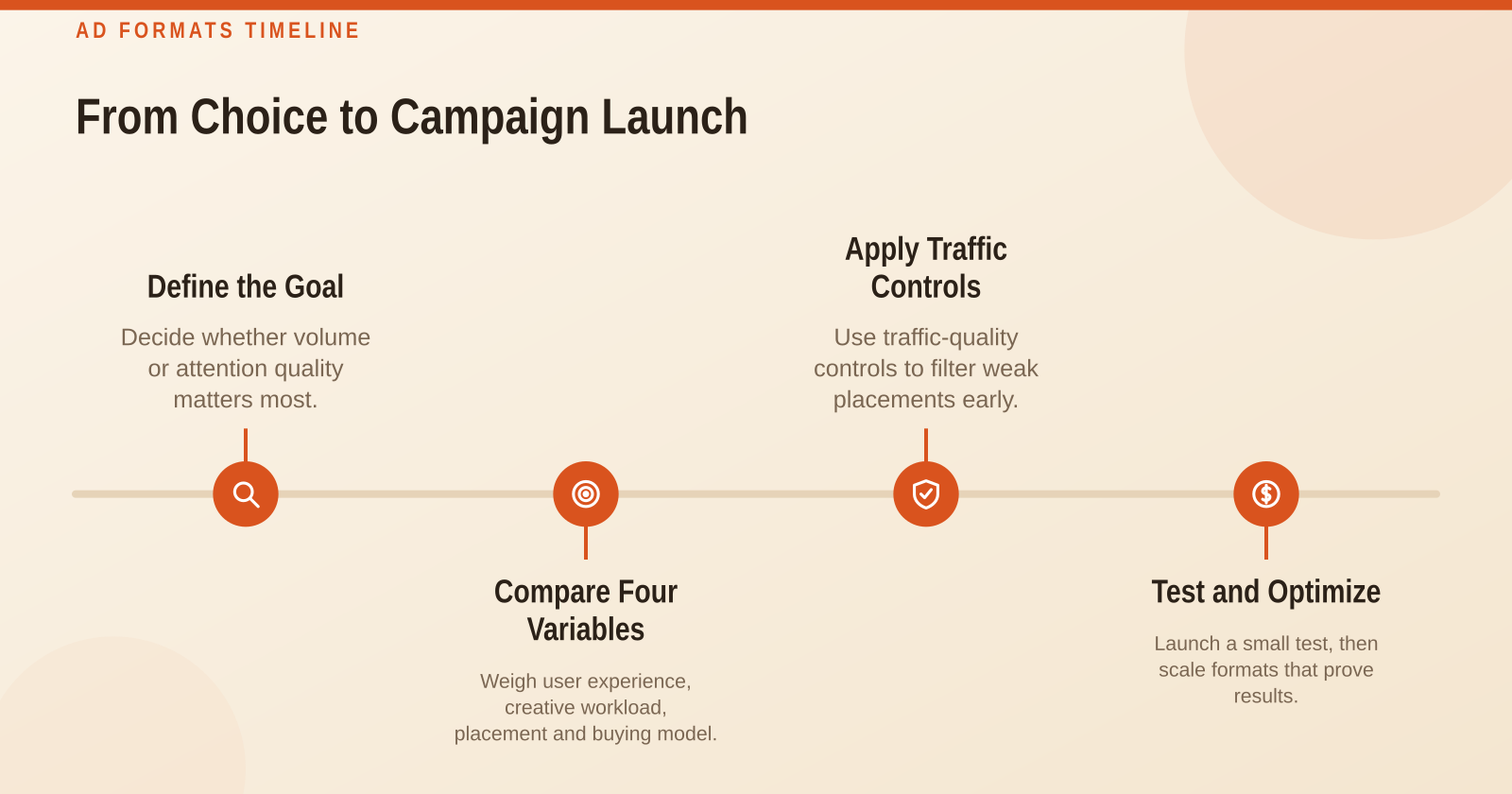
The decision process works best as a sequence rather than a single judgment. The first step is to define the business outcome precisely. Awareness, leads, app installs, sales and retention each imply different formats and different measurement. A campaign aiming for installs will weigh push and interstitials differently from a campaign aiming for leads through content, and a campaign aiming for retention may be better served by push than by any acquisition-oriented format.
The second step is to match the outcome to format strengths and to the user-experience tolerance of the audience. If the offer requires a considered decision, native or video may give the user enough context to act. If the offer is time-sensitive and the audience has opted in, push may be the strongest option. If the goal is recall for a brand the user already knows, display banners may be sufficient. The point is to let the outcome narrow the field before the budget is considered.
The third step is to assess creative capacity and refresh frequency. A format that the team cannot produce, localize and refresh on schedule is not a real option regardless of its theoretical strengths. Buyers should estimate the number of assets each shortlisted format requires and compare that number with what the team can deliver in the launch window and sustain over the campaign.
The fourth step is to pick a buying model that aligns with measurable goals. The model should reward the action that is closest to value and should be supported by tracking that can confirm the action. If the tracking cannot confirm conversions, a conversion-based model should be deferred until the measurement is in place.
The fifth step is to run a controlled test with two or three formats before scaling. The test should have a single hypothesis, a fixed budget, explicit exclusions, frequency caps and a review checkpoint. At the checkpoint, the buyer compares formats on the same outcome and the same time window, and only then decides where to concentrate spend.
The following criteria are useful for scoring each shortlisted option consistently:
- Reach potential at the budget under consideration
- Expected cost per outcome, based on the buying model and any prior data
- Creative production effort and refresh requirements
- Brand and user-experience risk, including frequency sensitivity
- Scalability, meaning how much budget the format can absorb before quality declines
- Measurement readiness, including whether the outcome can be tracked reliably
Where a platform such as digital ad formats fits into this comparison, it should be evaluated the same way as any other option: against these criteria, using the same test structure and the same outcome. A self-serve platform that offers push, native, display and pop units across a large supply base can be a practical way to run the controlled test described above, provided the buyer confirms that the inventory, reporting and controls meet the standards the rest of the comparison demands.
Common Mistakes and How to Avoid Them
The most frequent error is choosing a format by its lowest CPM and ignoring post-click quality. A cheap impression that leads to a bounce is not a bargain, and buyers who measure only cost at the top of the funnel often discover that their cheapest inventory produces the weakest customers. The remedy is to include a quality measure, such as engagement depth or primary action completion, in the evaluation from the start.
The second mistake is launching without frequency caps. Interruptive formats in particular can damage trust and brand perception quickly, and the damage is slow to reverse. A buyer who sees short-term volume and removes caps to chase it is usually trading future reach for present delivery. Setting caps before launch, and reviewing frequency distribution during the test, prevents this.

The third mistake is underestimating creative refresh needs and running tired assets for weeks. Fatigue appears as rising frequency with falling click-through and rising cost, and buyers who do not monitor these signals often attribute the decline to the market rather than to the creative. A scheduled review of fatigue indicators, with a pre-approved refresh plan, keeps performance from drifting.
The fourth mistake is testing too many variables at once and reading noise as a result. When a campaign changes the format, the audience, the offer and the landing page simultaneously, no single change can be credited with the outcome. Testing one variable at a time, or deliberately grouping variables that are meant to move together, makes the result interpretable.
The fifth mistake is ignoring placement and inventory reports until performance drops. By then, the poor-quality sources have already consumed budget and the data needed to explain the decline may be harder to reconstruct. Reviewing source and placement reports on a regular schedule, and acting on them, is far less costly than diagnosing a failure after the fact.
The sixth mistake is scaling a format before validating the landing experience and conversion path. A campaign can deliver strong clicks and still fail if the destination loads slowly, repeats a different promise or hides the call to action on mobile. Validating the full path from ad to outcome before increasing budget ensures that the traffic being bought can actually convert.
What the Target Site Helps Users Accomplish
Readers who arrive at the platform's ad formats page can carry out several practical tasks. They can compare formats side by side, reviewing how push, native, display, pop and related options differ in their delivery and requirements. They can review format requirements to understand what assets, specifications and campaign structures each one involves, which is the information a creative team needs to estimate workload. They can review buying models to see how cost is structured and which model fits their objective.
These capabilities translate into concrete outcomes. A buyer can shortlist formats for a campaign brief by applying the criteria in this article against the platform's documented options. A planner can estimate creative resources by reading the requirements for each shortlisted format and comparing them with the team's capacity. A performance marketer can set up a test structure with a defined number of formats, a fixed budget and explicit controls, using the buying models to match the test objective.
The useful question for any reader is whether the platform's format options match a given campaign objective and budget. The answer depends on the outcome, the audience's tolerance for interruption, the creative capacity available and the measurement the team can support. A format that fits a retention campaign may be the wrong choice for an acquisition launch, and a format that delivers reach cheaply may not justify its cost if the audience cannot be converted. Reading the platform's options through this framework lets the buyer decide whether they fit before any budget is committed.
Conclusion: Applying the Comparison to Your Next Campaign
The comparison of ad formats comes down to four connected decisions. First, define the business outcome and let it narrow the field, because a format is only useful relative to what it is meant to achieve. Second, assess user-experience tolerance and creative capacity together, since an audience-appropriate format that the team cannot produce or refresh is not a real option. Third, choose a buying model that places risk where it belongs and that the tracking can support. Fourth, validate with a controlled test of two or three formats, reviewing sources, frequency and the full path to the outcome before scaling.
Before the next campaign brief is approved, check a few points. Confirm that the target outcome is written down in measurable terms and that the measurement can confirm it. Confirm that each shortlisted format has been scored against reach, cost per outcome, creative effort, brand risk, scalability and measurement readiness. Confirm that frequency caps, exclusions and a review checkpoint are set before launch. Confirm that the landing page keeps the promise made in the ad and that the conversion path works on the devices the audience uses. A campaign that passes these checks is ready to test, and a test that is designed this way will tell you which format deserves the next dollar.