
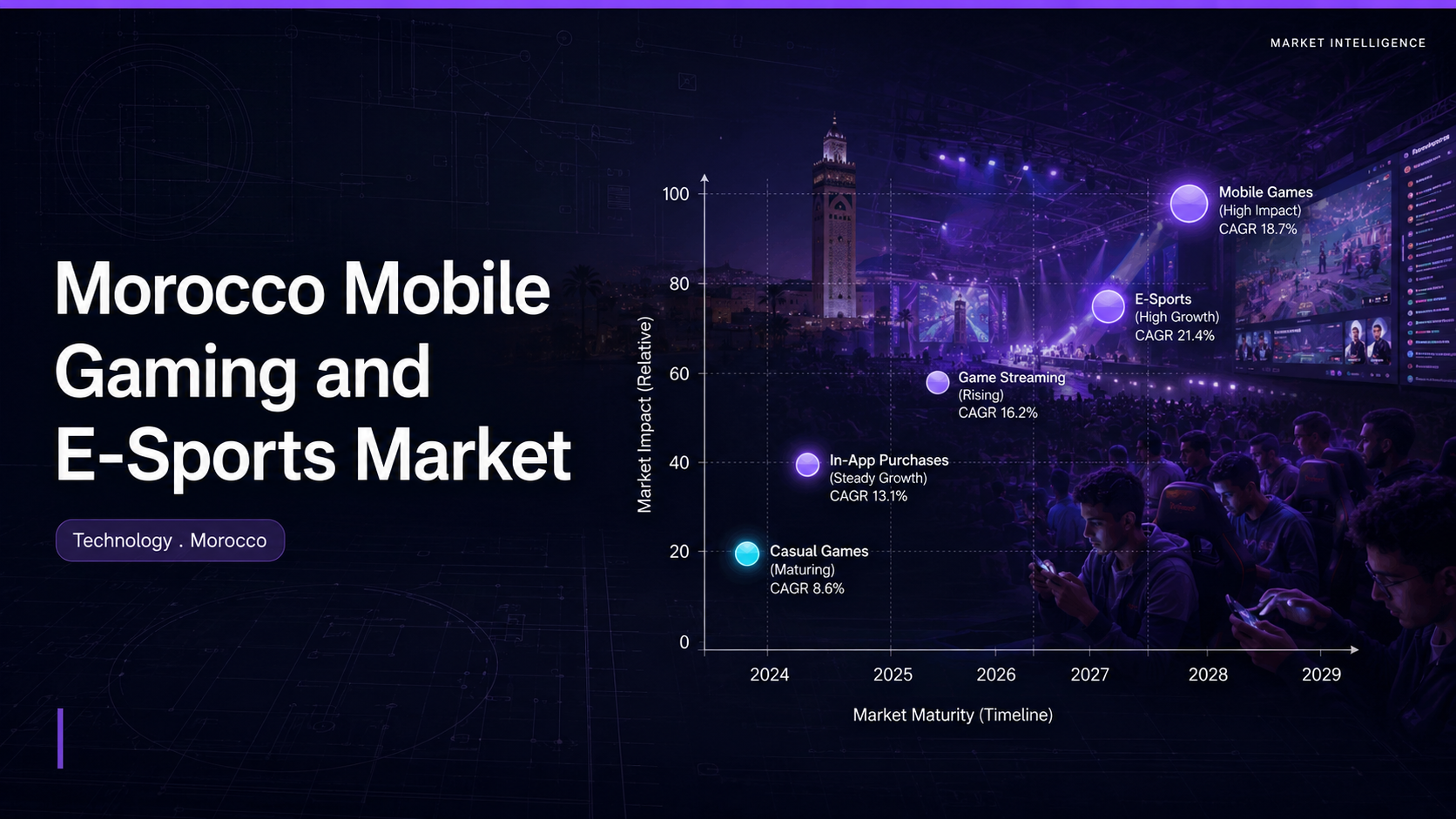
Morocco Mobile Gaming and E-Sports Market Outlook 2024-2030: Growth and Players
Executive Summary
Morocco's mobile gaming and esports market is scaling on a young population and state-backed digital strategy. Smartphone adoption, telecom investment, and a structured esports scene are pushing the sector from about USD 277 Million in 2024 toward roughly USD 1 Billion by 2030, one of the region's fastest trajectories.
Key Market Velocity Data
- Current Market Value: about USD 277 Million in 2024
- Projected Market Value: around USD 1 Billion by 2030
- CAGR: about 24% during 2025 to 2030
- Dominant Device: smartphones, with penetration near 70% and 25 million users
- Primary Growth Catalyst: a young population and state digital strategy
What Is Driving Demand in the Morocco Gaming Market?
Demand is young, mobile, and connected. Over 50% of Morocco's population is youth, smartphone penetration nears 70% with about 25 million users, and internet penetration exceeds 70% as broadband subscriptions grow about 15% a year. The gaming sector reached roughly USD 277 Million in 2024 and targets USD 1 Billion by 2030. Affordable mobile data and a mobile-first culture make smartphones the default gaming device.
- Demographics: youth make up over 50% of the population, fueling mobile-first adoption.
- Connectivity: smartphone penetration near 70% reaches about 25 million users.
- Broadband growth: internet access above 70% expands about 15% annually.
- Ambition: the sector targets USD 1 Billion in annual revenue by 2030.
How Do Policy and Regulation Shape the Market?
State strategy is the accelerant. Maroc Digital 2030, launched in September 2024 with about USD 1.1 Billion in funding, targets 240,000 digital jobs and a USD 10 Billion GDP contribution, lifting the gaming ecosystem (Maroc Digital 2030). Developer tax incentives arrived in 2023. The strategy also funds digital-skills training for 100,000 students and professionals by 2030.
Licensing sets the guardrails. The Ministry of Culture and Communication oversees game licensing and age restrictions, with an average approval timeline of about 6 months. This favors funded studios and compliant operators, while the Royal Moroccan Federation of Electronic Games formalizes the competitive scene. A clearer licensing path is drawing foreign studios to set up locally.
Which Companies Are Shaping the Competitive Landscape?
Telecom operators are the ecosystem builders. Orange Morocco became the first operator to sponsor a national esports team, backing Team xProjekt, which fields 29 players across 7 teams in 5 games, and funds the Orange eSport Scholarship and eBotola tournament. Inwi launched Morocco's first professional league across 8 flagship titles. This sponsorship turns esports into a mainstream youth spectacle, with prize money rising across regional events.
Global studios anchor content. Maroc Telecom completes the telecom trio, while Gameloft and Ubisoft Morocco run development studios locally, and TchouTchou Games, Playtika, and Tactile Games supply casual and mobile titles. The split runs between telecom-led esports infrastructure and studio-led game supply. Local development talent is deepening as studios expand Casablanca and Rabat teams.
What Does This Mean for B2B Decision-Makers?
For studios, telecoms, and investors, Morocco is an early, fast-scaling market where ecosystem position now decides margin. With the sector targeting a move from about USD 277 Million toward USD 1 Billion by 2030 at roughly 24% CAGR, the upside is large, but localization and licensing define who captures it. First movers on local leagues will own audience and sponsorship pipelines.
- For studios: localize mobile titles for a youth base exceeding 50% of the population.
- For telecoms: build esports leagues, as Orange and Inwi already structure the scene.
- For investors: ride Maroc Digital 2030, a USD 1.1 Billion state digital push.
- For developers: use the 2023 tax incentives to set up local studios.
Which Segments and Platforms Lead the Morocco Gaming Market?
Segment economics favor mobile free-to-play and casual gaming, with esports as the high-growth layer. Action, strategy, and sports titles lead engagement, casual gamers dominate the user base, and competitive and professional esports scale fastest. Free-to-play with in-app purchases is the core monetization model across smartphones. Esports viewership is steadily converting casual players into competitive participants, with sports and strategy titles leading competitive play.
- Device mix: smartphones dominate at about 70% penetration, with tablets a smaller tier.
- User base: casual gamers lead, while competitive esports players drive depth.
- Monetization: free-to-play with in-app purchases anchors revenue.
Ken Research Strategic Outlook
The decisive lever in Morocco gaming is state strategy plus telecom investment, not organic demand alone. As Maroc Digital 2030 funds skills and infrastructure, margin will migrate toward operators and studios that build local esports ecosystems and licensed content. Expect Orange and Inwi to anchor the competitive layer while global studios localize, pushing the sector toward its USD 1 Billion target. Rural connectivity gaps remain the main constraint on the next user wave.
Data Source and Full Analysis
For deeper segment-level analysis, access the full Ken Research report here: Morocco Mobile Gaming and E-Sports Market Report