
Office network performance rarely fails because of one dramatic event. More often, it erodes slowly. Video calls start breaking up in one meeting room. File transfers take longer than they should. Wireless access points look fine on paper but still feel inconsistent in daily use. A new VoIP phone system goes in, then someone discovers the existing cable plant was never designed for the power and bandwidth now riding over it. By the time these issues become obvious, the business has usually already paid for them in lost time and user frustration.
That is where CAT6 cabling earns its reputation. In many offices, it offers a practical balance of performance, durability, and cost, especially when compared with aging cable infrastructure. It supports modern network speeds more reliably than older categories, handles power delivery better, and gives IT teams room to grow without jumping straight to the higher cost of CAT6A cabling everywhere.
I have seen this play out in real office environments, from small professional suites with a single network closet to multi-floor tenant spaces where every move, add, and change exposed old shortcuts in the cabling. The difference between a network that merely functions and one that consistently performs often starts behind the walls, above the ceiling grid, and inside the rack.
The network is only as strong as its physical layer
Businesses tend to focus on visible hardware first. They buy newer switches, better firewalls, faster internet service, and enterprise-grade wireless access points. Those upgrades matter, but the physical layer sets the ceiling. If the network cabling is outdated, poorly terminated, or inconsistently installed, it becomes the hidden bottleneck under everything else.
CAT6 cabling improves that foundation in several important ways. It is designed for higher performance than CAT5e, with tighter specifications for crosstalk and signal integrity. In plain terms, it does a better job preserving data quality as traffic moves through the cable. That matters in an office where dozens or hundreds of devices are active at the same time, not just desktop PCs but phones, printers, cameras, access points, smart displays, badge readers, and conference room systems.
When businesses invest in structured cabling correctly, they are not just paying for cable. They are paying for predictable performance, easier troubleshooting, and a network that can keep up with daily operations.
What CAT6 actually changes in day-to-day office use
On a spec sheet, CAT6 is commonly associated with Gigabit Ethernet and, over shorter distances, support for higher speeds in the right conditions. For many offices, that translates into a more stable and capable environment for common workloads rather than some dramatic leap users can point to in a single moment.
The effect shows up in accumulated friction, or the lack of it. Large files move faster between workstations and servers. Docking stations and VoIP phones behave more consistently. Access points can operate without the same concerns about marginal cabling links. Users stop opening tickets that begin with, “It was fine yesterday, but today the connection keeps dropping.”
That last point matters more than many business owners realize. Intermittent network problems are expensive because they are hard to diagnose. A failed switch port is obvious. A bad patch panel termination, a run bent too tightly above the ceiling, or a cable installed too close to electrical interference can consume hours of labor before anyone isolates the cause. Quality CAT6 cabling installation reduces those gray-area problems.
Why CAT6 is a strong fit for modern office bandwidth
Most https://cablewiring829.iamarrows.com/how-low-voltage-cabling-integrates-it-and-building-technology office work does not require extreme bandwidth on every endpoint, but modern business traffic is heavier than it was even five years ago. Cloud applications refresh constantly. Teams upload and download media files. Security cameras stream continuously. Video conferencing has become standard, and those platforms punish weak or unstable links quickly.
CAT6 cabling supports 1 Gbps to the full standard channel distance of 100 meters when properly installed and tested. That alone is enough to improve many older office network cabling environments still relying on CAT5 or aging CAT5e runs that were installed years ago under looser standards or rougher conditions. In the right shorter-run scenarios, CAT6 can also support 10 Gigabit Ethernet, which is useful for uplinks, high-performance workstations, or specialized departments like design, engineering, and media production.
I have worked on offices where staff assumed their internet connection was the problem because uploads felt slow and shared folders lagged. The ISP circuit was fine. The actual issue was a patchwork of older data cabling, hand-crimped terminations, and unlabeled runs tied together over time by different vendors. Once those links were replaced with tested CAT6 cabling and organized patching, the network felt entirely different, even though the internet service had not changed.
Better crosstalk control, better signal quality
One of the technical reasons CAT6 performs better is its improved resistance to crosstalk. Crosstalk happens when signal from one wire pair interferes with another. In a busy office environment with dense cable bundles, poor separation, and multiple active devices, that interference can create errors, retransmissions, and unstable performance.
CAT6 cable is built to tighter standards than older categories, often including a spline separator or other construction features depending on manufacturer and model. The result is cleaner signal transmission and more headroom. That headroom matters because real-world offices are not laboratory spaces. Cable routes are rarely perfectly straight. Ceiling spaces are crowded. Closets run warm. Cables get moved and repatched over the years.
The more margin built into the cable plant, the more resilient the office network tends to be under real use.
Power over Ethernet raises the stakes
A decade ago, many office cable drops only carried data. Today, low voltage cabling often carries both data and power through Power over Ethernet, or PoE. That changes the demands on the cable system significantly.
Wireless access points, IP phones, security cameras, occupancy sensors, digital signage, and access control devices all rely on ethernet cabling to deliver stable connectivity and electrical power. CAT6 cabling generally handles these applications better than older cable categories, especially in denser deployments where bundle heating and insertion loss need to be taken seriously.
This is one of the less glamorous but more important reasons businesses upgrade. A new Wi-Fi deployment can look disappointing if the access points are connected over marginal legacy cabling. The AP itself may support advanced throughput, but if the cable run introduces errors, power instability, or negotiation issues, users feel the consequences right away. Good office network cabling gives the wireless layer a fair chance to perform.
The role of installation quality cannot be overstated
Cable category matters, but workmanship matters just as much. I have seen CAT6 installations underperform because the cable was kinked, untwisted too far at terminations, bundled too tightly with zip ties, or routed carelessly near fluorescent lighting ballasts and power infrastructure. I have also seen well-installed CAT5e outperform badly installed CAT6 in a limited environment.
That is why network cabling installation should never be treated as a simple commodity purchase. A proper business network installation includes planning, pathway management, labeling, testing, documentation, and attention to standards. If any one of those pieces is missing, the office may inherit future downtime that far exceeds the amount saved upfront.
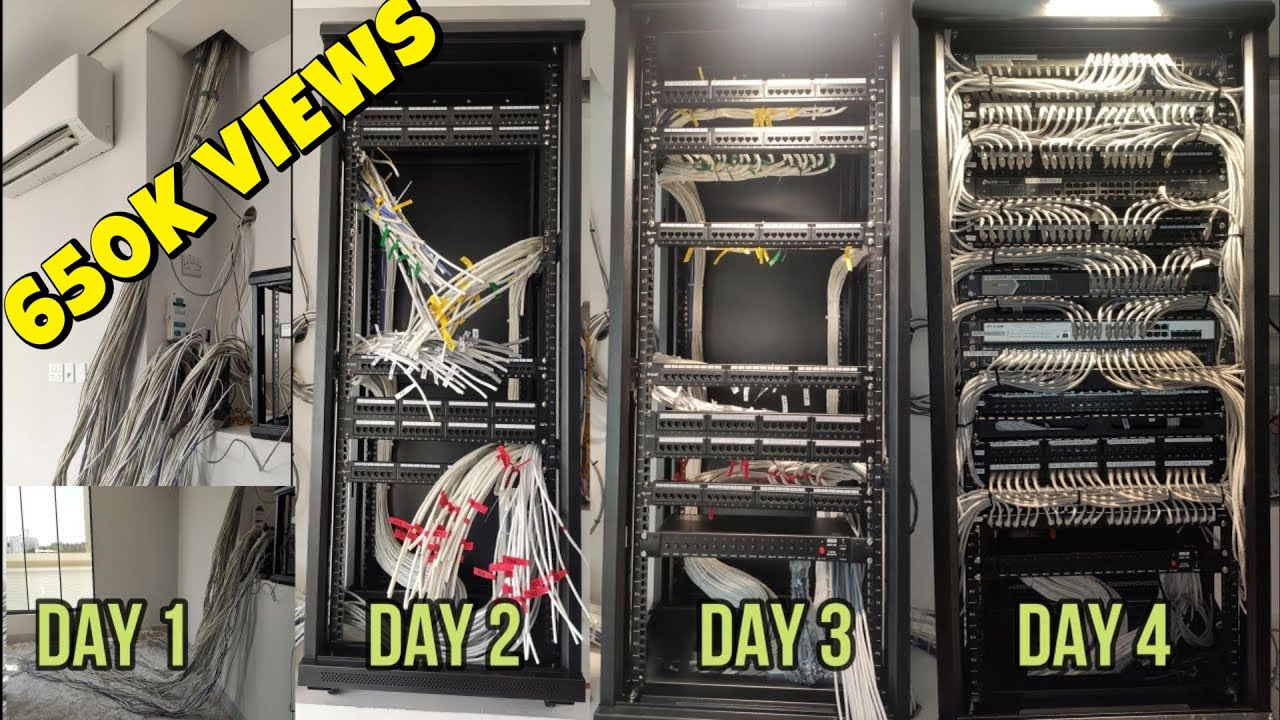
A clean structured cabling job usually includes the right cable support, thoughtful rack layout, properly dressed patch panels, tested permanent links, and clear port labeling from the work area to the closet. Those details are not decorative. They reduce troubleshooting time, simplify expansions, and help the next technician avoid disrupting active services.
One law office I visited had a persistent conference room issue where laptops would drop off the dock intermittently during client presentations. The room had already seen a dock replacement, a switch replacement, and two service calls focused on software. The actual culprit was a poorly terminated horizontal cable in the wall, installed during a remodel. The fix took less than an hour. Finding it took much longer because the original data cabling had never been tested or documented properly.
CAT6 versus CAT6A, where each makes sense
Businesses often ask whether they should skip straight to CAT6A cabling. The answer depends on the environment, the length of runs, the budget, and the expected applications.

CAT6A cabling is designed for more reliable 10 Gigabit Ethernet over the full 100-meter channel and offers improved alien crosstalk performance. It is an excellent choice for high-density spaces, demanding wireless deployments, larger enterprise environments, and organizations planning for substantial future bandwidth at the edge. It is also thicker, stiffer, and usually more expensive in both materials and labor.
CAT6 cabling remains a strong option for many offices because it covers current needs well without the same installation burden. In a typical business setting with standard workstation drops, VoIP phones, printers, and many wireless access point locations, CAT6 often delivers the best value. The office gets robust Gigabit performance, PoE support, and some room for higher-speed use cases, especially on shorter runs.
The practical decision often comes down to design. Some companies deploy CAT6A cabling selectively for backbone segments, high-performance endpoints, or access point locations expected to need more throughput later, while using CAT6 for general user areas. That kind of mixed approach can make sense when it is planned well and documented clearly.
Where office performance improves most visibly
The gains from CAT6 are not always flashy, but they are real. They tend to show up in a few consistent places.
- Faster, steadier file access for local servers, NAS devices, and shared storage More reliable VoIP calling and fewer intermittent desk phone issues Better support for modern wireless access points powered over Ethernet Cleaner performance for video conferencing rooms and collaboration spaces Less troubleshooting caused by aging or inconsistent cable runs
Each of those points translates into labor savings. If employees stop losing five or ten minutes at a time to dropped calls, reconnecting docks, or sluggish access to shared resources, the annual value adds up quickly. Network reliability is one of those business assets people only notice when it is missing.
Structured cabling supports growth better than patchwork fixes
Many offices do not suffer from one bad cable. They suffer from years of improvisation. One vendor installs phones, another adds cameras, someone else runs a quick drop during a renovation, and over time the rack becomes a tangle of undocumented connections and unlabeled patch cords. Performance issues become harder to isolate because the environment itself is no longer coherent.
Structured cabling solves that by treating the network as infrastructure instead of a series of isolated fixes. Horizontal runs are terminated consistently. Patch panels are labeled. Closet layouts support airflow and access. Pathways are planned instead of improvised. Future changes become manageable rather than risky.
When a business expands, reorganizes teams, or adds new systems, that order matters. A well-planned office network cabling system lets IT teams make moves quickly without guessing which port serves which office or whether a run was ever tested to standard. That operational efficiency is one of the least advertised but most valuable benefits of a proper structured cabling approach.
Performance depends on the whole channel, not just the cable in the wall
It is tempting to think of CAT6 as a single product, but the performance of an ethernet cabling link depends on the whole channel. The horizontal cable, patch panels, keystone jacks, patch cords, and switch connections all play a role. One weak component can drag down the link.
That is why quality materials and consistent compatibility matter. Mixing unknown components, bargain patch cords, and inconsistent terminations can undermine an otherwise solid design. In offices with strict uptime needs, I generally prefer systems that use reputable components end to end and are tested after installation. A certification report is not paperwork for its own sake. It is proof that the data cabling performs as intended before users depend on it.
This is also where ongoing maintenance comes in. Even a strong installation can deteriorate if racks are repatched carelessly over time, cable management is ignored, or furniture moves put strain on workstation terminations. Good physical infrastructure still needs discipline.
The hidden cost of staying with outdated cabling
Businesses sometimes delay cabling upgrades because the existing network still “works.” That can be true in the narrowest sense and still expensive in practice. Older or marginal cable plants tend to create soft costs rather than obvious failures. Users adapt. IT spends time chasing random link problems. New systems take longer to deploy because no one trusts the underlying cable. Conference rooms gain a reputation for being unreliable, so staff avoid them or waste time testing before important meetings.
Those costs rarely appear as a single line item, which is why they are easy to overlook. But when a company is planning a remodel, office expansion, or technology refresh, that is usually the right moment to address the physical layer. Pulling new CAT6 cabling during open-wall construction or planned tenant improvements is far more efficient than doing it later through piecemeal after-hours work.
I have seen companies spend thousands on wireless tuning and conference room upgrades when the better investment would have been a cleaner low voltage cabling backbone. You can only optimize around bad cabling for so long.
What to consider before a CAT6 upgrade
A successful upgrade starts with honest assessment. Not every office needs a complete rip-and-replace, and not every existing run is a problem. The right scope depends on age, condition, application mix, and growth plans.
- The age and category of the current cable plant Whether existing runs support current PoE and bandwidth demands The number of new devices expected over the next three to five years Closet condition, labeling quality, and available rack space Whether some areas would benefit more from CAT6A cabling instead
Those questions help shape the design. In some offices, the right answer is full replacement. In others, it is targeted replacement in high-value areas such as conference rooms, wireless access point locations, and spaces with repeated support issues. A professional site survey and testing pass usually reveals more than assumptions do.
Why CAT6 remains the practical standard for many businesses
There is a reason CAT6 cabling shows up so often in commercial projects. It is not hype. It solves common office problems with a sensible balance of capability and cost. For many businesses, it delivers the performance needed for everyday operations, cloud applications, voice, video, and PoE devices without pushing the budget and installation complexity of CAT6A into every corner of the floor plan.
That balance matters in real projects. Budgets are finite. Office buildouts move on deadlines. Tenants need networks live before staff arrive. In that environment, good decisions are usually the ones that pair solid technical performance with manageable installation and long-term maintainability. CAT6 fits that brief well.
When installed as part of a disciplined structured cabling system, it improves more than raw throughput. It improves consistency. It reduces weird, time-consuming faults. It gives IT teams a more trustworthy physical layer. And it supports the technologies offices actually depend on now, from VoIP and cloud access to Wi-Fi, security, and collaboration tools.
For businesses evaluating network cabling, it helps to think beyond cable category as a simple product choice. The real question is whether the office has a physical network foundation strong enough for the way people work. In many cases, CAT6 is the upgrade that moves an organization from merely connected to reliably productive.
Fontana Tech Pros provides professional network cabling installation, structured cabling, fiber optic installation, commercial WiFi, access control, security camera installation, alarm systems, and phone system solutions for businesses throughout Southern California. Learn more at https://fontanatechpros.com/.
Fontana Tech Pros specializes in reliable network cabling solutions for commercial offices, warehouses, schools, and industrial facilities. Our experienced team delivers high-quality structured cabling and low-voltage installations designed for long-term performance.