
The 312-40 exam format is simple to state: 125 multiple-choice questions, 4 hours, and a 70% score to pass. You sit it through the EC-Council Exam Portal, and it leads to the Certified Cloud Security Engineer (CCSE) credential.
What makes the format interesting is not the numbers on their own but what they ask of you. Four hours is a long sitting, 125 questions is a lot of reading, and the content runs across three cloud providers at once. This post breaks the format down into a pacing plan, shows how the 11 course modules turn into a study grid, and lists the mistakes that cost candidates the most time. Every exam figure here was read on EC-Council's own CCSE page on 28 November 2026.

What is the 312-40 exam format?
The 312-40 exam is a single multiple-choice test of 125 questions with a 4-hour time limit. The EC-Council Certified Cloud Security Engineer page lists the details in its "About the Exam" tab:
- Exam title: Certified Cloud Security Engineer
- Exam prefix: 312-40 (ECC EXAM)
- Number of questions: 125
- Test duration: 4 hours
- Test format: multiple choice
- Test delivery: EC-Council Exam Portal
- Passing score: 70%
EC-Council describes CCSE as a multi-cloud security certification. Its selling point is the blend: vendor-neutral ideas such as the shared responsibility model and governance frameworks, mixed with vendor-specific skills for Amazon Web Services, Microsoft Azure and Google Cloud. The official training runs for 5 days and includes more than 85 labs.
One thing the page does not list is the exam fee. The price depends on how you buy the exam, for example with official training or as a separate voucher, so confirm it with EC-Council or an accredited training center before you plan your budget.
How much time do you get per 312-40 question?
You get about 1 minute and 55 seconds per question. Four hours is 240 minutes, and 240 divided by 125 is 1.92 minutes.
That sounds generous, and for short recall questions it is. The catch is that cloud security questions are often scenarios. A question may describe an organization, its cloud provider, a misconfigured storage bucket and a compliance goal, and then ask for the best control. Reading that carefully takes a full minute before you even look at the options.
A pacing plan stops one hard question from eating ten minutes. These checkpoints are our own suggestion, not EC-Council guidance:
- By 60 minutes: about question 32.
- By 120 minutes: about question 63, the halfway mark.
- By 180 minutes: about question 94.
- Last 15 to 20 minutes: return to the questions you flagged.
If you are well ahead at the first checkpoint, do not speed up. Use the spare minutes to reread scenario questions, because most wrong answers in cloud exams come from missing one word such as "least", "first" or "most cost-effective".
What does the 70% passing score mean in questions?
A 70% pass mark on 125 questions works out to 87.5, so aim for at least 88 correct answers. That leaves room for about 37 wrong answers.
EC-Council states the pass mark only as a percentage, so treat 88 as a planning number rather than an official count. The useful lesson is the size of the margin. You can miss more than one question in four and still pass, which means you do not need to master every provider-specific detail. You do need steady accuracy across all 11 modules, because a weak area that covers a tenth of the exam is hard to make up elsewhere.
Which 11 modules does the 312-40 exam cover?
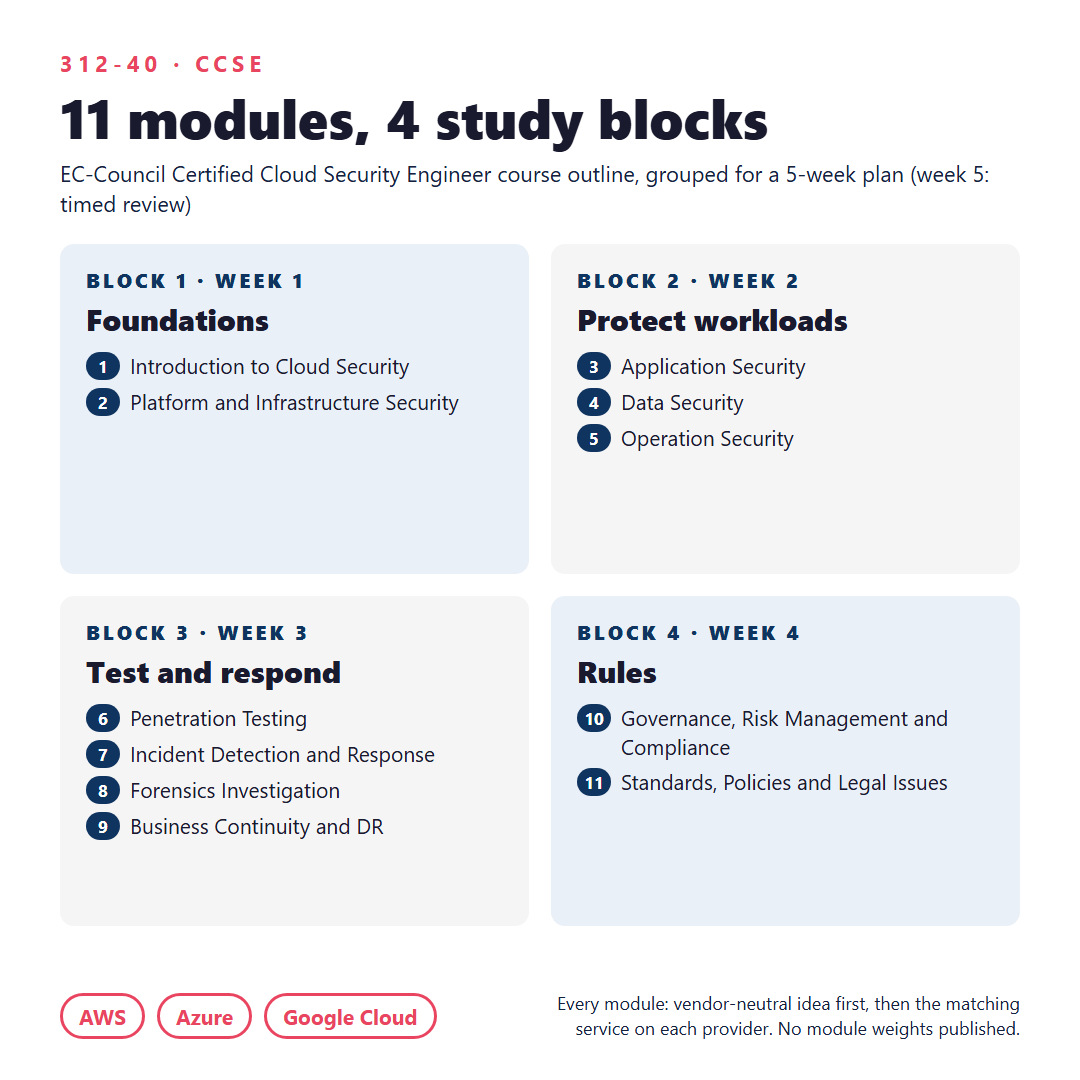
The CCSE course outline has 11 modules, and the exam questions are drawn from them. EC-Council does not publish a weight for each module, so plan to give every module real attention. We find it easier to study them in four blocks:
Block 1, foundations (modules 1 and 2)
- Module 1: Introduction to Cloud Security
- Module 2: Platform and Infrastructure Security in the Cloud
Block 2, protecting what runs in the cloud (modules 3 to 5)
- Module 3: Application Security in the Cloud
- Module 4: Data Security in the Cloud
- Module 5: Operation Security in the Cloud
Block 3, testing and responding (modules 6 to 9)
- Module 6: Penetration Testing in the Cloud
- Module 7: Incident Detection and Response in the Cloud
- Module 8: Forensics Investigation in the Cloud
- Module 9: Business Continuity and Disaster Recovery in the Cloud
Block 4, rules and accountability (modules 10 and 11)
- Module 10: Governance, Risk Management, and Compliance in the Cloud
- Module 11: Standards, Policies, and Legal Issues in the Cloud
Each module covers the vendor-neutral idea first and then the services AWS, Azure and Google Cloud offer for it. That is why a three-column study grid works well: for every module, write down the concept and the matching service on each provider.
Module 5, operation security, also rewards real hardening practice on the virtual machines you run in the cloud. Linux hosts are common there, and our notes on measuring LPIC-3 303-300 security by its tools show the kind of host-level work that sits underneath the cloud controls.
Why does the shared responsibility model matter so much for 312-40?
The shared responsibility model is the idea that runs through almost every module, so it is worth learning first. It answers one question: which security tasks belong to the cloud provider, and which belong to you?
The AWS Shared Responsibility Model page puts it in two short phrases. AWS handles security "of" the cloud, such as the hardware and the facilities. The customer handles security "in" the cloud, such as data, identities and the configuration of each service.
For exam scenarios, this split is often the whole answer. When a question describes a leaked file, a weak password policy or an open firewall rule, the fix is almost always the customer's job, not the provider's.
Microsoft explains the same idea with a table that shifts as you move from on-premises to IaaS, PaaS and SaaS. Its guide to shared responsibility in Azure makes one point that suits exam scenarios well: whatever the service type, you always keep responsibility for your data, your endpoints, your accounts and access management.
The responsibility line moves with the service type. With a virtual machine (IaaS) you patch the operating system yourself; with a managed database (PaaS) the provider patches it, but you still decide who can connect and whether the data is encrypted.
Google Cloud adds a further layer it calls shared fate, where the provider also helps customers set up secure defaults. The Google Cloud page on shared responsibilities and shared fate is worth one careful read, because it shows how the three providers frame the same idea in slightly different words.
How should you prepare for the 312-40 exam in five weeks?
A five-week plan works for candidates who already know basic networking and security and have used at least one cloud console. The weeks follow the four study blocks, with one week for review.
- Week 1, foundations: modules 1 and 2. Build your three-column grid for service models, the shared responsibility model and network security services such as virtual private clouds and web application firewalls.
- Week 2, workloads: modules 3 to 5. Focus on identity and access management, key management, encryption at rest and in transit, and secure development practices. Practice reading an access policy and saying in one sentence what it allows.
- Week 3, testing and response: modules 6 to 9. Learn the incident response lifecycle in order, what SOAR automates, how logs such as AWS CloudTrail and Azure activity logs support an investigation, and how backup differs from disaster recovery.
- Week 4, governance: modules 10 and 11. Learn what ISO/IEC 27017, HIPAA and PCI DSS each care about, and which provider tools help with audits and compliance reports.
- Week 5, review and pacing: run timed sets of 30 to 35 questions at under two minutes each, then fill the gaps in your grid.
The forensics week often surprises people who have done on-premises investigation before. Cloud forensics adds problems such as shared hardware and short-lived instances. If network evidence is your weak point, our earlier GNFA exam preparation plan covers how to build that skill with hands-on lab work.
Keep your three-column grid as one living document through all five weeks. By the review week it should fit on a few pages, with one row per topic and a provider service in each column. Gaps in the grid show you exactly where to spend the last days.
When you want to check your readiness against the full 125-question format, the 312-40 CCSE practice exam on EduSum lets you rehearse the timing before exam day.
What does a typical 312-40 scenario look like?
A typical scenario gives you a small story and asks for the best next step. Here is one we wrote ourselves to show the shape, with the reasoning worked through. It is not taken from the exam.
A retail company keeps customer order files in cloud object storage. A routine review finds that one storage container can be read by anyone on the internet. The company must meet PCI DSS, and the security team wants to act quickly without breaking the order system.
Working through it:
- First, contain: remove the public access setting so no one else can read the files. This is the customer's task under the shared responsibility model, because the configuration is "in" the cloud.
- Then, investigate: check the access logs to see whether anyone outside the company read the files while they were public.
- Then, prevent: add a policy or guardrail that blocks public access on new storage, and turn on a configuration monitoring service that alerts on the same mistake.
- Finally, report: because card data may be involved, follow the incident process that PCI DSS requires.
Notice how one scenario touches four modules: data security, incident response, operation security and compliance. That is why the exam rewards a connected understanding rather than a list of memorized service names.
What are the most common 312-40 mistakes?
The most common mistakes come from studying one provider deeply and the other two only lightly. Watch for these:
- Studying only AWS. The exam covers AWS, Azure and Google Cloud. Learn the name of the matching service on each provider for every module.
- Skipping governance. Modules 10 and 11 look dry, but compliance frameworks appear in many scenarios.
- Mixing up backup and disaster recovery. A backup is a copy of data; disaster recovery is the plan and the capacity to keep running.
- Ignoring the word "first". In incident questions, containment usually comes before investigation and reporting.
- Losing time on one question. Flag it, move on and come back in the last 20 minutes.
The EduSum video below walks through a one-month way to prepare for the exam, which pairs well with the five-week plan above.
Frequently asked questions
1. How many questions are on the 312-40 exam?
The 312-40 exam has 125 multiple-choice questions, according to EC-Council's Certified Cloud Security Engineer page.
2. How long is the 312-40 exam?
You get 4 hours, which is 240 minutes. That is about 1 minute and 55 seconds per question.
3. What is the passing score for the 312-40 exam?
EC-Council states that you need to score 70% to pass. On 125 questions that is about 88 correct answers if every question counts the same.
4. Which cloud platforms does the 312-40 exam cover?
It covers Amazon Web Services, Microsoft Azure and Google Cloud, together with vendor-neutral cloud security concepts such as the shared responsibility model and governance frameworks.
5. How is the 312-40 exam delivered?
EC-Council lists the EC-Council Exam Portal as the test delivery method. Check the current booking options with EC-Council or your training center when you register.