
The DP-700 exam duration is 100 minutes. That is the time Microsoft gives you to answer the questions on Implementing Data Engineering Solutions Using Microsoft Fabric, and you should plan for about 120 minutes in the seat, because reading the instructions and accepting the candidate agreement come on top of the exam clock.
Those two numbers look simple, but the clock on DP-700 behaves in ways that catch people out. Five minutes of break time are already inside the 100. Microsoft Learn is open during the exam, yet every minute you spend searching it comes off the same timer. And once you leave a block of questions for a break, you cannot go back to it. This post explains how the time actually works and gives a minute-by-minute plan you can rehearse before exam day. Every exam figure below was read on Microsoft's own pages on 24 November 2026.

How long is the DP-700 exam?
You get 100 minutes to complete DP-700. The Fabric Data Engineer Associate certification page says it plainly: "You will have 100 minutes to complete this assessment." The exam is proctored, and Microsoft adds that it may include interactive components.
Microsoft separates two kinds of time:
- Exam duration: the time you have to answer questions. For DP-700 this is 100 minutes.
- Seat time: the time you should block out in your calendar. For associate and expert role-based exams without labs it is 120 minutes. It covers the instructions, the candidate agreement, the questions themselves and any comments you leave at the end.
Microsoft's general table also lists 120 minutes of exam time (140 in the seat) for role-based exams that may contain labs, and it does not publish which exams have labs. The time shown when you register and on the overview screens at launch is the one that counts, so read those screens carefully on the day.
How many questions are on DP-700?
Microsoft does not publish a fixed question count for DP-700. Its exam duration and exam experience page says most Microsoft certification exams contain between 40 and 60 questions, and that the number can vary from exam to exam and over time.
That range matters for pacing. At 40 questions you would have 2.5 minutes each; at 60 you would have about 1.7 minutes each, and that is before any break or lookup. Because you will not know the exact count until the exam starts, it is safer to practise at the faster rate. If your exam turns out shorter, the spare minutes go into review.
Question styles vary too. Microsoft's own samples include case studies, where you read a longer scenario and answer several questions about it, and problem-solution sets, where you judge whether a proposed fix would work. Case studies take far more reading time than a single multiple-choice item, which is why a flat "minutes per question" figure is only a starting point.
Does the clock stop for breaks or Microsoft Learn lookups?
No. The timer keeps running in both cases, and that is the single most important thing to know about the DP-700 exam duration.
Breaks. Five minutes are built into the exam time for unscheduled breaks; Microsoft removed questions from the exam to make room for them. You can take a break at almost any point, but not in the middle of a lab or inside a problem-solution set. When you start a break, every question you have already seen is locked, even if you left it blank or marked it for review. Breaks are allowed during a case study, but the same lock applies.
Microsoft Learn. During the exam you can open learn.microsoft.com in a split screen next to the question. Everything on that domain is available except the Q&A section, Practice Assessments and your own profile, and you can search inside a page with Ctrl+F. It is a real help for syntax you half remember. It is also the fastest way to lose ten minutes, because the exam clock does not pause while you read.
Treat Learn as a reference shelf, not a textbook. If you cannot find the answer within about a minute, flag the question, close the pane and move on.
How should you split the 100 minutes?
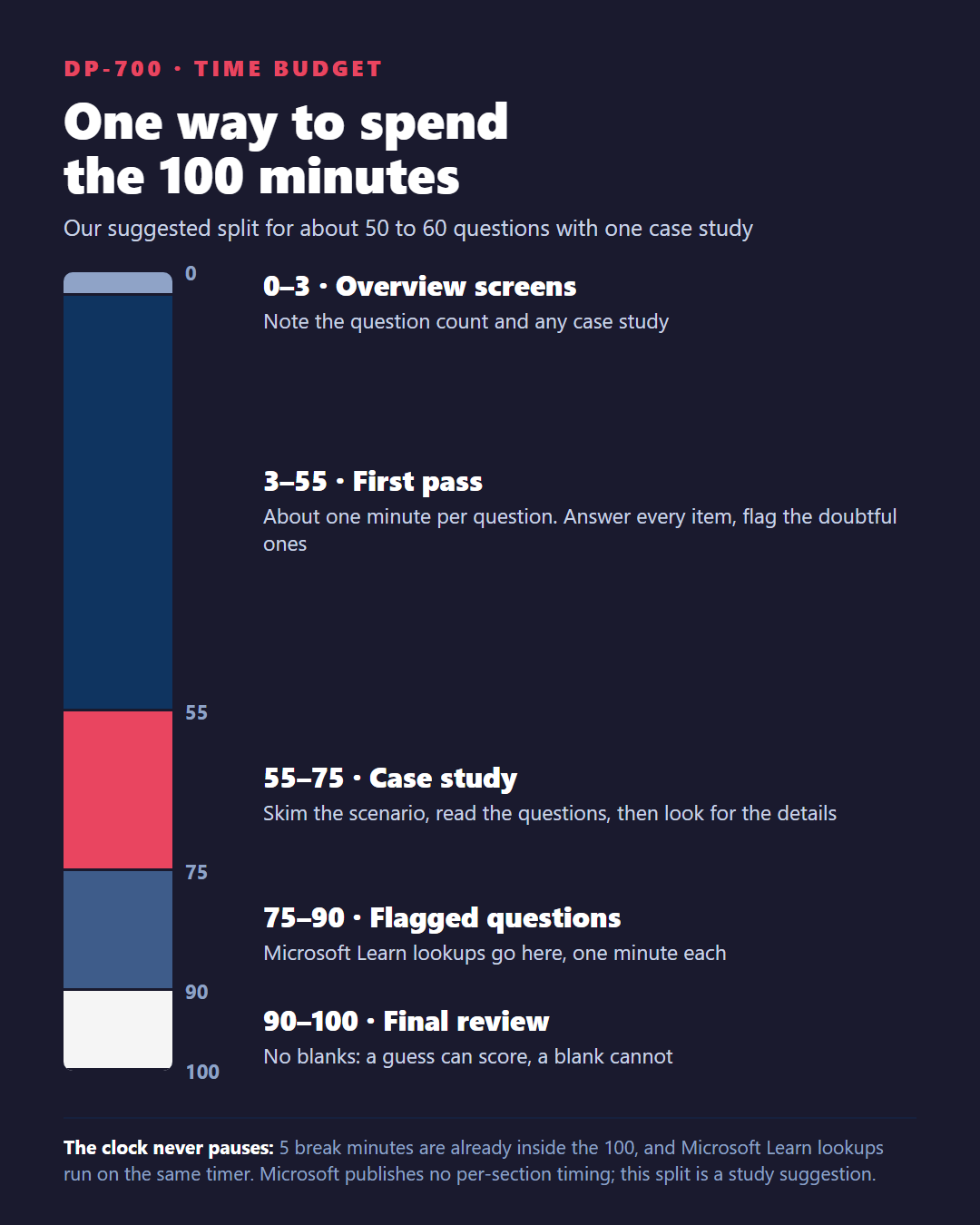
Microsoft publishes no per-section timing, so the plan below is our own suggestion. It assumes 50 to 60 questions including one case study, which sits in the middle of Microsoft's usual range. Adjust the blocks once you see the real count on the first screen.
- Minutes 0 to 3: read the overview screens. Note the question count, whether a case study is listed, and whether any section says you cannot return to it.
- Minutes 3 to 55: first pass through the standalone questions. Aim for about one minute each. Answer every question, even with a guess, and flag the ones you want to revisit.
- Minutes 55 to 75: the case study. Skim the scenario to see how it is organised, read the questions, then go back into the scenario for the details each question needs.
- Minutes 75 to 90: flagged questions. This is where Microsoft Learn lookups belong, one minute at a time.
- Minutes 90 to 100: final review. Check that nothing is blank. A blank answer cannot score; a reasoned guess can.
Notice that there is no break in this plan. If you need one, take it right after you finish a block and before you open the next, because any question you have seen is locked once the break starts.
What do the three skill areas mean for your pacing?
The DP-700 study guide lists three skill areas, each weighted at 30 to 35%:
- Implement and manage an analytics solution: workspace settings, version control, deployment pipelines, access controls, dynamic data masking, sensitivity labels and orchestration with pipelines and notebooks.
- Ingest and transform data: full and incremental loads, dimensional models, shortcuts, mirroring, batch transformation with PySpark, SQL and KQL, and streaming with eventstreams, Spark structured streaming and KQL windowing functions.
- Monitor and optimize an analytics solution: monitoring Fabric items and refreshes, alerts, fixing pipeline, dataflow, notebook, eventhouse, eventstream and T-SQL errors, and tuning lakehouse tables, warehouses, Spark and queries.
Because the three areas are close to equal, no single one can be skipped. What changes the pace is the type of reading each area asks for. Questions on ingestion and transformation often show code in PySpark, SQL or KQL, and the study guide's audience profile expects you to be comfortable in all three. If you read PySpark slowly, those questions will cost you more than a minute each, so practise reading short snippets until you can say what they return without running them.
The security items in the first area, such as row-level and column-level access and dynamic data masking, reward clear definitions more than long reading. They are good candidates for quick first-pass answers.
A worked timing scenario
Here is a situation we wrote ourselves to show the clock at work. It is not taken from the exam.
You are 40 minutes in and have answered 34 questions. The next item describes a lakehouse table that receives late-arriving rows every night and asks which load pattern keeps the table correct without reloading the whole history. You know it is an incremental pattern with a watermark, but you are unsure of the exact syntax option offered in one of the answers.
The slow route is to open Microsoft Learn, search for the feature, read two pages and compare. That can take five or six minutes. The better route is to choose the answer that matches the pattern you know, flag the question, and continue. In the flagged-question block, with the pressure lower, you open Learn, search once, and confirm or change the answer in about a minute. Same result, a fraction of the time, and no risk that a long lookup leaves the last ten questions unread.
A four-week plan that trains for the clock
This plan assumes you already work with Fabric or a similar data platform and can give it six to eight hours a week.
- Week 1: map the skills. Go through the study guide line by line and mark each skill as strong, partial or new. Build one small lakehouse and one pipeline so the terms are concrete.
- Week 2: the code. Spend most of the week on PySpark, SQL and KQL reading. Write short transformations that deduplicate, aggregate and handle missing values, then read other people's snippets and predict their output.
- Week 3: monitoring and tuning. Break things on purpose: a failing pipeline, a slow Spark job, a semantic model that will not refresh. Learn where each error shows up and what fixes it.
- Week 4: timed rehearsal. Take Microsoft's free Practice Assessment and try the exam sandbox so the interface holds no surprises. Then run at least two timed sessions of 100 minutes with Microsoft Learn open beside you, using the block plan above.
If you want the full topic list in one place alongside a practice exam, the EduSum DP-700 syllabus and preparation guide sets out every objective with sample questions.
What timing mistakes cost candidates the most?
Most time problems on DP-700 come from habits, not from hard questions.
- Using Learn as a study tool during the exam. Reading a whole article instead of searching for one term can swallow ten minutes.
- Taking a break in the wrong place. A break locks everything you have already seen, so a break taken halfway through a case study can strand questions you meant to revisit.
- Over-reading the case study. Reading every line of the scenario before looking at the questions doubles the time it needs.
- Leaving blanks for later. If time runs out, a blank scores nothing. Always put down your best answer on the first pass.
- Practising untimed. Knowing the content is not the same as knowing it at one minute per question.
Comparing exam formats can help you see this. Our breakdown of how the EC-Council ECES questions spread across its objectives shows a fixed-length exam, a useful contrast with Microsoft's flexible question count, where the overview screen is your first piece of timing information.
What if English is not your first language?
DP-700 is offered in English, Japanese, Chinese (Simplified), Chinese (Traditional), German, French, Italian, Korean, Spanish and Portuguese (Brazil). Candidates in Japan can therefore sit it in Japanese.
Two details are worth knowing. First, Microsoft updates localized versions about eight weeks after the English version changes, so if the skills have just been updated, the Japanese exam may briefly lag. Second, if the exam is not available in your preferred language, you can request an additional 30 minutes. That request goes through Microsoft's accommodation process, so make it before you book, not on the day.
The fee is set by the country or region where you take the exam, and Microsoft shows your local price when you register.
What happens if you run out of time or fail?
You need a score of 700 or more to pass. If you fall short, Microsoft's retake rules apply: you wait 24 hours before your second attempt, then 14 days between later attempts, with at most five attempts in 12 months.
Running out of time is a common cause of a near miss, which is another reason to rehearse the 100 minutes before the real attempt rather than after it.
Once you pass, the Fabric Data Engineer Associate certification has to be renewed every year. Renewal is a free, open-book online assessment on Microsoft Learn that you can take during a six-month window before it expires, and passing extends the certification by one year.
Watch: preparing for DP-700
This EduSum video walks through how to prepare for DP-700 and what to expect from the exam.
Frequently asked questions
1. How long is the DP-700 exam?
DP-700 gives you 100 minutes of exam time. Microsoft recommends planning for about 120 minutes of seat time for associate role-based exams without labs, which covers the instructions, the candidate agreement and optional comments.
2. How many questions are on the DP-700 exam?
Microsoft does not publish a fixed number for DP-700. It says most of its certification exams contain between 40 and 60 questions, and the count can vary.
3. Does the timer stop when I use Microsoft Learn or take a break?
No. The exam timer keeps running while you use Microsoft Learn and during breaks. Five minutes of break time are already built into the 100 minutes.
4. What is the passing score for DP-700?
You need a score of 700 or greater to pass DP-700.
5. Can I get extra time on DP-700?
If the exam is not available in your preferred language, you can request an additional 30 minutes. DP-700 is offered in ten languages, including Japanese. If you use assistive devices or need extra time for another reason, request an accommodation from Microsoft before you book.