
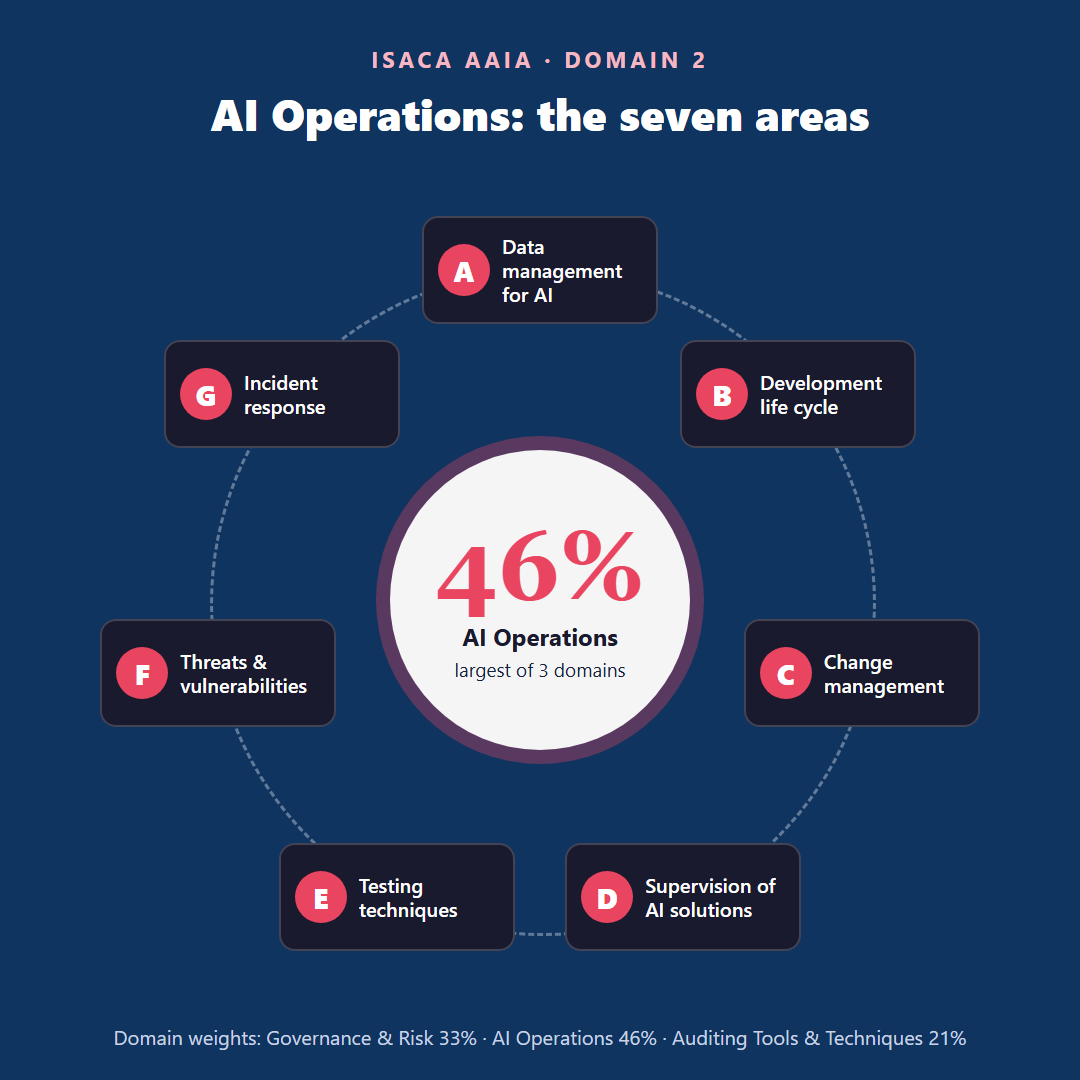
The AAIA AI Operations domain is Domain 2 of ISACA's Advanced in AI Audit exam, and it carries 46% of the exam, more than the other two domains. It tests whether an auditor can judge how AI systems are fed with data, built, changed, supervised, tested, attacked and recovered after an incident, across seven areas labelled A to G.
That weight surprises many candidates. Most people who sit AAIA are experienced IT auditors, so they expect the audit-techniques domain to be the big one. It is the smallest, at 21%. This post walks through the AI Operations domain area by area, shows what an auditor should be able to do in each, and gives a study plan that puts your hours where the questions are. Every exam figure below was read on ISACA's own pages on 19 November 2026.

What is the AAIA AI Operations domain?
AI Operations is the second of three domains on the AAIA exam, and it is the largest at 46%. The official AAIA exam content outline describes it as the domain that confirms your skill in assessing an organisation's risk profile and the rewards and consequences of AI, while making sure the organisation is operationally ready to adopt it.
The three domains and their weights are:
- Domain 1, AI Governance and Risk: 33%
- Domain 2, AI Operations: 46%
- Domain 3, AI Auditing Tools and Techniques: 21%
Put simply, Domain 1 asks whether the organisation has the right rules for AI, and Domain 3 asks how you audit it. Domain 2 sits in the middle and asks whether the AI actually runs safely day to day. If the weights translate directly into question counts, which ISACA does not promise, 46% of 90 questions would be about 41 questions. That is our own arithmetic, but it shows the scale: almost half your exam is about operations.
What do the seven areas of Domain 2 cover?
Domain 2 has seven areas, A to G, and each one follows a stage in the life of an AI system, from the data that goes in to the incident review after something breaks. Here is what each area covers and the question an auditor should be ready to answer.
A. Data management specific to AI
This area covers data collection, classification, confidentiality, quality, balancing, scarcity and security. The audit question is: is the training and input data fit for the purpose, and is it protected? Expect scenarios where a model performs badly for one customer group because the data was unbalanced, or where sensitive data entered a training set without the right classification. Privacy-minded readers will see a strong overlap with data privacy engineering; our earlier note on the four CDPSE exam domains covers that ground from the privacy side.
B. AI solution development methodologies and life cycle
This area covers the AI development life cycle and privacy and security by design. The audit question is: were controls built in from the start, or added at the end? Know the stages of an AI life cycle well enough to say where a missing control should have been caught.
C. Change management specific to AI
AI changes in ways normal software does not. A model can be retrained on new data and behave differently even if no code changed. The audit question is: does the change process treat retraining, new data sources and model updates as changes that need approval and testing?
D. Supervision of AI solutions
The outline lists this area as supervision of AI solutions, for example their outputs, impacts and decisions, and the topic of AI agency sits here. The audit question is: who watches what the AI decides, and can a human step in? This is where human oversight, monitoring of outputs and limits on what an AI system may do on its own come together.
E. Testing techniques for AI solutions
This area covers conventional software testing applied to AI and AI-specific testing techniques. The audit question is: was the model tested for the risks that matter, not only for whether it runs? Think accuracy over time, bias, robustness and behaviour on unusual inputs.
F. Threats and vulnerabilities specific to AI
This area covers the types of AI-related threats and the controls against them. The audit question is: does the threat and vulnerability program know about AI-specific attacks, such as poisoned training data or manipulated inputs, and are there controls for them? Classic security controls still matter here. Auditors who also review network controls may find our study guide on the Check Point CCSA R81.20 exam a useful reminder of how policy and traffic controls are tested.
G. Incident response management specific to AI
The steps are prepare, identify and report, assess, respond, and post-incident review. The audit question is: does the incident plan cover an AI system that gives harmful or wrong output, not just one that goes offline? A model that keeps running while making bad decisions is an incident too.
What is the AAIA exam format?
The AAIA exam has 90 multiple-choice questions in 150 minutes, scored on a scale of 200 to 800, and you need 450 to pass. These details come from the AAIA Exam Candidate Guide that ISACA publishes for 2026.
- Questions: 90, multiple choice, each with a stem and four options and one best answer
- Time: 2.5 hours (150 minutes)
- Passing score: 450 on a scaled range of 200 to 800
- Languages: English, Simplified Chinese, Spanish and Japanese
- Delivery: PSI test centres or remote proctoring (test centres only for residents of India, Mainland China and Hong Kong)
- Price: US$459 for ISACA members, US$599 for non-members
Some questions are pretest items that do not count toward your score, and you cannot tell which ones they are. Your result depends on the total number of correct answers. Domain results are shown for information only, so a weak domain will not fail you by itself, but with 46% of the content in one domain, a weak AI Operations score is very hard to make up elsewhere.
You get one break of no more than ten minutes. Our own arithmetic: 150 minutes for 90 questions is 100 seconds per question.
Who is eligible for the AAIA exam?
You need an active CISA, or one of the accounting and audit designations ISACA lists, held by someone with an IT audit or IT advisory role focus. AAIA is an add-on credential, not a starting point.
The ISACA AAIA certification page says every CISA holder qualifies. Holders of the CIA, the US CPA, ACCA and FCCA, the Canadian and Australian CPA, ICAEW, CA ANZ, Hong Kong CPA and a few others qualify when their role is focused on IT audit or IT advisory.
Readers in Japan should note two details: the Japanese CPA issued by the Japan Financial Services Agency is on the list, and the exam itself is offered in Japanese.
ISACA has two sister AI credentials for other roles: AAISM for security managers and AAIR for risk professionals. If you are weighing AAIA against AAIR, our AAIR study plan by domain weight shows how differently that exam is weighted.
Why do auditors find AI Operations the hardest domain?
Because it is the domain furthest from classic audit work. An experienced CISA already knows how to plan an audit, sample, collect evidence and write a report, which is most of Domain 3. Domain 1 is close to the governance and risk work many auditors already do. Domain 2 asks about data balancing, retraining, model supervision and AI-specific attacks, which most auditors have not had to judge before.
The trap is to spend your time on what feels comfortable. If you are strong in audit methods, the familiar 21% will feel productive to revise. The 46% that feels unfamiliar is where your score is decided.
How should you split your AAIA study time?
Split your hours roughly in line with the weights, and give Domain 2 a little extra if AI is new to you. The plan below is our own suggestion for about 40 hours over six weeks, for a CISA holder with little hands-on AI experience. It is not an ISACA requirement.
- Week 1 (6 hours): Domain 1 basics: types of AI, models, the AI life cycle, and AI governance roles and policies.
- Week 2 (6 hours): Domain 1 continued: AI risk management, privacy and data governance, ethics and the main AI standards and regulations.
- Week 3 (8 hours): Domain 2, areas A to C: data management for AI, development life cycle and change management for models.
- Week 4 (8 hours): Domain 2, areas D to G: supervision, testing, AI threats and incident response.
- Week 5 (6 hours): Domain 3: audit planning, testing and sampling for AI, evidence, data analytics and reporting.
- Week 6 (6 hours): Review your weakest areas, re-read the content outline line by line, and do one timed run of 90 items from ISACA's official preparation material.
That gives Domain 2 about 16 of 40 hours, or 40%, before your review week. Spend most of week 6 on Domain 2 as well and you reach roughly its 46% weight.
What does an AI Operations scenario look like?
Here is a scenario we wrote to show the style of thinking the domain asks for. It is not an exam question and it is not taken from one.
A bank uses a model to flag suspicious card payments. The data science team retrains it every month on new transaction data. Last month's retraining went live after the team checked that the model still ran and that overall accuracy stayed above target. Two weeks later, customer complaints show that payments from one region are being blocked far more often than before.
What should the auditor focus on first? Not the accuracy figure, which was fine on average. The better finding is in change management (area C) and testing (area E): retraining was treated as routine, so nobody tested whether the new data shifted the model's behaviour for particular groups. A good recommendation is to treat each retraining as a change that needs approval, with tests for bias and for performance by segment, and to add output monitoring (area D) so a shift like this is caught in days, not by complaints. Notice that the answer links three areas of Domain 2. Real exam scenarios often do the same.
What mistakes cost candidates time?
- Studying AI as a data scientist would. You do not need to build models. You need to judge whether the controls around them are right.
- Treating a model update like a code release. Retraining with new data is a change even when no code moves.
- Reading only the domain titles. The outline's list of other skills tested, such as evaluating vendors and supply chain programs for AI, identity and access management for AI, and KPIs and KRIs for AI, shows the kind of judgement the questions expect.
- Assuming the incident plan is fine because the system has uptime monitoring. In AI, the dangerous incident is often a system that is up and wrong.
- Leaving no time for retakes in your plan. See the policy below.
What does AAIA cost, and what if you fail?
The exam costs US$459 for ISACA members and US$599 for non-members, and after you pass there is a US$50 application processing fee. Registration fees are non-refundable.
Once you register, you have six months to take the exam. You can book an appointment as early as 48 hours after paying, and appointments open 90 days ahead. You can reschedule without penalty if you do it at least 48 hours before your appointment.
If you do not pass, you have four attempts in a rolling 12-month period. The second attempt needs a 30-day wait after the first, and the third and fourth each need a 90-day wait. Each attempt is paid in full. Once you pass, you have five years to apply for the certification.
Where should you start?
Start with the official outline and the candidate guide, then map each Domain 2 area to a real system you have seen at work. For the full syllabus in one place, with every subtopic listed under its domain, see the ISACA AAIA exam syllabus and domain breakdown on EduSum. This video from the EduSum channel covers preparation strategies for the AAIA exam:
Frequently asked questions
1. What percentage of the AAIA exam is AI Operations?
AI Operations is Domain 2 and makes up 46% of the AAIA exam. AI Governance and Risk is 33%, and AI Auditing Tools and Techniques is 21%.
2. How many questions are on the AAIA exam?
The AAIA exam has 90 multiple-choice questions, and you have 150 minutes to answer them. Some questions are unscored pretest items.
3. What is the AAIA passing score?
You need a scaled score of 450 on ISACA's scale of 200 to 800. The score is based on all correct answers, not on passing each domain.
4. Can I take the AAIA exam without CISA?
Yes, if you hold another designation on ISACA's list, such as the CIA, US CPA, ACCA or Japanese CPA, and your role is focused on IT audit or IT advisory. CISA holders qualify without that role condition.
5. Is the AAIA exam available in Japanese?
Yes. ISACA offers the AAIA exam in English, Simplified Chinese, Spanish and Japanese, and you choose the language when you schedule.