
Linear motor stage— I used to think they were just expensive ball screw stages. A luxury for people who had money to burn on precision they didn't really need. Then I spent a week in a semiconductor fab, watching a linear motor stage position wafers with repeatability that made my jaw drop.
The stage moved at speeds that would have caused a ball screw to whip and vibrate uncontrollably. It accelerated like a sports car, stopped on a dime, and positioned with accuracy that was measured in nanometers—not microns. And it did it all without a single mechanical transmission. No ball screws. No belts. No gears. Just pure, electromagnetic force moving a platform exactly where it needed to go.
That's when I started paying attention to what a linear motor stage actually is—and why it's become the foundation of precision motion in the most demanding applications on earth.
The Middleman Problem
Every traditional motion system has a middleman. A ball screw converts rotary motion into linear motion. A belt transfers force from a motor to a load. A rack and pinion translates rotation into straight-line movement. Each of these mechanical transmissions introduces friction, backlash, wear, and complexity.
The problem is that mechanical components wear out. Ball screws develop backlash over time. Belts stretch and need retensioning. Bearings wear and introduce play. Every mechanical interface is a potential failure point, and every failure point requires maintenance, replacement, and downtime.
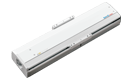
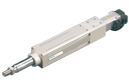
A linear motor stage eliminates the middleman entirely. Instead of using a motor to spin a screw that pushes a nut that moves a load, it uses a direct-drive linear motor that moves the load directly. The motor consists of a stationary primary (coils) and a moving secondary (magnets). Apply current to the coils, and the platform moves. There's nothing in between.
The result is a motion system that's faster, smoother, and more precise than anything with mechanical transmissions can achieve.
The Numbers That Made Me a Believer
The performance advantages of a linear motor stage are striking.
Speed. A ball screw is typically limited to about 2.5 meters per second. A linear motor stage can reach speeds of 3,000 millimeters per second or more. Some stages achieve maximum velocities of 4,000 mm/s. That's not just faster—it's transformative for applications that require rapid positioning.
Acceleration. Without rotating transmission components to limit dynamics, a linear motor stage can achieve accelerations up to 1g or more. This makes them ideal for applications that require rapid start-stop cycles, like semiconductor inspection and pick-and-place systems.
Precision. A linear motor stage can achieve bidirectional repeatability of 0.12 micrometers and straightness to 2 micrometers. Some systems achieve resolution from 0.5 nanometers to 1.0 micron. This is precision that ball screws simply cannot match.
Zero Backlash. Ball screws, even preloaded ones, have some play. A linear motor stage has zero backlash because there are no mechanical interfaces. This reduces settling times and improves positioning accuracy.
No Wear. Ball screws wear over time. The threads and balls experience friction with every cycle. A linear motor stage operates without contact between the moving and stationary parts. There's nothing to wear out.
Ironless Motors. The best linear motor stages use ironless motors, which eliminate undesirable interactions with permanent magnets. This results in smoother motion and better precision.
The Hidden Costs I Never Considered
I wish I'd understood the hidden costs of ball screw stages earlier. The screws that need replacing. The bearings that wear out. The lubrication that attracts contaminants. The downtime for maintenance.
With a linear motor stage, those costs disappear. The primary maintenance is keeping the track clean. Some systems are rated for millions of maintenance-free cycles. The direct-drive design means there's no gearhead, servomotor, or ballscrew to align and integrate, saving valuable engineering time.
The efficiency is also better. A ball screw system loses energy to friction. A linear motor stage converts electrical energy directly into mechanical force, minimizing losses.
Where They Shine
Linear motor stages are found in the most demanding industrial and scientific applications.
In semiconductor manufacturing, they're used for wafer inspection, nano-lithography, mask and CD measurement, and wafer dicing. The precision and speed required for these processes simply can't be achieved with mechanical transmissions.
In photonics and optics, they're used for fiber alignment, lens positioning, optical component testing, and assembly. The sub-micron precision ensures consistent, reliable performance.
In metrology and inspection, they provide the stable, accurate positioning needed for precision measurement. The low runout and high repeatability ensure measurement accuracy.
In laser microprocessing, they guide lasers with the speed and precision needed for clean, accurate cuts. The high dynamics enable rapid scanning and positioning.
In biotechnology and medical engineering, they position samples and instruments with the precision required for research and diagnostics.
What I Wish I'd Known
I wish I'd known that a linear motor stage isn't just a replacement for a ball screw—it's a fundamentally different way of thinking about motion. The design philosophy changes. You design around the motor's capabilities rather than working around the limitations of a mechanical transmission.
I also wish I'd known that the technology is more accessible than I assumed. While the initial cost is higher than ball screw stages, the total cost of ownership is often lower when you factor in maintenance, downtime, and replacement parts.
The linear motor stage is no longer a niche product. It's a proven technology that delivers speed, precision, and reliability that mechanical systems simply cannot match. It's the stage that changed everything I knew about motion.