
Stamped concrete has grown from a niche accent to a staple finish for patios, pool decks, walkways, and entry courts. Owners want stone character without the settlement-prone joints of pavers or the cost of cut flag, and they want it fast. Meanwhile, Concrete Contractors face tighter schedules, more weather swings, and higher expectations for crisp textures and tidy control joints that do not fight the pattern. The result is a craft shaped not just by skill, but by smart gear choices and a disciplined approach to timing.
This is a look at modern tools for concrete jobs that actually earn their place on the truck, especially when the goal is better stamped concrete designs and cleaner, longer-lasting joints. The field keeps changing, but the physics stay the same. If you place the right mix at the right slump, manage bleed and evaporation, lock in a joint plan, and hit the finishing window on time, the slab performs. Tools help you do that with less guesswork and fewer callbacks.
Why textures and joints deserve the same respect
Texture sells the project. Joints keep it alive. When stamped textures are sharp and consistent, clients will forgive small variances in color or sheen. When joints are laid out with intent, the slab moves where you want it to move, not where it pleases. The headache starts when control joints land across grout lines in a fieldstone pattern, or when a groove wanders a few degrees off square and becomes the only thing you see after sealing. Good texture work happens within a tight time window, but jointing has a window of its own. Marry the two and you get a slab that looks right on day one and still looks right after the first winter.
The tool landscape, trimmed to what pulls weight
Twenty years ago, a decent stamp set, a bull float, and a groover could carry the day. Today you can rent or buy laser screeds, battery vibrators, early-entry saws, Bluetooth slump sensors, and VOC-compliant sprayers for release and sealer. The hard part is knowing what matters for the job in front of you.

On most residential and light commercial flatwork in the 300 to 2,500 square foot range, three categories of tools move the needle: placement and finishing equipment that controls the surface before you ever touch a stamp, stamp and detailing tools that sharpen the imprint and cut down your rework, and jointing tools that let you control cracking without scarring the pattern.
Placement and finishing that set up the stamp window
Texture quality lives or dies during placement. A vibrating screed or a lightweight roller screed helps you hit target thickness with less overworking. That preserves cream at the top, which is what the stamps bite into. You do not need a laser screed for a small patio, but a grade-checked, string-lined base and a two-person vibrating screed will keep highs and lows under a quarter inch across the field. Magnesium bull floats beat steel at this stage because they open the surface without sealing it too early.

On mixes with integral color or color hardener, a fresno can polish the cream too much and create a sealer-like crust that rejects release. If you use a fresno, keep it to a couple light passes and avoid heavy back-and-forth just for shine. A channel float or a large magnesium float is kinder to your texture window.
Timing matters more than any brand name. If a crew spends an hour chasing bleed water with steel trowels, the window for stamping closes and you start fighting to seat your mats. An evaporation retarder, not water, buys you open time on a breezy, low-humidity day. A handheld anemometer and an IR thermometer sound like overkill until you realize wind over 8 to 10 mph and surface temperatures over 85 F can cut your open time in half.
Stamps, skins, and the details that sell the job
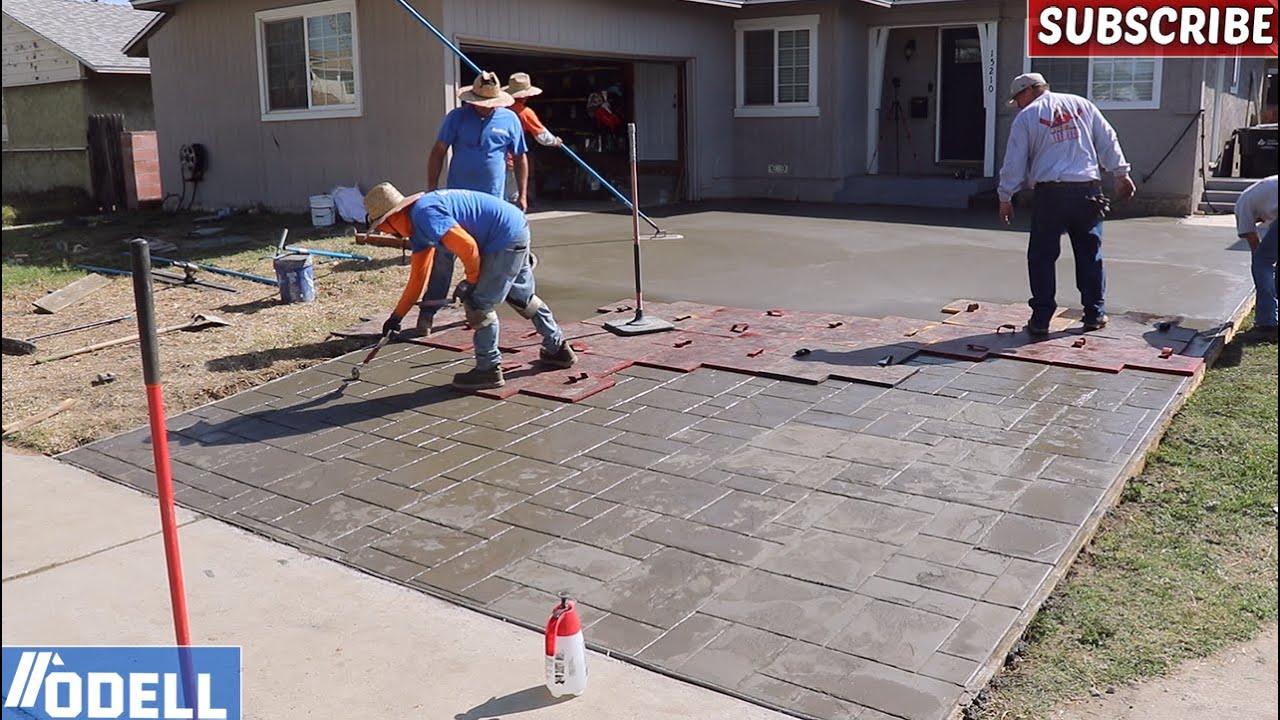
Polyurethane stamps have become lighter and more forgiving, with cleaner undercuts that read well after sealing. The best sets include enough rigid mats to bridge soft spots and at least one floppy to hug edges and odd angles. For patios framed by a curved border, seamless texture skins save hours. Throw a stone, slate, or travertine skin down after edging, then come back with a border stamp or a sawcut on a snapped line to separate fields. The trick is keeping consistent release and crew choreography so the surface reads as one pour.
Detailing is where crews separate themselves. A modest set of chisels, a 4 inch margin trowel, a rigid grout roller for de-burring, and an angled touch-up skin help treat the stamp joints as real grout lines, with break lines that feel chipped, not torn. Keep a toothbrush-sized nylon brush on hand to sweep out crumbled paste before it hardens and becomes a white scar under the sealer.
Color choices also ride on tools. Powder release gives that soft antique look and stays slick longer in hot weather, but it is messier and needs careful cleanup, especially if you have a pool nearby. Liquid release is cleaner, friendlier with stamped concrete designs that rely on bright integrals, and works well with water-based antiquing later. The sprayer needs to match the product. Pump-up sprayers with solvent-resistant seals for liquid release, and a broad, adjustable tip for even coverage. Streaks in the release telegraph into streaks in the texture.
Color hardener still earns its place on many jobs. You gain abrasion resistance and crisper impressions because the surface is denser. The tradeoff is crew load. You need people comfortable with dust control, broadcasting in two to three passes, and floating it in without rolling aggregate. It is not an add-on to squeeze in after a pour that was already rushed.
Joints, planned rather than forgiven
Most callbacks trace back to cracks, and most cracks trace back to poor jointing. Stamped surfaces complicate jointing because you want control joints that disappear into the pattern, yet meet structural rules. The baseline still holds: cut joints to a depth of one quarter of slab thickness, typically 1 inch on a 4 inch slab, and space joints at 24 to 30 times the slab thickness in inches. For a 4 inch slab, that is roughly 8 to 10 feet. That guidance bends to geometry and restraint. Long, thin sections need tighter spacing. Monolithic steps or piers pin edges and demand a joint near the restraint.
Early-entry saws changed the game. With the right blade and skid plate, you can cut within 3 to 12 hours while the surface is still green. On a cool day, midnight cuts might still be on time. On an 80 F afternoon with wind, you may need to be back with a saw before dinner. The benefit is fewer random cracks and tighter, cleaner kerfs that do not ravel stamped grout lines. Hand groovers have their place along borders and inside banding where you want a tooled joint to read as a deliberate detail, not a saw mark.
Here is a lightweight, field-proven plan for jointing on stamped work that balances structure with appearance:
- Snap a primary grid before placement, aligning at least one control joint with a dominant grout line in the stamp set. Keep panels near square, avoid slivers. Form or pre-tool joints in borders and banding so the saw work can focus on larger fields. Use early-entry saws for main field joints within the first 3 to 12 hours, aiming for one quarter depth. Adjust timing by weather, not the clock. Add relief joints where restraint exists, such as re-entrant corners at steps, posts, or inside corners of walls. When stamping patterns with strong direction, bias the joint layout to flow with that direction, then disguise the joints by chasing stamp grout lines with a small chisel after sawing.
Not every slab wants a saw. In decorative borders that will be colored separately or where clients ask for a grout-like joint, a tooled joint with a narrow, deep blade can look intentional and still function. Preformed crack inducers, sometimes called zip strips, can work in straight runs under seamless skins, but they rarely play well with strong stone patterns and can ghost through.
The tension between pattern and performance
Some stamp sets include false grout lines that do not run straight for more than a few feet. They read beautifully but fight joint layout. In those cases, accept that one or two joints will read as straight cuts and treat them as design lines. A contrasting border or a sawcut band at 12 or 24 inches from the edge lets you land a straight joint where it belongs, then muffle it by shifting texture emphasis toward the field. Clients usually pick beauty shots with no joints. Walk them around existing work and show how a well-placed joint looks after sealing. Education early saves arguments later.
Concrete mix, slump, and the stamp window
Modern mix design is a tool in itself. Mid-range water reducers buy workability without pushing the slump too high. For most stamped slabs, a 4 to 5.5 inch slump after admixture feels right. Above that, texture softens and joints tend to ravel. Air content matters outdoors. Five to seven percent entrained air protects against freeze-thaw, but too much air at the surface can make color hardener crusty and fragile. Fibers help control plastic shrinkage, especially on windy days, but hairy fibers left proud at the surface telegraph through the sealer. Micro-synthetic fibers do better here than macro fibers, which are better kept for structural work or buried slabs.
If you are chasing the cleanest possible texture, finish your grading and forms so you can place a thicker, creamier top with less agitation. The more you work the surface, the more paste you burn off, and the shorter your stamping window becomes. Finishing starts the https://www.longisland.com/profile/xippusakxf/ moment the concrete drops off the chute. Screed, bull float, edge once, and step back. Every pass costs you cream.
Working edges, borders, and steps
Edges sell the job in photos and in person. A 3/8 inch edger cleans up the slab and sets a crisp line for a border. After edging, many crews skin the whole surface, then come back and stamp the border with a contrasting pattern or lay out a sawcut border the next day. Either approach works if the tooling is consistent. For steps, rubber step liners simplify life. You pour the tread, press the liner, and you are done. Without a liner, you are carving the face with a floppy and a chisel while the clock runs, which eats labor and leads to inconsistent results.
When stamping close to walls or posts, a floppy mat is the hero. Press it tight, then detail with a touch-up skin and a joint tool. Do not force a rigid mat into a corner. It leaves a bruise you will notice forever after sealing.
Weather, moisture, and the timing gear that pays for itself
Hot, dry, or windy weather shortens your stamping window and speeds the onset of shrinkage stress. Cold weather stretches everything out, then punishes you with surface crusts that shear under a stamp. Two inexpensive tools protect against both: a simple weather meter and an IR thermometer. Track air temperature, concrete temperature, wind speed, and relative humidity. Combine that with an evaporation rate chart and you will know when to spray an evaporation retarder during finishing, how soon to start stamping, and whether to stage more hands.
Curing matters even on decorative work. Cure and seal products bridge the gap between performance and appearance, but they are not a cure for poor timing. A breathable, solvent-based cure and seal at 25 to 30 percent solids lays down well if the surface moisture and dew point cooperate. Put a film over a slab that is still bleeding vapor and you get blushing, milky patches that turn a good job into a warranty visit. A handheld dew point meter, or a quick calculation from the weather meter, keeps you from sealing when the substrate temperature is too close to the dew point. Leave at least 24 hours, often 48, before your second coat or before water-based antiquing and reseal.
Before any reseal, measure moisture. Calcium chloride tests are not practical on small patios, but an RH probe set at 40 percent depth, or even a qualitative moisture meter reading across known dry and suspect areas, tells you if the slab is ready. Many manufacturers want slab RH under 75 percent or a minimum cure time of 28 days before non-breathable coatings. On simple cure and seals, you mainly want the surface dry and the forecast friendly.
Sealers and slip resistance, with real-world tradeoffs
Film-forming sealers brighten color and pop texture, but they are slippery when wet if you apply them wrong or skip traction additive. Broadcast polymer grit into the second coat or mix it into the pail and keep the sprayer tip moving. Too much grit reads cloudy and traps dirt, but too little is a liability next to a pool. Penetrating sealers, silanes, and siloxanes, leave the surface looking more natural and improve freeze-thaw resistance. They do not add that wet-look punch many clients ask for. If you are sealing a seamless skin patio that aims for a stone yard look, penetrating might be your best friend. For a slate stamp with color variation, film-forming is what most clients expect.
Solvent choice is part chemistry, part logistics. Low-VOC solvents can gel older sealers, which is how you get orange peel. Keep a small board on the truck with cured patches of your go-to sealers. Test the solvent and additive before you commit to a 1,000 square foot surface.
A compact crew toolkit that pays for itself
- Vibrating or roller screed sized to your bays, plus a magnesium bull float and channel float. Polyurethane stamp set with rigid and floppy mats, a couple seamless skins, and detailing chisels. Early-entry saw with correct blade and skid plate, plus a straightedge groover for borders. Pump-up sprayers with solvent-resistant seals and adjustable tips for release and sealer. Weather meter, IR thermometer, and a simple dew point chart to time stamping and sealing.
None of these tools replace judgment, but together they shave hours, reduce rework, and widen your safety margin on difficult days.
Putting numbers to it, including the price of concrete patios
Owners ask one question more than any other: How much does it cost? The price of concrete patios varies with region, access, base prep, mix design, reinforcement, pattern, and finish. On recent projects in the Midwest and Mountain West, a basic broom finish 4 inch patio often lands near 7 to 10 dollars per square foot. Step into Stamped Concrete with one color and a straightforward pattern and you typically see 12 to 18 dollars per square foot. Add borders, multiple color hardeners, antiquing, complex sawcuts, and the range moves to 18 to 28 dollars per square foot, sometimes higher in coastal metros.
Thickness, reinforcement, and subbase drive real cost and real performance. Four inches over 4 inches of compacted crushed stone works for patios with typical loads. Six inches, or 4 inches with thickened edges, might be justified at drive-on aprons or where soils are suspect. Wire mesh does little unless chaired. #3 rebar at 18 to 24 inches on center, tied and chaired, holds joints tight and reduces differential movement, but you still need proper joint spacing. Fibers help control early shrinkage. They do not replace steel if you expect restraint or odd loading.
Access changes the math. A 600 square foot backyard patio with a narrow side yard can add 400 to 1,000 dollars in labor for wheelbarrow placement or a line pump. Decorative borders and steps add lineal footage of labor, not just square footage. Sealer maintenance is a long-term cost. Film-forming sealers typically need refresh coats every 2 to 4 years, more often around pools and shaded, damp spots. Penetrating sealers last longer but do not give that gloss clients often want.
Business Name: LEANDER STAMPED CONCRETEBusiness Address: 15901 Ronald Reagan Blvd, Leander, TX 78641
Business Phone: (512) 545-3879
LEANDER STAMPED CONCRETE offers free quotes and assessment
LEANDER STAMPED CONCRETE has the following website https://leanderstampedconcrete.com
What separates reliable Concrete Contractors on stamped work
Good crews do not just show photos. They walk you through joints, mix design, and the plan for weather. They own an early-entry saw or have one reserved, they can show stamps in the trailer that match the sample, and they carry release and sealer that play well together. If you ask about Stamped concrete designs and hear only brand names and adjectives, keep shopping. Ask for addresses of jobs older than two winters. Look at joints and edges first, then color. If joints are crooked or out of scale, the crew is not marrying texture to structure.
For contractors bidding work, resist the urge to pad square footage prices and then strip scope to “win.” Spell out base prep, thickness, reinforcement, joint layout, stamp set, color system, release type, and sealer, then price it straight. The client who understands what they are buying is easier to keep happy when the weather pushes you to cut at midnight or to delay sealing a day.
Small decisions that add up on site
Two examples from real pours help show how tools and choices work together.
A pool deck with a heavy slate pattern, 900 square feet with inside corners at planters, was scheduled for a 78 F afternoon with 12 mph wind. The mix was a 5 inch design with mid-range reducer and air at 6 percent, integral medium gray. We added an evaporation retarder to the truck list and bumped release to liquid for less mess. Screed crew used a roller screed, then magnesium float, edge, and stopped. No fresno. Stamping started earlier than usual because of wind. Early-entry saw came back just before dusk and cut along pre-snapped lines that aligned to two dominant slate grout directions. At the re-entrant corners, we added a short relief cut into a planter band. Sealing waited 48 hours due to overnight humidity spikes. The deck stayed free of random cracks through the first two winters. The only callback was to add more traction grit near a diving board, which the owner accepted after testing a few patches.
A front entry court, 450 square feet with a 24 inch border and a fieldstone stamp inside, had poor access. The owner wanted dramatic antique powder. We used color hardener for durability at the entry and powder release for the soft veining. The border was skinned and sawcut the next day on a chalk line, then stained a shade darker. Early-entry saw cuts in the field aligned to a few honest straight grout lines and were chased by hand with a chisel to blend. Powder cleanup needed a light wash, neutral detergent, then a day of dry sun. Sealer was solvent-based with 30 percent solids and a light broadcast of traction additive. The joint through the center reads as a design line, not a crack savior. It is both.
Where modern tools for concrete jobs truly change outcomes
A few developments have shifted from “nice to have” to “quietly essential.”
Early-entry saws reduce random cracking on stamped slabs without tearing texture. They are loud, pricey to own, but fast to rent and worth the return.
Roller and vibrating screeds let small crews hold grade and keep cream up without rotary laser theatrics. They save the top paste that stamps best.
Sealer-compatible sprayers with solvent-proof seals make or break a finish day. Cheap sprayers spit and streak. You will chase those flaws under the sun, then see them forever after.
Weather meters, IR thermometers, and dew point checks are simple insurance. Guessing wrong costs more than the tool.
Polyurethane stamps with matched floppies, touch-up skins, and clean undercuts give sharper, more believable textures and reduce knee time with chisels.
None of these eliminate the need for experience, but they widen your margin on days when the environment is not your friend.
Final thoughts from the slab
Stamped Concrete is not just about imprinting a good pattern. It is about stacking small, correct decisions from base prep to sealing so the texture has a fair chance and the joints do their job quietly. When tools serve that sequence, they earn their keep. When they are ornaments, they slow you down and distract from planning.
If you are an owner, a brief talk about joint layout, mix, and timing should be part of the proposal, right next to the sample board of Stamped concrete designs. If you are a contractor, commit your plan to paper and set expectations about schedule slips when weather and moisture say wait. Most of the disappointment around stamped work starts with rushed days, not with the stamps themselves.
And for anyone pricing or buying, remember the spread in the price of concrete patios reflects more than color and pattern. It reflects subbase, steel, time windows, saw cuts at odd hours, and the unglamorous gear that lets a small crew produce a slab that looks like stone and behaves like concrete. That is the union you are really paying for, and it is the union modern tools, used with judgment, make possible.