
Sawdust is one of the most widely available wood-processing residues in the world. Every day, sawmills, furniture factories, woodworking workshops, flooring manufacturers, and timber-processing plants generate large amounts of sawdust. Although sawdust can be sold directly for some applications, loose material has relatively low bulk density and can be difficult to store and transport efficiently.
Turning sawdust into biomass pellets provides a practical solution. Through controlled preparation and mechanical compression, loose sawdust can be transformed into dense cylindrical pellets with consistent dimensions and convenient handling characteristics. These pellets can be used in biomass boilers, industrial heating systems, commercial energy facilities, and other applications where standardized solid biomass fuel is required.
A complete pellet production project involves much more than pelletizing alone. Raw material quality, moisture control, particle size, drying, compression, cooling, screening, and packaging all influence the final product. Therefore, businesses planning to invest in sawdust pellet production should evaluate the complete process before selecting equipment.
This article provides a detailed overview of how sawdust is converted into pellets, what equipment is required, how to improve pellet quality, and what factors should be considered when designing a commercial production line.
Why Turn Sawdust Into Pellets?
Sawdust is already a relatively fine material, but its loose structure creates several challenges.
It takes up considerable storage space, generates dust during handling, and can be expensive to transport because of its low bulk density. Pelletizing compresses the particles into a denser form and creates a standardized product.
The major benefits of sawdust pellet production include:
-
Higher bulk density
-
Easier transportation
-
More efficient storage
-
Improved material handling
-
Uniform pellet dimensions
-
Compatibility with automatic fuel-feeding systems
-
Better utilization of wood-processing residues
-
Reduced waste disposal requirements
-
Additional value from sawmill by-products
For companies that generate large quantities of sawdust, pellet production can therefore become a way to integrate waste utilization with biomass fuel manufacturing.
What Raw Materials Can Be Used?
A wide range of clean wood residues can be processed into pellets.
Typical materials include:
-
Pine sawdust
-
Spruce sawdust
-
Fir sawdust
-
Hardwood sawdust
-
Mixed wood sawdust
-
Wood shavings
-
Planer dust
-
Sawmill residues
-
Furniture factory sawdust
-
Fine wood chips
-
Bamboo residues
Different raw materials may require different processing conditions.
Softwood generally has different physical and bonding characteristics from hardwood. Particle size can also vary depending on the original woodworking process.
Clean, untreated wood is generally the preferred raw material for biomass fuel. Sawdust contaminated with excessive paint, plastic, chemical preservatives, or other foreign materials should be evaluated carefully before pellet production.
Analyze the Sawdust Before Choosing Equipment
A successful production line starts with raw material analysis.
The following parameters should be investigated.
Moisture Content
Moisture determines whether drying is required and strongly affects pellet formation.
Particle Size
Fine sawdust may be ready for pelletizing, while larger chips and shavings may require grinding.
Wood Species
Different wood species can require different die compression ratios and operating parameters.
Contamination
Metal and other foreign materials can damage grinding and pelletizing equipment.
Raw Material Supply
The amount of available sawdust determines the realistic plant capacity.
Seasonal Variation
Moisture and supply may change depending on weather and production schedules.
The more accurate the raw material analysis, the easier it is to select appropriate equipment.
Complete Sawdust Pellet Production Process
A typical production process is:
Raw Material Receiving → Cleaning → Crushing/Grinding → Drying → Buffer Storage → Pelletizing → Cooling → Screening → Packaging → Storage
However, not every project requires exactly the same configuration.
For example, sawdust produced by a modern woodworking factory may already have a suitable particle size and moisture level. In this situation, crushing or drying capacity can potentially be reduced.
By contrast, sawdust collected from different sources may contain coarse particles and excessive moisture, requiring more comprehensive pretreatment.
The production line should therefore be customized according to actual material characteristics.
1. Raw Material Receiving
Sawdust can enter the plant through several methods.
An integrated sawmill may transfer sawdust directly from cutting and processing equipment through a conveyor or collection system.
Independent pellet producers may purchase sawdust and transport it to the plant by truck.
Raw material receiving systems should be designed to ensure stable feeding into storage and processing equipment.
Important planning factors include:
-
Daily sawdust availability
-
Monthly raw material supply
-
Moisture content
-
Seasonal changes
-
Transportation distance
-
Storage capacity
-
Material handling method
A sufficient raw material buffer is important for continuous pellet production.
2. Sawdust Cleaning
Although sawdust is relatively clean, it can contain foreign materials from the wood-processing process.
Typical contaminants include:
-
Nails
-
Screws
-
Metal fragments
-
Stones
-
Plastic
-
Oversized wood pieces
A magnetic separator can remove ferrous metal, while screening equipment can remove oversized particles.
Cleaning protects downstream machines and helps reduce unexpected shutdowns.
For industrial plants, an effective cleaning system is particularly important because foreign objects can cause serious damage to high-speed grinding equipment and pellet mills.
3. Crushing and Grinding
Some sawdust can be pelletized directly, but other materials require additional size reduction.
This is especially true when the raw material contains:
-
Wood chips
-
Long shavings
-
Coarse fibers
-
Large irregular particles
A hammer mill can reduce the material to a more consistent size.
The objective is not to produce the smallest possible particles. Instead, the material should have a suitable size distribution for efficient die filling and compression.
Excessive grinding can increase power consumption without providing a corresponding improvement in pellet quality.
The appropriate particle size depends on:
-
Wood species
-
Moisture
-
Pellet diameter
-
Die compression ratio
-
Pellet machine design
-
Desired pellet quality
4. Drying the Sawdust
Moisture control is one of the most important stages of pellet production.
Sawdust with excessive moisture can create several problems, including weak pellets, unstable feeding, high energy consumption, and die blockage.
For medium- and large-scale plants, a rotary drum dryer is commonly used to reduce moisture.
Many wood pellet plants target approximately 10–15% moisture before pelletizing. However, the actual optimum range depends on the raw material and equipment.
If the Sawdust Is Too Wet
Excessive moisture may cause:
-
Soft pellets
-
Low durability
-
Poor compression
-
Die blockage
-
Reduced output
-
Higher energy consumption
If the Sawdust Is Too Dry
Over-drying can also negatively affect pellet formation.
Very dry material may generate excessive dust and may not form strong pellets under certain conditions.
Therefore, the goal should be stable moisture control rather than maximum drying.
5. Buffer Storage and Controlled Feeding
After drying, sawdust can enter a buffer hopper.
The hopper provides temporary storage and helps balance the material flow between the dryer and pelletizing system.
A controlled feeding system can maintain a stable flow rate.
Stable feeding is important because large fluctuations can affect:
-
Motor load
-
Pellet density
-
Production capacity
-
Machine wear
-
Energy consumption
Large pellet plants can use automatic level sensors and variable-speed feeders for better control.
6. Pelletizing With a Sawdust Pellet Making Machine
Pelletizing is the central process of the production line.
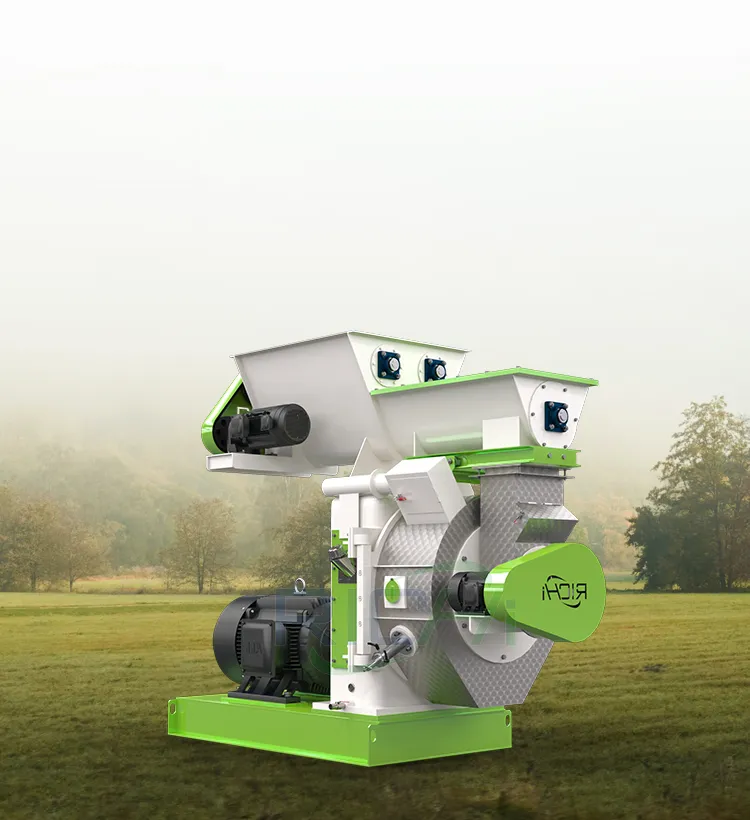
A sawdust pellet making machine compresses prepared wood particles through a specially designed die to produce dense cylindrical pellets.
Inside the pellet machine, rollers press the sawdust against the die. Pressure and friction generate heat, which helps soften the natural lignin contained in the wood. The lignin contributes to bonding between the particles.
The compressed material passes through the die holes and is cut into pellets of the required length.
The pelletizing process depends on several operating factors:
-
Moisture content
-
Particle size
-
Wood species
-
Feeding rate
-
Die hole diameter
-
Die compression ratio
-
Roller condition
-
Motor power
-
Operating temperature
This is why a pellet machine should be selected based on the actual raw material rather than only its nominal capacity.
How Does a Sawdust Pellet Making Machine Work?
The basic working principle is relatively straightforward.
First, prepared sawdust enters the feeding system.
Second, the material is distributed evenly into the compression chamber.
Third, rollers apply pressure to force the particles into the holes of the die.
Fourth, the compressed material passes through the die.
Finally, the extruded material is cut into pellets.
The machine continuously repeats this process to produce a steady stream of biomass pellets.
The quality and output of the pellets depend on the interaction between the raw material, die, rollers, feeding system, and operating parameters.
Choosing the Right Pellet Machine Capacity
Production capacity should be determined by raw material availability and market demand.
For example, a factory that generates only a few tons of usable sawdust per day should not necessarily install a very large production system.
Before choosing equipment, investors should calculate:
-
Available sawdust per day
-
Working hours per day
-
Expected annual operating days
-
Desired finished-pellet output
-
Raw material losses
-
Seasonal supply changes
-
Future production expansion
The pellet machine should be integrated with the capacity of the dryer, cooler, screening system, and packaging equipment.


Selecting the Correct Die
The die is a critical component of the pelletizing system.
Its hole diameter determines the approximate pellet diameter, while its compression ratio affects pellet formation and density.
Die selection should consider:
-
Wood species
-
Sawdust moisture
-
Particle size
-
Pellet diameter
-
Required density
-
Production capacity
-
Pellet durability
If the customer requires multiple pellet sizes, interchangeable dies can provide greater flexibility.
Ring Die Pellet Machines for Commercial Production
Ring die pellet machines are commonly used for medium- and large-scale biomass pellet manufacturing.
They are designed for continuous operation and can provide stable output when correctly configured.
A commercial ring die pellet machine typically includes:
-
Main drive
-
Ring die
-
Rollers
-
Feeding system
-
Material distributor
-
Lubrication system
-
Bearings
-
Safety protection
-
Cutting mechanism
The die and rollers are important wear components and should be manufactured from suitable wear-resistant materials.
Regular inspection is necessary to maintain stable pellet production.
7. Pellet Cooling
Fresh pellets leave the pellet machine at a relatively high temperature.
They are also relatively soft immediately after compression.
A counterflow pellet cooler can reduce their temperature and remove residual moisture.
Cooling improves:
-
Pellet hardness
-
Structural stability
-
Storage performance
-
Handling quality
-
Packaging efficiency
The cooler must be properly matched to the pellet machine capacity.
If the cooling system is too small, hot pellets can accumulate and restrict production.
8. Pellet Screening
After cooling, the pellets are screened.
The screening machine removes:
-
Fine particles
-
Broken pellets
-
Undersized material
Qualified pellets continue to packaging, while suitable fines can often be recycled.
Screening is important for improving product consistency and reducing loose dust.
If the percentage of fines suddenly increases, operators should inspect:
-
Moisture
-
Die condition
-
Roller condition
-
Cooling performance
-
Feeding stability
-
Operating parameters
9. Packaging and Storage
Finished sawdust pellets can be packaged in different formats.
Small bags are appropriate for retail and household heating markets.
Large bags or bulk transportation are more suitable for commercial and industrial customers.
Automatic packaging systems can integrate:
Weighing → Filling → Sealing → Conveying → Palletizing
After packaging, the pellets should be stored in a dry environment.
Moisture exposure can cause pellets to swell, crack, and lose their mechanical strength.
Important Pellet Quality Indicators
Several characteristics can be used to evaluate finished sawdust pellets.
Pellet Density
Dense pellets occupy less storage volume and are more efficient to transport.
Durability
Durable pellets generate fewer fines during handling and transportation.
Moisture
Appropriate moisture improves storage stability.
Fines Content
A low percentage of fines is generally preferred.
Pellet Dimensions
Consistent pellet diameter and length improve compatibility with automated feeding systems.
Factors Affecting Pellet Quality
Pellet quality is influenced by multiple factors.
Raw Material Moisture
Incorrect moisture is one of the most common causes of poor pellet formation.
Particle Size
Consistent particles improve die filling and compression.
Wood Species
Different woods require different operating conditions.
Die Compression
The compression ratio must match the material.
Roller Condition
Worn rollers can reduce compression efficiency.
Cooling
Insufficient cooling can reduce pellet stability.
Screening
Effective screening removes excessive fines before packaging.
Common Problems During Sawdust Pellet Production
Soft Pellets
Soft pellets may be caused by:
-
Excessive moisture
-
Incorrect die compression
-
Insufficient compression
-
Poor particle preparation
High Fines Content
Possible causes include:
-
Worn die
-
Worn rollers
-
Incorrect moisture
-
Poor cooling
-
Weak pellet formation
Low Output
Low production may result from:
-
Wet sawdust
-
Coarse particles
-
Unstable feeding
-
Incorrect die
-
Worn components
-
Insufficient motor power
Die Blockage
Die blockage may occur because of excessive moisture, unsuitable particle size, foreign materials, or improper operating parameters.
The cause should be identified before continuing production.
Small-Scale Sawdust Pellet Production
Small pellet production systems can be suitable for:
-
Small sawmills
-
Furniture factories
-
Woodworking workshops
-
Farms
-
Local biomass fuel businesses
A simple process may consist of:
Grinding → Drying → Pelletizing → Cooling → Screening → Packaging
If the raw material is already dry and fine, the process can be simplified.
Small-scale systems generally offer:
-
Lower initial investment
-
Smaller footprint
-
Simple operation
-
Easier maintenance
-
Lower labor requirements
However, the investment should still be based on actual raw material availability.
Medium-Scale Production
Medium-scale pellet plants can serve local and regional biomass fuel markets.
A typical configuration includes:
Raw Material Storage → Cleaning → Grinding → Drying → Buffer Hopper → Pelletizing → Cooling → Screening → Packaging
A centralized electrical control system can coordinate equipment operation.
Dust collection systems can be installed at grinding, conveying, cooling, screening, and packaging points.
Large-Scale Industrial Production
Large commercial plants require comprehensive engineering.
Multiple pellet machines may operate in parallel to reach higher capacities.
A complete industrial process may include:
Raw Material Receiving → Cleaning → Crushing → Grinding → Drying → Intermediate Storage → Pelletizing → Cooling → Screening → Packaging/Bulk Loading
Additional systems can include:
-
Automatic feeding
-
Dust collection
-
Fire protection
-
Centralized control
-
Finished-product silos
-
Automatic palletizing
-
Bulk loading systems
The capacities of the individual machines should be properly matched.
(click here to investigate: RICHI Machinery)
Energy Efficiency in Pellet Production
Energy consumption is a major operating cost.
The largest energy demands often come from:
-
Grinding
-
Drying
-
Pelletizing
-
Material conveying
Several measures can improve efficiency.
Optimize Grinding
Do not grind already suitable sawdust unnecessarily.
Control Dryer Operation
Avoid over-drying the material.
Maintain the Pellet Machine
Worn dies and rollers can increase energy consumption.
Stabilize Feeding
Stable material flow reduces unnecessary fluctuations in motor load.
Recycle Suitable Fines
Returning suitable fines to the pelletizing system can improve material utilization.
The most meaningful energy-efficiency indicator is often electricity and thermal energy consumption per ton of finished pellets.
Dust Collection and Safety
Wood dust can be generated throughout the production line.
Important dust-generating areas include:
-
Raw material handling
-
Grinding
-
Conveying
-
Pelletizing
-
Cooling
-
Screening
-
Packaging
A professional dust collection system can reduce airborne particles and improve the working environment.
Regular housekeeping is also essential. Dust should not accumulate around motors, bearings, electrical cabinets, or other potential heat sources.
Fire prevention, ventilation, electrical protection, and other safety measures should be designed according to local regulations and professional engineering standards.
Maintenance of a Sawdust Pellet Production Line
Regular maintenance is essential for reliable operation.
Operators should inspect:
-
Pellet machine die
-
Rollers
-
Bearings
-
Lubrication system
-
Main drive
-
Feeding system
-
Hammer mill
-
Dryer
-
Cooler
-
Screening equipment
-
Conveyors
-
Dust collection system
Dies and rollers are wear parts and require periodic inspection.
Preventive maintenance can reduce unexpected downtime and help maintain consistent pellet quality.
How to Build a Sawdust Pellet Production Line
A commercial project can be developed through a structured process.
Step 1: Test the Raw Material
Determine moisture, particle size, wood species, contamination, and available quantity.
Step 2: Define the Final Product
Determine pellet diameter, quality requirements, packaging, and intended application.
Step 3: Determine Capacity
Calculate the required hourly and annual output.
Step 4: Design the Process
Determine whether cleaning, grinding, drying, cooling, screening, and packaging are required.
Step 5: Select Equipment
Choose equipment according to the actual raw material and capacity.
Step 6: Plan the Layout
Arrange equipment according to material flow, maintenance access, safety, and future expansion.
Step 7: Install and Commission
Complete equipment installation, electrical integration, testing, and parameter adjustment.
Step 8: Optimize Operation
Monitor production rate, pellet quality, energy consumption, and wear-part life.
What Determines the Investment Cost?
The investment required for a sawdust pellet plant depends on many factors.
Major equipment may include:
-
Raw material storage
-
Cleaning equipment
-
Crushers
-
Hammer mills
-
Dryers
-
Pellet machines
-
Coolers
-
Screening machines
-
Conveyors
-
Dust collectors
-
Control systems
-
Packaging machines
-
Storage systems
Additional costs can include:
-
Workshop construction
-
Electrical installation
-
Civil works
-
Transportation
-
Installation
-
Commissioning
-
Spare parts
Operating costs should also be considered, including:
-
Electricity
-
Thermal energy
-
Labor
-
Maintenance
-
Packaging
-
Transportation
-
Raw material procurement
A lower initial equipment price does not necessarily mean lower total production costs. Equipment efficiency, wear-part life, maintenance requirements, and technical support can have a significant impact on long-term profitability.
Why Complete Process Engineering Matters
A pellet plant is a complete production system rather than a single machine.
For example, if the dryer cannot provide enough dry sawdust, the pellet machine cannot achieve its expected capacity.
If the cooler is undersized, production may have to slow down.
If the screening machine cannot process the pellet output, the finished-product section becomes a bottleneck.
Therefore, the complete line should be balanced:
Raw Material Preparation → Drying → Pelletizing → Cooling → Screening → Packaging
Each stage should have suitable capacity and compatible operating parameters.
RICHI Sawdust Pellet Production Solutions
RICHI provides biomass pellet machines and complete production line solutions for customers processing sawdust and other wood residues.
Production lines can be customized according to:
-
Raw material type
-
Moisture content
-
Particle size
-
Wood species
-
Production capacity
-
Pellet diameter
-
Fuel application
-
Factory layout
-
Automation requirements
-
Investment budget
A complete sawdust pellet production line can include:
Cleaning → Crushing → Grinding → Drying → Pelletizing → Cooling → Screening → Conveying → Packaging
Additional auxiliary systems can be incorporated depending on project requirements.
The goal is to create a balanced production system rather than simply supplying an individual pellet machine.
Questions to Consider Before Purchasing Equipment
Before investing in a sawdust pellet project, buyers should answer several questions:
-
How much sawdust is available every day?
-
What is the average moisture content?
-
Does moisture change seasonally?
-
What wood species are available?
-
What is the particle size?
-
Is additional grinding required?
-
Is drying necessary?
-
What pellet diameter is required?
-
What production capacity is needed?
-
Who are the target customers?
-
How will the pellets be packaged?
-
How much finished-product storage is required?
-
What level of automation is appropriate?
-
What are the expected energy costs?
-
What spare parts will need regular replacement?
Answering these questions can make equipment selection more accurate and reduce unnecessary investment.
Applications of Sawdust Pellets
Sawdust pellets can be used in various biomass energy applications.
Residential Heating
Small biomass heating systems can use standardized wood pellets as a convenient solid fuel.
Commercial Boilers
Hotels, commercial buildings, and other facilities may use biomass pellets for heating.
Industrial Heating
Factories can use wood pellets as an alternative biomass fuel in suitable industrial heating systems.
Biomass Energy Plants
Larger facilities can consume substantial volumes of standardized wood pellets.
The exact fuel specifications should always match the requirements of the combustion equipment.
Future Development of Sawdust Pellet Production
The demand for efficient biomass utilization continues to encourage technological improvements in pellet production.
Future pellet plants are likely to focus increasingly on:
-
Energy-efficient drying
-
Automated feeding
-
Intelligent process monitoring
-
Stable pellet quality
-
Better dust management
-
Longer equipment service life
-
Reduced maintenance
-
Flexible production
-
Improved raw material utilization
For companies that already produce sawdust, these developments can create opportunities to increase the value of their existing wood residues.
Conclusion
Sawdust pellet production is an effective way to transform loose wood-processing residues into dense, uniform, and convenient biomass fuel. A complete production process may include raw material receiving, cleaning, grinding, drying, pelletizing, cooling, screening, packaging, and storage.
The sawdust pellet making machine is the core equipment responsible for compressing prepared wood particles into finished pellets. However, its performance depends on the entire production system. Proper moisture control, suitable particle size, correct die compression, stable feeding, effective cooling, and regular maintenance are all essential for reliable operation.
For sawmills, furniture factories, woodworking businesses, and dedicated biomass fuel producers, sawdust pellet production can provide a practical way to convert wood residues into a higher-value product. By designing the production line according to actual raw material characteristics, capacity requirements, pellet specifications, and market demand, businesses can establish an efficient and reliable biomass fuel production operation.
With appropriate equipment and professional process design, sawdust that was once considered a low-value by-product can become a standardized fuel suitable for residential, commercial, and industrial biomass energy applications.