
Cow dung is a major organic by-product of cattle farming and an important source of recyclable nutrients. With the expansion of dairy farms, beef cattle operations, and commercial livestock production, efficient manure management has become increasingly important. Simply storing fresh manure in open piles is no longer an ideal solution for farms that want to reduce environmental pressure and improve resource utilization.
Through controlled fermentation, composting, crushing, mixing, granulation, pelletizing, drying, cooling, and packaging, cow dung can be transformed into valuable organic fertilizer products. Among these products, cow dung pellets offer a convenient format for transportation, storage, application, and commercial distribution.
A well-designed cow dung fertilizer production line can turn livestock waste into a standardized agricultural input. It can also combine cow dung with crop residues, chicken manure, sheep manure, humic substances, or other organic materials to produce customized fertilizer products.
This article explains the complete process of cow dung recycling, the technologies used to manufacture pellet fertilizer, the equipment required, the applications of the finished product, and the key considerations for establishing a commercial production plant.
Why Cow Dung Recycling Matters
Cattle produce manure continuously. For a small farm, manure can often be collected and applied to nearby fields after suitable treatment. However, a large cattle farm may produce tons of manure every day.
When the amount of manure exceeds the farm's direct agricultural demand, long-term storage becomes a major challenge.
Uncontrolled manure accumulation can cause:
-
Strong odors
-
Excessive land occupation
-
Nutrient losses
-
Rainwater runoff
-
Potential water pollution
-
Increased insect activity
-
High transportation costs
-
Difficult daily farm management
Resource recovery provides a better alternative.
Instead of treating cow dung only as waste, farms can process it into fertilizer products and return the recovered nutrients to agricultural production.
The basic concept is:
Cattle Farm → Cow Dung → Processing → Organic Fertilizer → Crop Production
This creates a circular agricultural system in which livestock waste becomes a useful input for crop farming.

Cow Dung as an Organic Fertilizer Raw Material
Cow dung contains organic matter as well as nutrients such as nitrogen, phosphorus, and potassium. However, its composition is not fixed.
The characteristics of cow dung depend on:
-
Cattle diet
-
Animal type
-
Bedding material
-
Manure collection method
-
Water content
-
Storage period
-
Fermentation conditions
For this reason, commercial fertilizer manufacturers should test their raw materials before developing a final product formula.
Cow dung can be processed independently or mixed with other materials to achieve the desired physical and nutritional characteristics.
Main Ways to Utilize Cow Dung
There is no single method for processing cattle manure. Different farms can select different resource utilization routes.
Composting
Cow dung is biologically decomposed and stabilized before being used directly as compost.
Organic Fertilizer Powder
Processed manure can be dried and crushed into a loose fertilizer product.
Granular Fertilizer
Cow dung can be combined with other ingredients and formed into granules.
Pelletized Fertilizer
Prepared manure can be compressed into uniform cylindrical pellets.
Biogas
Cow dung can be used as feedstock for anaerobic digestion to produce biogas.
Integrated Resource Recovery
Large farms can combine biogas production and fertilizer manufacturing to recover both energy and nutrients.
The best solution depends on the farm's manure output, available land, target market, investment budget, and local regulations.
Why Convert Cow Dung Into Pellets
Fresh manure is bulky and difficult to transport.
Loose compost is easier to handle than fresh manure, but it can still require substantial storage and transportation capacity.
Pelletizing changes the physical form of the material.
The benefits include:
Compact Form
Compression creates a denser and more standardized product.
Convenient Transportation
Pellets can be transported in bags or bulk with relatively simple handling.
Easy Storage
Uniform pellets can be stacked more efficiently than loose manure.
Standardized Application
Pellets can be applied using suitable fertilizer spreading equipment.
Commercial Packaging
Pellet fertilizer can be packaged in different bag sizes for retail or wholesale markets.
Improved Product Appearance
Uniform particles provide a more professional commercial appearance.
Complete Cow Dung Fertilizer Production Process
A typical commercial process can be arranged as:
Cow Dung Collection → Dewatering → Fermentation → Composting → Crushing → Screening → Batching → Mixing → Pelletizing → Drying → Cooling → Screening → Packaging
Some projects may add coating or additional treatment stages.
The final process depends on the characteristics of the raw material and the specifications of the finished fertilizer.
Step 1 Cow Dung Collection
Efficient collection is essential for maintaining a stable raw material supply.
Depending on the cattle housing system, manure can be collected by:
-
Manual labor
-
Scraper systems
-
Manure belts
-
Conveyor systems
-
Mechanical collectors
-
Flush systems
Large livestock farms often use mechanical collection equipment to reduce labor and improve consistency.
The collected manure should be transferred to a designated receiving area.
The receiving area should have suitable drainage and protection against excessive rainwater.
Step 2 Solid-Liquid Separation
Fresh cow dung often contains substantial moisture.
High moisture can increase transportation costs and make subsequent processing more difficult.
A solid-liquid separator can remove part of the liquid fraction.
The resulting solid fraction can be directed to fermentation and composting.
The liquid fraction may be treated separately or used in anaerobic digestion where appropriate.
Removing excess water at an early stage can reduce the load on downstream drying equipment.
Step 3 Controlled Fermentation
Fresh cow dung should generally undergo controlled biological treatment before becoming a commercial fertilizer.
During aerobic fermentation, microorganisms break down easily degradable organic matter.
Heat is generated naturally during microbial activity.
Proper fermentation helps improve the stability and handling characteristics of the manure.
The main parameters to monitor include:
-
Moisture
-
Temperature
-
Oxygen
-
Carbon-to-nitrogen balance
-
Fermentation duration
Step 4 Composting
Composting continues the stabilization process.
A compost turner can regularly turn manure to introduce oxygen and redistribute heat and moisture.
Turning can help create a more uniform composting environment.
Depending on production capacity and available space, producers may use:
-
Windrow composting
-
Composting chambers
-
Fermentation tanks
-
Composting tunnels
-
Mechanical composting systems
For large projects, mechanical turning can significantly reduce manual labor.
Using Crop Residues With Cow Dung
One of the advantages of cow dung recycling is that other agricultural wastes can be incorporated into the same system.
Possible materials include:
-
Rice straw
-
Wheat straw
-
Corn stalks
-
Rice husk
-
Sawdust
-
Grass
-
Leaves
-
Peanut shells
-
Other plant residues
Dry fibrous materials can improve the structure of wet manure.
This makes it possible to establish a combined livestock and crop residue recycling system.
For example:
Cow dung + rice straw → fermentation → composting → crushing → pelletizing
This process can transform two agricultural waste streams into one useful fertilizer product.
Step 5 Crushing
After fermentation and composting, the material may contain large lumps.
A crusher reduces the particle size and breaks up compacted manure.
Common crushing equipment includes:
-
Vertical crusher
-
Hammer crusher
-
Cage crusher
-
Chain crusher
-
Organic fertilizer crusher
The crusher should be selected according to raw material moisture, hardness, particle size, and required production capacity.
Uniform particles generally improve mixing and pelletizing performance.
Step 6 Screening
Screening removes oversized particles before the material enters the mixing and pelletizing system.
It can also help separate foreign materials.
A typical preparation section is:
Compost → Crushing → Screening → Material Storage
The prepared material can then be accurately batched and mixed.
Step 7 Batching and Mixing
Commercial fertilizer production may require several ingredients.
Cow dung can be combined with:
-
Compost
-
Chicken manure
-
Sheep manure
-
Humic acid
-
Biochar
-
Peat
-
Crop residues
-
Phosphate sources
-
Potassium sources
-
Other organic materials
An automatic batching system can weigh each ingredient according to the selected formula.
A fertilizer mixer then produces a uniform mixture.
Accurate batching and mixing are important when producing fertilizer with specific nutrient targets.
Step 8 Pelletizing Cow Dung
Pelletizing is the main forming process.
The prepared material enters the pellet mill through a controlled feeding system.
Inside the pelletizing chamber, rollers compress the material against a die.
The compressed material passes through die holes and forms continuous strands.
A cutter then cuts these strands into pellets.
The pellet diameter is mainly determined by the die hole size.
The pellet length can be adjusted through the cutting mechanism.

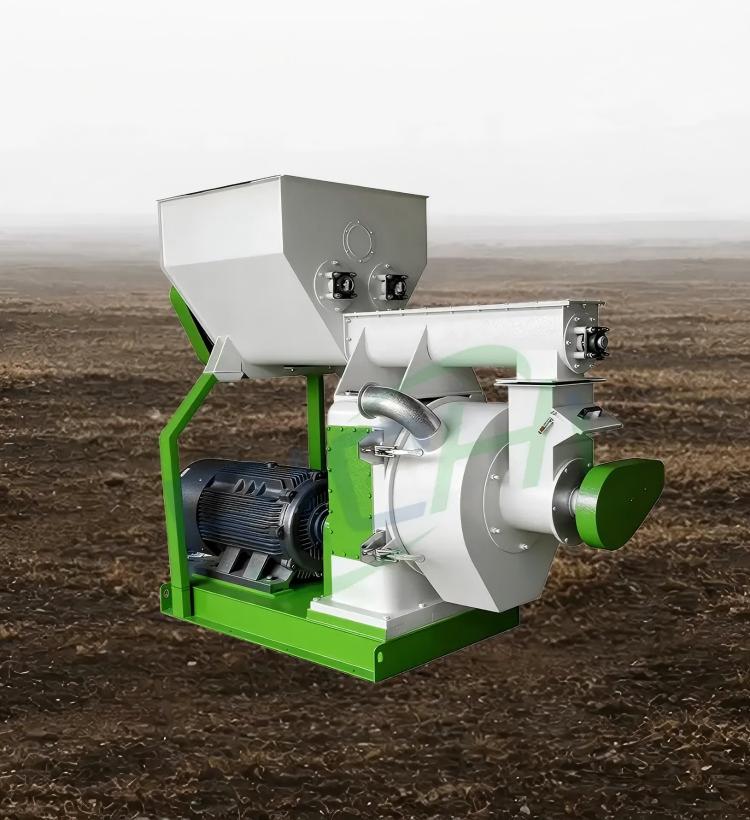
What Are Cow Dung Pellets
Cow dung pellets are compact organic fertilizer particles produced by compressing properly treated cow dung or a cow dung-based fertilizer mixture.
Before pelletizing, the manure normally needs to undergo fermentation and composting.
The material is then crushed, screened, mixed, and adjusted to suitable processing conditions.
The pelletizing machine compresses the prepared mixture into a standardized form.
Compared with loose manure, pelletized fertilizer is generally easier to:
-
Transport
-
Store
-
Package
-
Handle
-
Weigh
-
Apply
Different pellet diameters can be produced according to equipment configuration and market requirements.
Factors Affecting Pellet Quality
Pellet quality depends on multiple process parameters.
Moisture
The moisture level affects material feeding, compression, pellet formation, and drying requirements.
Particle Size
Large particles can reduce pellet stability and create inconsistent products.
Formula
Different raw materials have different binding and compression characteristics.
Die Design
The die affects pellet diameter, compression, and production performance.
Roller Condition
Worn rollers can reduce pelletizing efficiency.
Feeding Stability
Stable material feeding helps maintain consistent production.
Cooling
Proper cooling helps stabilize the finished pellets before packaging.
Benefits of Pelletized Cow Dung Fertilizer
Pelletization provides several practical benefits for agricultural producers.
Easier Handling
Uniform pellets are easier to handle than loose manure.
Better Transportation
Compact fertilizer can be transported more conveniently.
Convenient Storage
Bags of pellets can be stacked in warehouses.
More Uniform Application
Standardized particles can be spread using fertilizer application equipment.
Improved Marketability
Pellets can be sold as a finished commercial fertilizer product.
Reduced Waste
Fine particles can often be recycled back into the pelletizing process.
Step 9 Drying
After pelletizing, the material may contain excessive moisture.
A rotary dryer can reduce the moisture level.
The dryer should be selected according to:
-
Initial moisture
-
Required final moisture
-
Production capacity
-
Heat source
-
Fuel availability
-
Energy costs
Drying is often one of the most energy-intensive stages in an organic fertilizer production line.
For this reason, effective dewatering and appropriate process design are important for controlling operating costs.
Step 10 Cooling
Dried fertilizer pellets are hot and should be cooled before packaging.
A cooling machine reduces their temperature and improves product stability.
Proper cooling can help prevent:
-
Condensation
-
Moisture accumulation
-
Pellet deformation
-
Packaging problems
For large production lines, a continuous fertilizer cooler can be integrated with the dryer and screening system.
Step 11 Screening Finished Pellets
After cooling, the pellets pass through a screening machine.
The screen separates the material into different size fractions.
Qualified pellets are sent to packaging.
Fine particles can be recycled.
Oversized particles can be crushed and returned to the production line.
This process improves product uniformity and material utilization.
Step 12 Pellet Coating
Some commercial fertilizer products require surface coating.
A coating machine can apply a controlled layer of coating material to the pellets.
Depending on the formula, coating can be used to improve:
-
Product appearance
-
Surface characteristics
-
Dust control
-
Handling performance
Coating is optional and should be selected according to the target product.
Step 13 Packaging
The final pellets can be packed into different bag sizes.
Common options include:
-
5 kg
-
10 kg
-
20 kg
-
25 kg
-
40 kg
-
50 kg
-
Jumbo bags
Small packages are suitable for retail and horticultural markets.
Large packages are more suitable for commercial farms and fertilizer distributors.
Automatic packing systems can perform weighing, filling, sealing, and conveying.
Complete Cow Dung Pellet Production Line Equipment
A commercial organic fertilizer production line may include:
-
Cow dung receiving system
-
Solid-liquid separator
-
Fermentation system
-
Compost turner
-
Crusher
-
Screening machine
-
Batching system
-
Fertilizer mixer
-
Pellet mill
-
Rotary dryer
-
Fertilizer cooler
-
Finished product screener
-
Coating machine
-
Automatic packing machine
-
Conveyors
-
Dust collection system
-
PLC control system
Not every project needs all of these machines.
For example, a farm with relatively dry and well-composted manure may require a simpler system.
A commercial fertilizer manufacturer may need a fully automated line with drying, cooling, screening, coating, and packaging.
Small Scale Cow Dung Pellet Production
Small cattle farms can begin with a relatively simple system.
A possible process is:
Cow dung collection → Fermentation → Crushing → Pelletizing → Cooling → Packaging
If the manure reaches an appropriate moisture level during composting, drying requirements may be reduced.
The pellets can be used directly on the farm.
If production exceeds internal fertilizer demand, the surplus can potentially be sold to nearby agricultural customers.
Industrial Cow Dung Fertilizer Production
Large dairy farms may generate enough manure to establish a dedicated commercial production plant.
An industrial system can continuously process manure and produce standardized fertilizer.
Automation can coordinate:
-
Feeding
-
Batching
-
Mixing
-
Pelletizing
-
Drying
-
Cooling
-
Screening
-
Packaging
A centralized PLC system can also monitor equipment status and process parameters.
This reduces manual operation and helps maintain consistent production.
Applications of Cow Dung Fertilizer Pellets
Properly processed cow dung fertilizer can be used in a variety of agricultural applications.
Grain Production
Fertilizer pellets can be applied to corn, wheat, rice, and other field crops according to nutrient requirements.
Vegetable Farming
Vegetable growers can use manure-based organic fertilizer as part of soil fertility management.
Fruit Orchards
Pellets can be distributed around fruit trees according to crop requirements.
Greenhouses
Greenhouse producers can use organic fertilizer pellets as part of soil management.
Nurseries
Horticultural nurseries can be another potential market.
Landscaping
Packaged organic fertilizer pellets can also be marketed to landscaping businesses.
The application rate should be determined based on nutrient analysis, soil conditions, crop requirements, and applicable regulations.
Cow Dung Pellets for Soil Improvement
Processed cow dung can provide organic matter to agricultural soils.
Organic matter can contribute to:
-
Improved soil structure
-
Better water retention
-
Nutrient cycling
-
Biological activity
-
Long-term soil quality
However, fertilizer should be applied according to actual crop and soil needs.
Excessive manure application can result in nutrient accumulation and environmental problems.
Cow Dung and Organic Waste Integration
A major advantage of manure processing is the ability to combine multiple organic waste streams.
For example:
Cow dung + rice straw + sawdust → fermentation → composting → crushing → mixing → pelletizing
Another possibility is:
Cow dung + poultry manure + crop residues → composting → fertilizer production
This integrated approach can improve the utilization of local agricultural resources.
Integrating Biogas and Fertilizer Production
Large cattle farms may also consider anaerobic digestion.
A possible integrated system is:
Cow dung → Anaerobic digestion → Biogas + Digestate
Biogas can be used as a renewable energy source.
Digestate can be further processed into organic fertilizer.
The overall system can therefore recover:
Energy + Nutrients + Organic Matter
This is especially attractive for large livestock farms with continuous manure production.
Quality Control for Commercial Products
Commercial fertilizer producers should establish a consistent quality control program.
Important parameters may include:
-
Moisture
-
Organic matter
-
Nitrogen
-
Phosphorus
-
Potassium
-
Pellet diameter
-
Bulk density
-
Pellet durability
The exact testing requirements depend on the target market and local fertilizer regulations.
Raw material testing is also important because manure composition can vary significantly.
Common Problems in Pellet Production
Excessive Moisture
Wet material may create feeding problems and increase drying costs.
Solution: Improve dewatering, composting, and moisture control.
Weak Pellets
Pellets may break easily because of unsuitable moisture, particle size, formulation, or compression.
Solution: Optimize material preparation and pelletizing parameters.
Excessive Fines
Too many fines can reduce the commercial quality of the final product.
Solution: Check pellet formation, die condition, cooling, and screening.
Uneven Pellets
Inconsistent pellet size may result from unstable feeding or cutter adjustment.
Solution: Improve feeding stability and adjust the cutting system.
High Energy Consumption
Drying costs may become excessive when raw material moisture is high.
Solution: Remove as much excess water as practical before thermal drying.
How to Choose Pelletizing Equipment
Selecting a suitable pellet machine requires more than considering capacity alone.
Investors should provide:
-
Raw material type
-
Moisture content
-
Particle size
-
Production capacity
-
Pellet diameter
-
Formula
-
Working hours
-
Available electricity
-
Heat source
-
Factory space
Testing the actual raw material is highly recommended before final equipment selection.
Different manure mixtures may have significantly different pelletizing characteristics.
Factory Layout for a Cow Dung Fertilizer Plant
A logical factory layout can improve production efficiency.
A typical flow is:
Raw Material Area → Fermentation Area → Crushing → Mixing → Pelletizing → Drying → Cooling → Screening → Packaging → Finished Product Warehouse
The layout should minimize unnecessary material transportation.
Fresh manure should be separated from finished fertilizer.
The factory should also provide:
-
Proper drainage
-
Ventilation
-
Dust collection
-
Maintenance access
-
Electrical protection
-
Fire safety
-
Worker safety measures
Energy Efficiency in Manure Pellet Production
Energy efficiency is especially important in large fertilizer plants.
Drying can consume significant amounts of energy.
Several approaches can reduce energy consumption:
Effective Dewatering
Removing water mechanically is generally more energy-efficient than evaporating it thermally.
Proper Dryer Design
The dryer should match the actual production capacity.
Heat Recovery
Where technically feasible, waste heat can be recovered.
Efficient Motors
High-efficiency motors can reduce electricity consumption.
Stable Feeding
Consistent feeding can improve equipment utilization.
Regular Maintenance
Maintaining dryers, pellet mills, conveyors, and other equipment helps avoid unnecessary energy losses.
Economic Value of Cow Dung Recycling
Cow dung pellet production can provide value beyond waste disposal.
The benefits may include:
-
Reduced manure storage costs
-
Lower waste handling pressure
-
Internal fertilizer production
-
Commercial fertilizer sales
-
More efficient transportation
-
Utilization of crop residues
-
Better resource recovery
The economic feasibility of a project depends on:
-
Manure availability
-
Equipment investment
-
Fertilizer selling price
-
Electricity
-
Fuel
-
Labor
-
Packaging
-
Transportation
-
Market demand
A detailed feasibility study should be completed before investing in a commercial plant.
How to Start a Cow Dung Pellet Business
A successful project should begin with raw material and market analysis.
1. Calculate Manure Availability
Determine daily and annual manure production.
2. Test Raw Materials
Analyze moisture, organic matter, and nutrient composition.
3. Define the Product
Decide whether the target is compost, powder, granules, or pellets.
4. Determine Production Capacity
Capacity should correspond to manure supply and market demand.
5. Select Pellet Specifications
Determine pellet diameter and packaging requirements.
6. Identify Customers
Potential customers include:
-
Crop farms
-
Vegetable farms
-
Fruit orchards
-
Greenhouses
-
Nurseries
-
Fertilizer distributors
-
Landscaping businesses
7. Design the Production Line
Select equipment according to actual material and product requirements.
8. Plan the Factory
Reserve space for raw material storage, fermentation, production, packaging, and finished product storage.
RICHI Cow Dung Fertilizer Production Solutions
RICHI Pellet Machine can design customized cow dung fertilizer production lines according to the customer's raw materials, capacity, fertilizer formula, and final product requirements.
Depending on the project, the system can include compost turners, crushers, mixers, pellet mills, dryers, coolers, screening machines, coating machines, packing systems, conveyors, dust collectors, and PLC control systems.
The production process can be customized for different manure moisture levels and fertilizer formulations.
For complete projects, RICHI can provide turnkey services covering:
-
Production process design
-
Factory layout
-
Equipment manufacturing
-
Equipment installation guidance
-
Commissioning
-
Operator training
-
Spare parts supply
-
Technical support
This integrated approach allows customers to obtain a complete manure fertilizer solution rather than assembling unrelated machines from multiple suppliers.
Future Trends in Cow Dung Resource Utilization
The future of livestock waste management will focus increasingly on resource recovery.
Rather than considering manure simply as waste, modern cattle farms can recover several valuable resources:
Organic matter + Nutrients + Energy
Cow dung can be converted into organic fertilizer.
Crop residues can be incorporated into composting.
Anaerobic digestion can produce renewable energy.
Digestate can be further processed into fertilizer.
Automation can improve production efficiency.
Digital sensors can monitor moisture and temperature.
Energy-efficient dryers can reduce operating costs.
These technologies can make livestock manure management more sustainable and commercially attractive.
Conclusion
Cow dung is not merely a waste generated by cattle farms. With suitable treatment and processing technology, it can become a valuable raw material for organic fertilizer production.
The complete process typically begins with manure collection and dewatering, followed by fermentation and composting. Crushing, screening, batching, and mixing prepare the material for pelletizing. After pellet formation, drying, cooling, screening, and packaging transform the product into a convenient commercial fertilizer.
The production of cow dung pellets provides a practical way to improve the handling and utilization of cattle manure. Compared with fresh or loose manure, pelletized fertilizer is easier to transport, store, package, and apply. It can be used on field crops, vegetables, fruit trees, greenhouses, nurseries, and other agricultural applications according to soil and crop requirements.
For small cattle farms, a simple pellet production system can help recycle manure for internal agricultural use. For large dairy farms and commercial fertilizer manufacturers, a complete automated production line can transform a continuous supply of manure into a standardized fertilizer product.
With appropriate raw material preparation, reliable equipment, scientific process control, and professional production line design, cow dung recycling can create both environmental and economic value. It reduces the pressure of manure disposal while returning organic matter and nutrients to agriculture, helping livestock farms move toward a more efficient and sustainable circular production model.