

Aquaculture has become one of the fastest-growing agricultural sectors worldwide. With increasing pressure on wild fisheries and growing demand for seafood, fish farming plays a critical role in global food security. However, the success of any aquaculture operation depends heavily on feed quality. Efficient feed production ensures optimal fish growth, improved feed conversion ratios, healthier aquatic animals, and greater farm profitability.
As aquaculture expands, feed manufacturers are investing in advanced technologies to improve production efficiency and product consistency. Among the most important innovations is the aquaculture feed pellet machine, which has revolutionized the way aquatic feeds are manufactured. By producing uniform and nutritionally balanced pellets, this equipment supports sustainable aquaculture development and helps meet the rising demand for high-quality seafood.
The Role of Feed in Aquaculture
Feed is the primary input in most aquaculture systems and often represents the largest operational cost. In intensive fish farming environments, natural food sources are limited, making formulated feed essential for achieving high production performance.
Quality feed contributes to:
- Faster growth rates
- Better feed conversion efficiency
- Stronger immune systems
- Higher survival rates
- Improved product quality
- Reduced environmental impact
Because feed quality directly affects production results, manufacturers continuously seek better processing methods and equipment to improve feed performance.
Understanding Aquatic Animal Nutrition
The nutritional needs of aquatic species vary according to species, age, water temperature, and farming objectives. Proper feed formulation is therefore a critical step in the production process.
Protein Requirements
Protein is the most important nutrient in aquaculture feed because it provides amino acids necessary for growth and tissue development.
Typical protein requirements include:
- Carp: 25–35%
- Tilapia: 28–35%
- Catfish: 30–40%
- Trout: 40–50%
- Salmon: 35–50%
Selecting high-quality protein sources is essential for achieving optimal growth while controlling feed costs.
Energy Sources
Fish require adequate energy to support daily activities and metabolic functions.
Common energy ingredients include:
- Corn
- Wheat
- Rice bran
- Cassava
- Wheat flour
Balanced energy levels improve feed utilization and production efficiency.
Lipids
Lipids provide concentrated energy and essential fatty acids that support fish health and growth.
Common lipid sources include:
- Fish oil
- Soybean oil
- Canola oil
- Palm oil
Proper lipid supplementation contributes to better growth performance and feed conversion ratios.
Vitamins and Minerals
Micronutrients play vital roles in:
- Skeletal development
- Immune function
- Reproduction
- Metabolic regulation
Deficiencies can negatively impact productivity and fish health.
Raw Materials Used in Aquafeed Manufacturing
The quality of feed begins with the quality of raw materials.
Protein Ingredients
Common protein sources include:
- Fish meal
- Soybean meal
- Corn gluten meal
- Poultry by-product meal
- Rapeseed meal
- Blood meal
Manufacturers often combine multiple protein ingredients to achieve balanced amino acid profiles.
Carbohydrate Sources
Carbohydrates provide energy and help improve pellet structure.
Frequently used ingredients include:
- Corn
- Wheat
- Rice bran
- Broken rice
These materials also assist in pellet binding during processing.
Functional Additives
Specialized additives enhance feed quality and fish performance.
Examples include:
- Probiotics
- Enzymes
- Organic acids
- Antioxidants
- Vitamin premixes
- Mineral supplements
Such additives support digestion, health, and production efficiency.
The Aquafeed Production Process
Modern aquafeed manufacturing involves a series of integrated processing steps designed to ensure consistent product quality.
Ingredient Reception and Storage
Incoming raw materials undergo quality inspections before entering production.
Manufacturers typically assess:
- Moisture content
- Nutritional value
- Physical condition
- Contamination risks
Proper storage conditions preserve ingredient quality and reduce spoilage.
Grinding
Grinding reduces ingredient particle size and improves processing efficiency.
Benefits include:
- Better digestibility
- Improved mixing accuracy
- Enhanced pellet quality
- Increased nutrient availability
Hammer mills are commonly used for this stage.
Mixing
The mixing process combines ingredients into a homogeneous feed formula.
Proper mixing ensures:
- Uniform nutrient distribution
- Consistent feed quality
- Effective additive incorporation
High-quality mixers help maintain production consistency.
Pellet Manufacturing Technology
Pellet formation is one of the most important stages in feed production.
Compared with powdered feed, pellets offer several advantages:
- Easier handling
- Improved storage
- Reduced feed waste
- Better feeding performance
- Higher nutrient retention
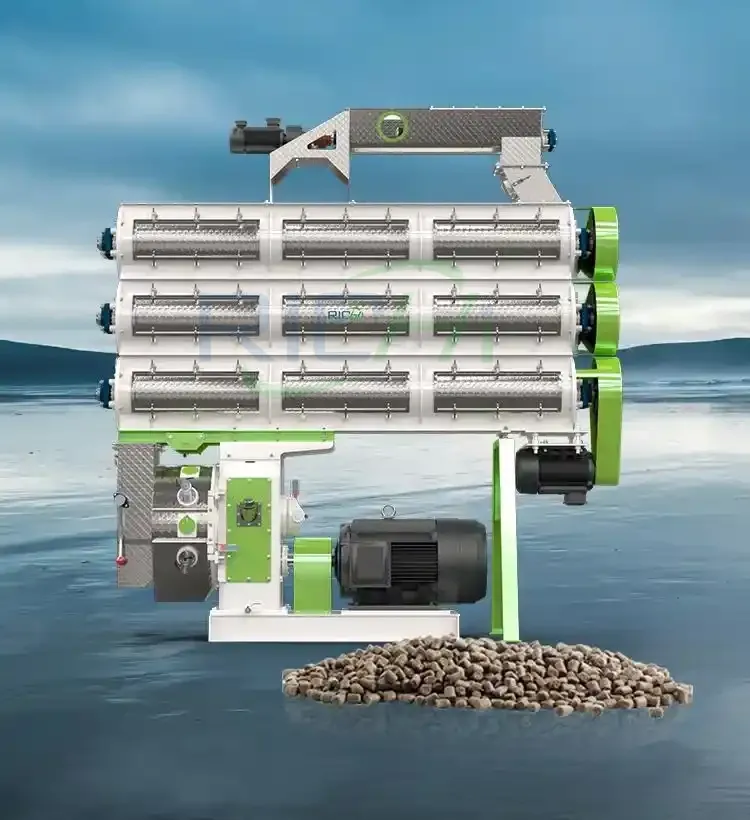
The aquaculture feed pellet machine is specifically designed to convert feed mash into compact, durable pellets suitable for aquatic animals.

How an Aquaculture Feed Pellet Machine Works
An aquaculture feed pellet machine applies pressure to conditioned feed materials and forces them through precision-engineered dies.
The process typically includes:
- Feeding mixed ingredients into the machine.
- Compressing material using rollers.
- Extruding feed through die holes.
- Forming pellets of desired dimensions.
- Cutting and discharging finished pellets.
This process creates pellets with consistent size, density, and durability.
Advantages of an Aquaculture Feed Pellet Machine
Uniform Pellet Production
Consistent pellet size is important because different fish species and growth stages require specific pellet dimensions.
Typical pellet sizes include:
- Starter feed: 0.5–1.5 mm
- Juvenile feed: 1.5–3 mm
- Grow-out feed: 3–8 mm
An aquaculture feed pellet machine can accommodate a wide range of pellet sizes through die changes.
Improved Pellet Durability
Durable pellets maintain their integrity during:
- Packaging
- Transportation
- Storage
- Feeding
This minimizes feed losses and improves customer satisfaction.
Higher Production Efficiency
Modern pellet machines provide:
- Continuous operation
- Stable output
- Reduced labor requirements
- Lower maintenance costs
These features improve overall manufacturing productivity.
Flexible Feed Production
An aquaculture feed pellet machine can produce feed for various species, including:
- Tilapia
- Catfish
- Carp
- Shrimp
- Trout
- Ornamental fish
This flexibility allows feed mills to serve diverse market demands.
Floating and Sinking Feed Production
Different aquatic species require different feed characteristics.
Floating Feed
Floating feed remains on the water surface, allowing farmers to monitor feeding activity.
Benefits include:
- Better feeding management
- Reduced waste
- Improved water quality
- Easier observation of fish health
Floating feed is commonly used for tilapia, catfish, and ornamental fish.
Sinking Feed
Sinking feed gradually descends through the water column and is suitable for species that feed below the surface.
Common applications include:
- Shrimp farming
- Eel production
- Certain carp species
Production parameters can be adjusted to achieve the desired pellet density.
Drying and Cooling
After pellet formation, moisture levels remain relatively high and must be reduced.
Drying
Dryers lower moisture content to improve product stability.
Advantages include:
- Extended shelf life
- Reduced microbial growth
- Better storage characteristics
Proper drying preserves nutritional quality while preventing spoilage.
Cooling
Cooling stabilizes pellet structure and improves hardness.
Benefits include:
- Reduced breakage
- Improved durability
- Better storage performance
Together, drying and cooling ensure high-quality finished products. (click to investigate)
Quality Assurance in Feed Manufacturing
Strict quality control procedures are necessary to maintain product consistency.
Raw Material Testing
Manufacturers evaluate ingredients for:
- Protein levels
- Moisture content
- Mycotoxins
- Contaminants
Only approved materials enter the production process.
Process Monitoring
Operators monitor critical parameters such as:
- Grinding performance
- Mixing uniformity
- Pellet durability
- Moisture levels
- Processing temperatures
Continuous monitoring helps prevent quality deviations.
Finished Feed Evaluation
Finished products undergo testing for:
- Nutritional composition
- Pellet size
- Water stability
- Density
- Durability
These evaluations ensure compliance with quality standards.
Water Stability and Environmental Benefits
Water stability is a critical characteristic of aquaculture feed.
Poorly manufactured pellets may dissolve rapidly, causing:
- Nutrient losses
- Water pollution
- Reduced feed efficiency
High-quality pellets remain intact long enough for fish to consume them effectively.
An advanced aquaculture feed pellet machine contributes significantly to producing pellets with superior water stability.
Automation in Modern Feed Mills
Automation is transforming feed manufacturing operations worldwide.
Modern feed mills increasingly utilize:
- Automatic ingredient weighing
- Computerized process control
- Real-time monitoring systems
- Production data management
These technologies improve efficiency while reducing human error.
Automation also helps manufacturers maintain consistent product quality across large production volumes.
Sustainability and Future Development
Sustainability has become a major priority for the aquaculture industry.
Alternative Protein Sources
To reduce dependence on marine resources, feed manufacturers are exploring:
- Insect meal
- Algae-based proteins
- Fermented proteins
- Single-cell proteins
These ingredients support environmentally responsible feed production.
Improved Feed Efficiency
Advances in nutrition and processing technology help improve feed conversion ratios and reduce resource consumption.
Advanced Equipment Technology
Future aquaculture feed pellet machine designs are expected to offer:
- Higher production capacities
- Lower energy consumption
- Greater automation
- Improved pellet quality
- Enhanced operational flexibility
These innovations will help feed manufacturers meet the increasing demand for sustainable aquaculture feed.
Economic Benefits of Modern Feed Production
Investing in advanced feed manufacturing technology provides significant financial advantages.
Benefits include:
- Increased production efficiency
- Reduced labor costs
- Improved product quality
- Lower feed losses
- Higher customer satisfaction
As competition in the aquaculture sector increases, efficient feed production becomes an important competitive advantage.
Conclusion
The continued growth of aquaculture depends on the availability of high-quality feed. Modern manufacturing technologies enable feed producers to create nutritionally balanced products that support healthy fish growth, efficient feed utilization, and sustainable farming practices. Every stage of production, from ingredient selection to final packaging, contributes to overall feed performance.
Among the most important technologies in the industry, the aquaculture feed pellet machine plays a central role in ensuring consistent pellet quality and production efficiency. By producing durable, uniform, and highly digestible feed pellets, this equipment helps manufacturers meet the evolving needs of fish farmers worldwide. As aquaculture continues to expand, advanced feed production systems will remain essential for supporting global seafood production and long-term industry sustainability.