
Every year, executives greenlight millions in digital transformation of new CRMs, ERP upgrades, and cloud migrations. Yet one function consistently gets left behind: sourcing and procurement.
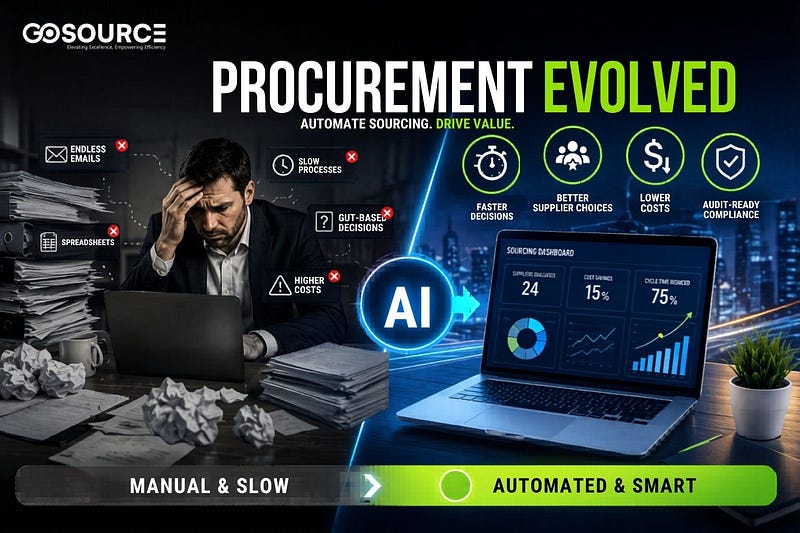
The result? Your procurement team is buried in spreadsheets, chasing supplier quotes over email, and making multi-million-dollar vendor decisions based on gut feel and outdated data. All while your competitors are automating the same process and reallocating those hours toward strategic growth.
This isn’t a technology gap. It’s a leadership blind spot, and it’s quietly bleeding your bottom line.
The Hidden Cost of Manual Sourcing
Ask your CFO how much time the procurement function spends on administrative tasks versus strategic work. Most won’t know. That’s the first problem.
Research consistently shows that procurement professionals spend 60–70% of their time on transactional, repetitive tasks: gathering quotes, sending follow-up emails, comparing vendor bids, and updating trackers. That’s not procurement; that’s data entry with a title.
For a company spending $10M annually on goods and services, even a 3–5% inefficiency in sourcing translates to $300,000–$500,000 in unnecessary costs. Not from fraud or negligence, just from slow, manual, disconnected processes that leave value on the table.
What Sourcing Automation Actually Means and What It Doesn’t
There’s a common misconception at the executive level: that “automating procurement” means replacing your team with software or reducing headcount.
It doesn’t. It means elevating what your team can do.
Modern sourcing technology handles the repetitive, low-judgment work of supplier discovery, RFQ distribution, bid collection, document parsing, and compliance checks so your procurement professionals can focus on what requires human expertise: relationship management, risk assessment, negotiation strategy, and cross-functional alignment.
Think of it this way: you didn’t give your finance team Excel to replace accountants. You gave it to them so accountants could stop calculating by hand and start delivering insight. Sourcing automation is the same shift, over a decade overdue.
Four Business Outcomes That Should Matter to Every CEO and COO
1. Faster Time-to-Contract
Manual sourcing cycles from need identification to signed contract routinely take 6 to 12 weeks. Automated sourcing platforms compress that to days. Faster sourcing means faster operations, faster product launches, and faster responses to market changes.
2. Better Supplier Decisions
When your team evaluates vendors based on three emailed quotes and a reference call, you’re working with incomplete data. AI-powered sourcing platforms analyze supplier performance history, financial health, geographic risk, compliance records, and pricing benchmarks, giving decision-makers a 360° view before they commit.
3. Measurable Cost Reduction
Automation increases competitive tension among suppliers by making it easier to solicit and compare more bids. More competition means better pricing. Companies that implement structured e-sourcing tools typically report an 8–15% reduction in sourcing costs in the first year alone.
4. Audit-Ready Compliance
Regulatory requirements, ESG commitments, and supplier diversity mandates are growing. Manual processes make compliance documentation a nightmare. Automated platforms create a clean, timestamped audit trail for every sourcing decision, protecting your business and satisfying board-level governance requirements.
The Competitive Divide Is Already Forming
Here’s what should concern every business leader: your more sophisticated competitors are not debating whether to automate sourcing. They already have.
They’re running AI-assisted supplier evaluations. They’re issuing RFQs to 20 vetted suppliers in the time it takes your team to build a shortlist of five. They’re using predictive analytics to get ahead of supply disruptions before they happen.
The companies that delay this shift aren’t just missing efficiency gains; they’re falling behind in resilience, agility, and strategic capability.
Where to Start: A Framework for Executive Decision-Makers
You don’t need to overhaul your entire procurement function overnight. Here’s a pragmatic path forward:
Step 1: Audit Your Current State. Quantify how long your sourcing cycles take, how many suppliers you evaluate per category, and what percentage of spend goes through a structured process. If you don’t have this data, that is a finding.
Step 2: Identify Your Highest-Leverage Category. Pick one spending category, indirect goods, logistics, or IT services, and run a pilot with a sourcing platform. Measure cycle time, cost savings, and supplier quality outcomes.
Step 3: Evaluate Platforms That Match Your Complexity. Not every business needs an SAP Ariba-scale deployment. Scalable, mid-market sourcing platforms now offer enterprise-grade capability without enterprise-grade implementation timelines or costs.
Step 4: Align Procurement Strategy with Business Strategy. Automation unlocks capacity. But that capacity needs direction. Work with your CPO or procurement lead to define what strategic sourcing looks like at your organization and build toward it.
The Bottom Line
The question for C-suite leaders is no longer “Should we automate sourcing?” but is less relevant than “How much longer can we afford not to?”
Every quarter that passes with manual sourcing processes is a quarter of avoidable costs, slower operations, and strategic opportunity lost to competitors who moved faster.
Sourcing technology isn’t a procurement initiative. It’s a business performance initiative, and it belongs to your agenda.