
Hvar Concierge Services: Luxury Villa Management & VIP Experiences in Croatia
Anyone who has tried to organize a week on Hvar knows how quickly the island's charm turns into logistics. Ferries fill up in July, the best tables in Hvar Town are booked weeks ahead, and a villa with a pool can look perfect in photos while hiding a broken water pump. This is the territory where a Hvar House style concierge model earns its keep: a single point of contact who handles villas, household needs, and on-island experiences so that guests and owners can focus on the reason they came. The question is what that help actually includes, and where its responsibilities stop.

What a Hvar Concierge Actually Covers and Where Its Scope Ends
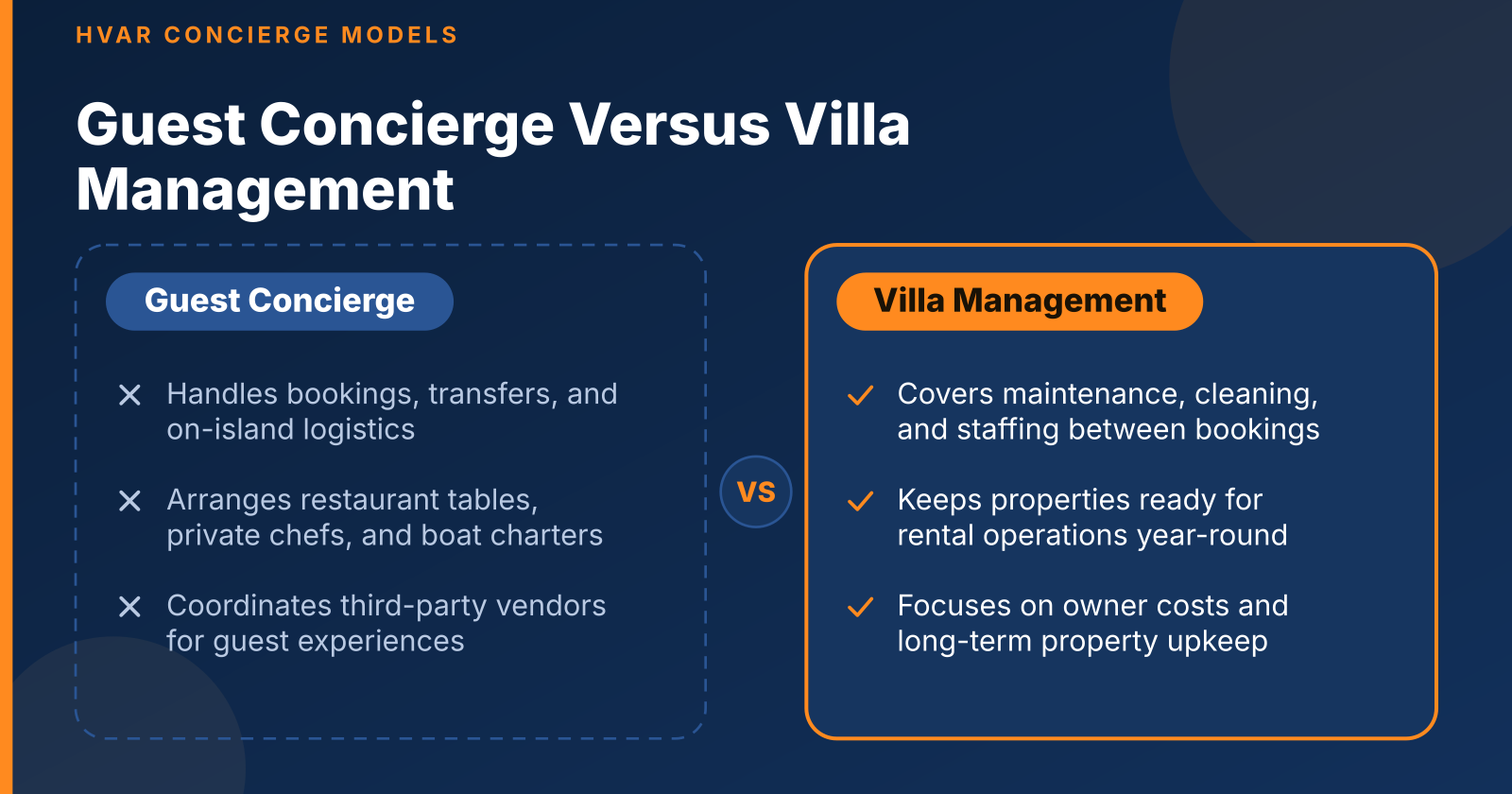
The word "concierge" is used loosely, so it helps to separate two models that often get blended together. The guest-facing concierge handles bookings, logistics, and on-island coordination: restaurant tables, private chefs, boat charters, transfers, and the small reservations that turn a holiday into something smooth. The owner-facing side is villa management, which covers maintenance, staffing, cleaning, rental operations, and the unglamorous work of keeping a property ready between bookings. A good provider can do both, but the two roles pull in different directions. An operator who earns commissions on restaurant bookings and charters has an incentive to steer guests toward partners who pay, and an owner's interest is to keep costs down. Readers should ask directly which side the provider represents when a recommendation is made.
- Some operators combine groups on the same vessel to fill seats, so ask whether the experience is exclusive and get that answer in writing
- Owners should be able to end the agreement with reasonable notice, and the contract should specify who holds the keys, access codes, and guest data at the end of the relationship
- Contingency plans should exist for weather, vendor failure, and medical incidents, including the nearest medical facilities and the process for contacting emergency services
- Start with a clear list of what you need, ask for the written scope and the references, and compare the answers carefully
Demand on Hvar also shifts sharply across the year, and that shift changes the service mix. From May through October the island is busy with day-trippers, yacht traffic, and families arriving on weekly rental cycles, so most requests concentrate on cleaning turnarounds, check-in logistics, and last-minute table reservations. In the shoulder months, the work tilts toward maintenance, pool preparation, and off-season repairs, because owners use quieter weeks to fix what summer wore down. A provider that markets itself as year-round should be able to explain how its team and vendor list change between these periods, rather than promising the same level of responsiveness in every month.
Several things are typically outside a concierge's authority, and knowing this in advance prevents disappointment. Transfers from Split or from the ferry terminal in Stari Grad and Hvar Town are usually arranged by the concierge but operated by independent drivers or boat captains, so liability for delays rests with those operators under their own terms. Medical, legal, and immigration matters belong to licensed professionals; a concierge can help find a doctor or a notary but cannot stand in for them. Independent yacht captains, caterers, and handymen are also third parties. The concierge coordinates them, and the contract should state clearly what the coordinator guarantees and what remains the vendor's responsibility.
Ask every provider to put in writing who is responsible when a boat is cancelled, a chef is ill, or a ferry is delayed. A verbal promise of "we'll sort it out" is not a service level.
How to Evaluate a Hvar Concierge Provider
Marketing language about "luxury" and "seamless" experiences tells you very little, so the useful evaluation starts with verifiable facts. Look first at operational credentials. A provider working in Croatia should be able to show local business registration, the relevant tourism board membership, and the licensing needed for the services it sells, whether that is accommodation management or the organization of tours and charters. Insurance deserves a direct question: does the policy cover guest activities, damage to the property, and the liability of the staff who enter the house? A provider that hesitates to show its insurance details has given you a clear answer already.
Staff structure is the next thing to examine, because it determines what happens during peak weeks. Some concierge businesses rely on a small in-house team supported by freelancers; others sub-contract almost everything. Neither model is wrong, but each has a different failure mode. Freelance-heavy operations can be flexible yet inconsistent, while small in-house teams may struggle when several villas need attention at once in August. Ask how many coordinators cover peak weeks, who answers the phone after hours, and what the escalation path looks like when a pool pump fails at midnight. Response time guarantees should be stated as numbers, not adjectives.
Reference checks tell you more than brochures. Ask about the repeat-client rate, because owners who return year after year are the strongest signal of reliable service. Ask how complaints were handled, not whether there were any, since every operator has problems and the difference lies in the response. Read the cancellation policy closely, especially for charters and private chef bookings where weather, fuel costs, and vendor availability can change the picture quickly. Transparency here is a reliable indicator of how the provider will behave when things go wrong.
Pricing structures vary widely and are easy to misread. Retainer-based arrangements suit owners who need steady oversight of a villa across the year, because the monthly fee covers inspections, supplier coordination, and standby availability. Per-task fees work better for guests who want a single cleaning or one restaurant reservation, or for owners with a light, predictable schedule. The critical detail is commission. Many providers earn a percentage from restaurants, charter operators, and chef services, and that income is rarely visible on the invoice. Ask directly whether commissions are charged, at what rate, and whether they are disclosed to the client. Also check for peak-season surcharges, marine fuel adjustments on boat trips, and gratuity expectations, which can add a meaningful share to the final bill.
Step-by-Step Process: From First Inquiry to Arrival on Hvar
Planning starts earlier than most people expect. For July and August, the strongest villas and yachts often fill months ahead, so an inquiry sent in early spring gives you real choice, while one sent in June may leave only the less convenient options. Shoulder-season travel in late May, June, or September is more flexible, and prices are usually lower, although some seasonal restaurants and boat operators reduce their schedules. Restaurant timing follows a similar logic: the most popular venues in Hvar Town take bookings for peak evenings well in advance, and a good concierge will request the tables you want as soon as your dates are confirmed rather than hoping for cancellations later. For guests who prefer to handle the details of their stay through a single point of contact, Hvar House offers an arrangement where villa preparation, transfers, and dining bookings are coordinated in one place, which can simplify planning during the busiest weeks of the season.
A practical document checklist prevents last-minute stress. Every guest should carry a valid passport or national identity card that meets the entry requirements for their nationality, and the lead traveler should have the booking confirmation for the villa and any charter or transfer. If the trip includes a privately chartered boat with a skipper, confirm which permits and crew documents the operator requires. A concierge who has run these itineraries before will send a short list well ahead of arrival, and that list is a good test of how organized the provider is.
During the stay, the value of a concierge lies in how changes are handled. Daily itineraries should be confirmed the evening before, with clear workflows for changes: who can approve a switch of restaurant or boat, how quickly the coordinator responds, and whether there is a cost for last-minute adjustments. Weather is the main variable on the water. Boat tours are typically rescheduled rather than refunded when the sea is rough, but the rules differ between operators, so the terms should be agreed before the first trip. Communication channels matter too. Establish one messaging method, usually WhatsApp or email, and one contact person, so that requests do not fragment across several people.
For owners, the post-stay cycle is where management quality becomes visible. Between bookings the property needs inspection, cleaning, linen replacement, pool checks, and any repairs noted by the previous guests. A well-run system produces a short written report after each turnover, with photos where useful, and flags anything that needs attention before the next arrival. Financial reporting should show rental income, deductions for services, and payout timelines in a format the owner can check against bank statements. If payouts are slow or reports are vague, that is a warning sign that deserves a direct conversation.
Common Mistakes Clients and Owners Make and How to Avoid Them
Guests most often underestimate peak-season pressure. Ferry capacity on the main routes is limited in July and August, and a private transfer booked on the day may cost far more than one arranged a month ahead. The same applies to restaurants and boats: the best experiences tend to go first, and a "private" tour is not always private. Vague inclusions cause a second category of disappointment. A welcome pack, a chef for dinner, or a full-day charter can mean very different things depending on the provider, so the written scope should list quantities, hours, and what is excluded.

Owners make their own characteristic errors. Choosing a manager on price alone is the most common, and it often reveals itself months later when maintenance is patchy, guest complaints go unanswered, or repairs are delayed because nobody was authorized to approve the spend. Clear authority limits solve this. The contract should state the amount up to which the manager can act without approval, how emergency repairs are handled, and how quickly the owner is informed. Exit clauses are equally important. Key and data handling is often overlooked until something goes wrong.
Risk mitigation comes down to written discipline. Contracts should define service levels, such as response times, inspection frequency, and the standard of cleaning, along with escalation procedures for emergencies. Finally, regular performance reviews, perhaps quarterly for owners and at the end of each stay for guests, allow both sides to measure delivery against what was agreed rather than against memory.
Conclusion: Choosing Concierge Support That Fits Your Hvar Plans
A concierge on Hvar is most valuable when its role is defined precisely: which tasks it performs, which it coordinates, and which remain with independent operators or with you. Readers who take the time to separate guest services from villa management, check credentials and insurance, read the commission and cancellation terms, and plan around the realities of peak season will get far more from any provider. Done this way, a concierge becomes the quiet structure behind an unforgettable stay, and a dependable partner for the property that keeps it running between visits.