Shangku is a two-door coupe owned by Volkswagen; its avant-garde and cool look has attracted a lot of attention; excellent handling performance also attracts many sports fans; Shangku adopts the EA113 2.0TSI engine, the 2.0TSI liter turbocharged direct injection gasoline engine +6 DSG dual clutch gearbox. This perfect combination provides a sustainable maximum torque of 280N·m and a maximum speed of 238km/h. Shangku 2.0 can also significantly improve the power performance, which increases fuel efficiency. It is more energy efficient. Although it is very satisfying in the performance, there is always a shortage of one side because of the electronic throttle design. The phenomenon of sluggish throttle response and frequent starting frustration makes many car owners unable to drive incisively and vividly and get fun. Plug and go throttle controller of PotentBooster. It solves the shortcomings, which makes the sports car "crazy wild up" and more cool.
Plug and go throttle controller is a vehicle acceleration improvement. By controlling the opening and closing sensitivity of the throttle, not only you can find the strong acceleration feeling of pulling the throttle back in the past, but also it greatly improve the control degree of the electronic throttle. The acceleration is graded from weak to strong, allowing the owner to choose the driving style he likes.
We have e throttle booster for sale! POTENT BOOSTER, founded in 2008, works on develop, produce, sale and related service for Electronic throttle controller, Jump starter etc. Welcome to contact us for more information or get quotation!
Potent booster electronic throttle controller is also called accelerator. It is the best electronic throttle controller. It usually has output values that are within the approved engine power. It won't do any harm to the car.
Electronic throttle valve is widely used in cars now, but electronic throttle valve has a disadvantage is the throttle valve slow response, throttle idle speed and some other problems. In some cases, such as climbing, a strong sense of stupor will occur, and even lead to the sudden forward movement of the vehicle. Electronic throttle does not limit the engine output, just to meet the needs of intelligent efficiency, because not everyone will feel the throttle slow.
Why don't car manufacturers just install or produce?
In fact, this problem is very easy to understand, car manufacturers will consider the user feeling based on big data and production. The preferences of everybody is different, some people like the car power strong, some like fuel economy, some like chassis low or high, and so on, something impossible to let all people like, electronic throttle accelerator is not exceptional also, only people who like to play cars with throttle delay to installation. Now some high-end cars will also come with a variety of car driving mode, the principle is similar to the accelerator.
No harm to your loved car
Car throttle controller makes accelerator pedal more responsive and faster to start. Electronic throttle accelerator is not an active signal equipment, but a passive receiving signals and then transfer out of the equipment, does not destroy any of the original car line. If the equipment is broken, no power, it is equivalent to a physical adapter, the car will only turn to the original car mode, will not cause load on the car, can be said to be zero damage to the car, commonly used throttle controller can also reduce the engine carbon deposition. Now the accelerator is more intelligent, faster or slower, all depend on you. No matter what kind of road conditions can cope with. The installation also does not destroy the car. It can be installed without any tools and can be done in 10 minutes, plug and play.
We have e throttle controller for sale! POTENT BOOSTER, founded in 2008, works on develop, produce, sale and related service for Electronic throttle controller, Jump starter etc. Welcome to contact us for more information or get quotation!
As vehicle emission control becomes more stringent, major automakers around the world have abandoned wire-type throttles and switched to more precise electronic throttles, but such throttles have the disadvantage of slower response. The electronic throttle accelerator is a good choice for some owners who are not satisfied with the slow response of the car throttle and start meat. Its function is to improve the throttle response speed, improve the car start speed, improve the vehicle throttle sensitivity, and reduce the engine carbon deposit. Let you find the feeling of pulling the throttle.
1. Before installation, first check the direction of each plug and socket, and identify the exit position of the accelerator pedal port, the direction of the accelerator pedal, the shape of the plug interface, etc.
2. First find the signal port behind the accelerator pedal. Most cars can be installed without removing the throttle pedal.
3. Unplug the original electronic throttle signal port. Note: Different plugs are different. Please look at it first and then pull it out, which can not be brute force, so as not to damage the port.
4. Connect the electronic throttle accelerator to the throttle pedal signal port. Note: Do not insert the ports on both ends of the accelerator.
5. Install the monitor in a fixed position for your own operation. Tie the extra wires and fix them.
We have electronic throttle control for sale! POTENT BOOSTER, founded in 2008, works on develop, produce, sale and related service for Electronic throttle controller, Jump starter etc. Welcome to contact us for more information or get quotation!
In traditional vehicle designs, stepping on the accelerator pedal moves a cable that is mechanically connected to a butterfly valve in the engine's throttle. The position of this valve directly controls the amount of air supplied to the cylinders and consequently determines the engine speed and torque. Most vehicles on the road today have electronic throttle controls. In these vehicles, stepping on the accelerator pedal sends an electrical signal to the engine control module (ECM). The ECM uses this information to send a control signal to an electric motor mounted to the throttle body that adjusts the position of the butterfly valve accordingly. A throttle position sensor is used to create a closed-loop control system to ensure that the throttle is open to the correct position.
A major advantage of an electronic throttle is that it can be easily linked to other systems such as engine control, traction control, electronic stability control and cruise control. These other systems are able to take control of the throttle when necessary to help improve vehicle safety, convenience and fuel economy. For example, the National Highway traffic Safety Administration has proposed a rule that all cars be required to have a brake-throttle override (BTO) system in place by September of 2014. The BTO system would give priority to brake inputs when the brake pedal and the accelerator pedal were engaged at the same time.
Like all of the electronic systems controlling safety critical functions in a vehicle, electronic throttle controls are designed with certain fail-safe features, including redundant sensors and self-diagnostic capabilities.
It's important that ETC reacts to fault detection with the correct countermeasure. Depending on the severity of the fault, the system may revert to one of the following four operating modes.
1. Limit Performance Mode
This safety mode will operate "when a reduction in the reliability of determining driver intent has been detected or when the ability to create high levels of engine power is impaired". Most typically it is caused by loss of accelerator pedal redundancy (meaning there's only one operational sensor signal) or there's a processor fault. Once tripped, Limited Performance Mode gives dulled throttle response, reduced engine torque at all throttle positions and brake pedal applications sets the engine to idle. It is still possible to continue driving.
2. Forced Idle Mode
This mode will engage when the system cannot sense reliable information on driver intent. A complete electronic throttle control failure will cause this condition. As you might've guessed, all that the engine can do in Forced Idle Mode is idle. It will not respond to accelerator applications. The primary aim of this mode is simply to maintain power for vehicle heating, cooling and lighting during adverse weather.
3. Power Management Mode
The only time this mode will activate is when the system is unable to control engine power via the throttle. In this instance throttle actuation is disabled, allowing the butterfly to spring back to its default position. It is still possible to continue driving (albeit slowly) thanks to the main processor's on-going control over fuel and ignition timing.
4. Engine Shutdown Mode
This is the most severe action that the main processor can take. If unable to control algorithms or engine power, the Delphi system disables fuel, ignition and throttle outputs. The engine is totally shut down. The most likely cause of this extreme condition is a processor fault or the inability of the throttle and/or intake system to control airflow.
We have throttle control for sale! POTENT BOOSTER, founded in 2008, works on develop, produce, sale and related service for Electronic throttle controller, Jump starter etc. Welcome to contact us for more information or get quotation!
Car throttle controller usually uses wo pedal position sensors and two throttle position sensors. The two sensors are connected in reverse to realize the reverse change of the resistance value, that is, the sum of the resistance changes of the two sensors is zero. When the same voltage is applied to the two sensors, the output voltage signals of the two sensors will change in reverse, and their sum is always equal to the supply voltage. Drivers can choose different working modes according to different driving conditions with mode switches. Generally, there are three modes: normal mode, power mode and snow mode. The difference of the three modes is that their response speed of throttle to accelerating pedal is different.
In normal mode, the response speed of car throttle controller to accelerating pedal is suitable for most driving conditions. In power mode, the throttle accelerates the response speed to the accelerating pedal, and the engine provides additional power. Under the condition of poor adhesion (e.g. snow, rainy day), the driver can choose snow mode to drive the vehicle. At this time, the response of throttle to acceleration pedal is reduced, and the output power of engine is smaller than that of normal condition, which makes the wheel not easy to slip and keeps the vehicle running steadily.
Up until the late 1980s, most cars had a fairly straightforward throttle control. You stepped on the accelerator pedal, the throttle opened, and air flowed into the engine, where it mixed with gasoline and burned. This burning gas powered the car's wheels, getting you down the road. If you wanted to go faster, all you had to do was step down harder -- the throttle would open wider, giving the car more power.
But electronic throttle control, which is sometimes called drive-by-wire, uses electronic, instead of mechanical, signals to control the throttle. That means that when you step on your car's gas pedal, instead of opening the throttle, you're activating an accelerator pedal module, which converts the pressure you put on the pedal into an electric signal. That signal is then sent to an electronic control unit, which takes your inputs into account, as well as outside variables, to open the throttle for optimum efficiency and performance.
It's a complex system, but one that has a lot of benefits for engine wear, performance and efficiency. However, like any complex system, it's not perfect, and drivers have raised a lot of questions about them. Can outside signals interact with the ETC? What kind of failsafe are in place if such interference happens? Read on to learn the answers.
Benefits of Electronic Throttle Control Electronic throttle control systems may seem a little silly. After all, if a mechanical throttle control system works, why make it more complicated?
While it's true that electronic throttle control adds complications, it also adds a number of benefits. The first is decreased maintenance. Mechanical throttle systems, because they are made up of a lot of moving parts, are subject to a lot of wear. Over the life of the car, the various components can wear out. By comparison, an electronic throttle control system has comparatively few moving parts -- it sends its signals by electric impulse, not moving parts. That reduces wear and the amount of maintenance needed on the system.
Beginning in 2009, electronic throttle control systems made headlines as a result of a large-scale recall of Toyota vehicles due to acceleration control problems. Given the negative press electronic throttle control systems received, you may be surprised to know that electronic throttle controls add a number of safety benefits over mechanical systems. In a mechanical system, the throttle relies only on driver input to decide how far to open or close. With an electronic throttle control system, the main control unit not only reads input from the driver's foot on the accelerator, but it also examines input from wheels that are slipping, wheels that have grip, the steering system and the brakes, helping correct driver error and keep the car under control. In other words, a throttle control system can balance several factors that affect a car's speed and direction -- not just a foot on the pedal. Plus, electronic throttle control is a key component in most cruise control systems.
Electronic throttle control may be a complex system, but it makes driving a car easier and safer, and it can reduce maintenance.
Now the relatively new car models generally use electronic throttle. Electronic throttle vehicles are generally appearing in the throttle lag problem, because of environmental protection, economy, reliability and other reasons. Traditionally, the accelerator pedal is directly connected to the throttle with a thin steel cable. The depth of the accelerator pedal directly corresponds to the opening and closing of the throttle. The electronic throttle has no cable. By installing a potentiometer (variable resistance) in the pedal, the depth of the accelerator pedal is converted into the resistance value. The ECU of the car determines the depth of the accelerator pedal indirectly through sampling the resistance value. Electronic throttle is characterized by the fact that the accelerator pedal only represents the driver's intention to operate, and the final throttle control is given to the ECU.
How does Potent Booster electronic throttle controller remove the lag?
(1)Accelerate throttle opening to enhance static response Potent Booster is mainly achieved by enhancing the throttle response sensitivity. When the system detects that the driver is willing to accelerate, the throttle is driven by the circuit to open as quickly as possible, thus enhancing the sensitivity of throttle response. But the Potent Booster electronic controller does not reduce the grading of accelerator pedal signals, as many have claimed. In fact, accelerator pedal signals remain step less.
(2)Amplifying throttle signal speed and improving dynamic response
When the accelerator pedal is pressed, the accelerator will calculate the rate of change of accelerator signal according to the pedal amplitude and time. The faster the change, the stronger the acceleration requirement will be, and the electronic accelerator will increase the rate of change, ultimately achieving better acceleration dynamic response.
(3)Provide false driving style for ECU to adjust engine parameters
The ECU of modern engines generally has the ability to adapt to the driving style. If the driver often puts a fast and deep foot on the accelerator (commonly known as pull speed), the ECU will gradually think that the style of the driver tends to be "fierce". In this way, the engine will slowly adjust the throttle and fuel injection system to get the best adjustment parameters of the engine in this style. After long-term use of the Potent Booster electronic throttle controller, the engine will still get a "fierce" driving experience even if driving according to the previous "mild" driving style, which is equivalent to adjusting the ECU parameters. Over time, the engine will automatically modify its parameters to adapt to the style.
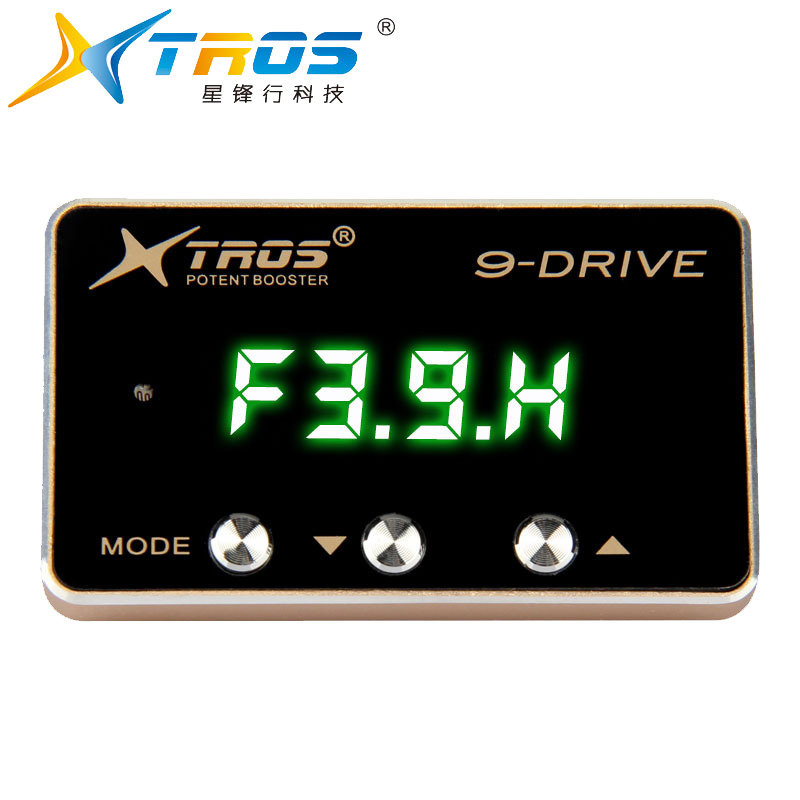
TROS new product Throttle Sensitivity Booster is easy to install, delivers immediate improvement with pedal response, and will enhance your driving experience. TROS offers an incredibly simple solution that generates “seat of the pants power” you won’t find anywhere else. TROS can pair with any of Edge’s performance products for maximum performance gains, or function as a standalone module, on gas and diesel applications.
The TROS Throttle Booster adjusts the vehicle’s throttle sensitivity, which reduces that dead pedal feeling while accelerating. Late model vehicles are built with an accelerator pedal position sensor to control engine fueling. The TROS Throttle Booster takes that stock signal of the accelerator and changes the mapping, which leads to a more sensitive throttle, giving access to more on-demand power. The addition of the TROS Power Switch allows your customers to adjust throttle sensitivity settings on-the-fly.
2.How is TROS throttle booster performance?
Includes coverage on the late model Power Stroke, Cummins, engines
Increases accelerator pedal response over stock
User-adjustable throttle sensitivity settings
Reduces dead pedal feeling (acceleration lag)
Works with stock or modified vehicles
Build turbo boost quicker on turbo charged vehicles
Multiple adjustable throttle sensitivity levels
Easy installation
3 . In the end.
TROS throttle controller is a complete solution for poor throttle response! Eliminate the slow throttle response on modern drive-by-wire vehicles, and improve your driving experience. It utilizes a plug and play design that is easy to install. All you do is unplug the factory connector from the accelerator pedal and connect the Plug and Play TROS. TROS can also be stacked with a TROS custom tune file that works with most SCT Handheld Tuning Devices
1.Must pull out the key after car power off ( if the car have key )
2.Install the product 3 minutes later after car power off.
Rev is normal but warning light on:
Solution:
1.Turn off car, start car again 3 seconds later, Repeat 3-5 times.
2.Flash ECU to remove warning light.
3.If the above solutions are no useful, remove throttle controller, after 3-5 minutes, then install throttle controller again.
Throttle pedal is abnormal, Rev can't go up, Warning light on:
Solution:
1.Check throttle controller plug NO. Whether fit car models.
2.Check the product whether plug well.
3.Remove throttle controller , after 3-5 minutes, then install throttle controller again.
Can't start car and Rev keep highly:
Solution:
1. Check throttle controller plug NO. Whether fit car models.
2. Check the product whether plug well.
3. Check the product whether plug reverse. ( Especially note plug NO. 510 )
4. Check the 6 pins whether broken in the plug socket.
Turn off car, the product controller light still on:
Reason : After turn off car, some car models need a little long time to Completely powered down, after 30 minutes, the controller light will be off. ( Note: Can’t use key to open car door, just see from outside the door )
Problem come out when driving:
1.Warning light on, throttle pedal is abnormal :
Solution : Remove the product, change to original car.
2. Waring light on, throttle pedal is normal :
Solution : Remove the product and install it again.
Up until the late 1980s, most cars had a fairly straightforward throttle control. You stepped on the accelerator pedal, the throttle opened, and air flowed into the engine, where it mixed with gasoline and burned. This burning gas powered the car’s wheels, getting you down the road. If you wanted to go faster, all you had to do was step down harder-- the throttle would open wider, giving the car more power.
But electronic throttle control, which is sometimes called drive-by wire system, uses electronic signals instead of mechanical to control the throttle. That meas that when you step on your car’s gas pedal, instead of opening the throttle, you’re activating an accelerator pedal module, which converts the pressure you put on the pedal into an electric signal. That signal is then sent to an electronic control unit, which takes your inputs into account, as well as outside variables, to open the throttle for optimum efficiency and performance.
With electronic throttle control, electrical signals, rather than manual pressure, carry messages from the gas pedal to the car’s throttle. The “drive-by-wire” system has surpassed the crude accelerator wire in commanding the engine control unit. Commands are performed by engine control unit, which electronically regulates the level of power output desired.
In theory, an electronic throttle controller sounds like and amazing alternative to traditional mechanical throttle control system. However, electronic throttle control system are not without problems. The most serious of these problems is response time. When using an electronic throttle control, throttle response time is considerably slower than it would be with mechanical throttle control. This can drastically increase the amount of time it takes for your vehicle to reach full power output, making your vehicle feel more sluggish, or seem less powerful, as well as slowing its rate of acceleration. This can be a problem if your car’s acceleration rate is already lower than you would like.
If you are always trying to push your car to limits and love cars with fast acceleration, a slow response time can be significant source of frustration, as it drastically increase your car’s acceleration time, making the entire car feel more sluggish. Luckily, there is a solution to this problem.
TROS Drive By Wire Accelerator makes it possible to resolve this natural dynamism, making your car much more reactive and lively. TROS Electronic throttle controller can be adjusted to suit your driving style and will not increment power output of your car but improve throttle response to match your personality.
Our Electronic throttle controller are vehicle specific and not generic/universal, in other words we do not have a “one size fits all”. Our units are specifically designed for different engines and different fuel systems. Select your vehicle brand, model and engine and find the best suitable model.