
Introduction
By 2026, Seedance 2.0 from ByteDance has become one of the go-to models for cinematic AI video generation. With native audio, lip-sync, and strong character consistency, the model now powers everything from short-form ads to indie film and product demos. ByteDance's Volcano Engine ranks Seedance among the top multimodal video models on public benchmarks, and adoption has spread fast across creative agencies, e-commerce teams, and solo developers. To plug Seedance 2.0 into production workflows, most teams reach for the Seedance 2.0 API . But the model is only half the story — the API layer is where the real decisions get made. Pricing, resolution limits, concurrency, and creative tooling differ widely across the providers that expose Seedance 2.0 through their endpoints. A wrong choice can mean paying twice as much for the same output, or hitting credit caps mid-project. Some providers charge official ByteDance rates, others offer discounted credit systems, and a few bundle Seedance inside broader creative suites. This guide compares the 10 leading providers offering the Seedance 2.0 API in 2026. Each one is reviewed on the same six criteria so you can pick the platform that fits your workflow, budget, and scale. At the end, we preview what's coming next with the Seedance 2.5 API.
How We Compare
Every platform here was reviewed on the same six points:
- Pricing model: pay-per-second, credit pack, or subscription
- Model variants: Mini, Fast, Pro availability
- Resolution and duration: 480p–4K, clip length, frame rate
- Multimodal inputs: text, image, reference video, audio, lip-sync
- Reliability: uptime data and concurrency limits
- Target user: who the platform actually serves
All figures come from each platform's official documentation. We list both entry and high-end rates so you can plan around your real workload.
TL;DR: Best Seedance 2.0 API Providers Compared
| Platform | Pricing Model | Starting Price | Highlight | Big For |
| ApiPass | credit, per second | $0.061/sec (480p ref) | 13%–32% off official rates | High-volume projects |
| OpenRouter | Pay-per-second | $0.00718/sec (low tier) | Unified API Marketplace | Multi-model developers |
| Fal | Pay-per-second | $0.061/sec (480p ref) | New audio included | Project Developer |
| ArtList | Subscription | $50/month | 4K cinematic output | Filmmakers |
| Atlas Cloud | Pay-per-second | $0.09/sec (Fast) | Phoneme-level lip-sync | E-commerce, music videos |
| VideoGen | Subscription | $29/month | Multi-model bundle | Studios with fixed budgets |
| KIE | Credit, per-second | $0.0575/sec (480p ref) | 4K support | 4K cinematic creators |
| Kinovi | Credit pack | $0.0353/sec (Mini) | Non-expiring credits | Concurrency-focused teams |
| Topview | Subscription | $16/month | AI agent bundle | Solo creators |
| PoYo | Pay-per-second | $0.024/sec (Mini 480p) | Lowest entry rate | High-throughput pipelines |
Here's the detailed breakdown of each platform.
10 Best Seedance 2.0 API Providers Reviewed: Which Suits You Best?
ApiPass
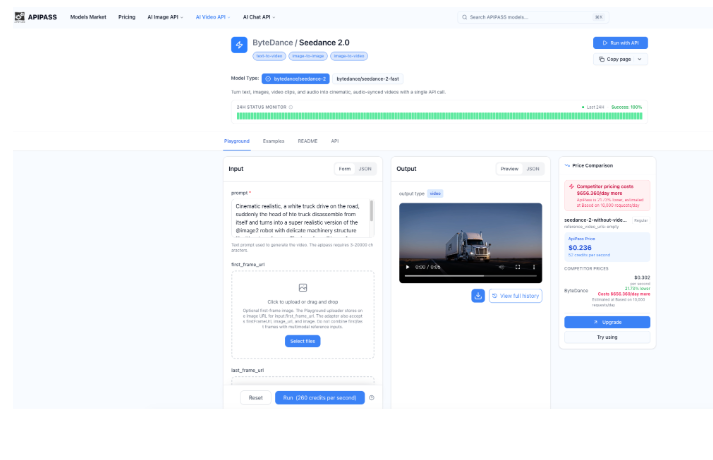
ApiPass is a credit-based API gateway built to deliver the full Seedance 2.0 feature set at prices well below official ByteDance rates. It targets teams running daily production workloads where every cent per second matters. Features:
- Text-to-video, image-to-video, and reference-video workflows
- Cinematic textures, realistic lighting, advanced physics
- Synchronized audio-visual output
- Aspect ratios: 1:1, 9:16, 16:9
- Strong temporal consistency across frames
- Seedance 2.5 API launching soon, with 30-second clips and frame-level editing
Seedance 2.0 API Pricing: Credit-based, billed per second.
| Resolution | Without Reference Video | With Reference Video |
| 480p | $0.111/sec | $0.061/sec |
| 720p | $0.236/sec | $0.145/sec |
| 1080p | $0.555/sec | $0.355/sec |
ApiPass delivers 13%–32% savings versus official rates. For 1,000 ten-second 1080p videos without reference, that means roughly $1,300 in daily savings at scale. The same credit balance also unlocks Seedance 2.5 on launch day with no separate signup.
Pros and Cons:
- Pros: significant cost savings, transparent credit system, lower reference-video rates, early Seedance 2.5 access
- Cons: credits require upfront purchase
Best for: High-volume developers, agencies, and studios that want official-tier output without official-tier billing.
OpenRouter
OpenRouter is a multi-model marketplace that exposes Seedance 2.0 through a unified endpoint shared with hundreds of other AI models. Developers use it to route between video, text, and image models without managing separate keys. Features:
- Top-tier ranking on the OpenRouter Text-to-Video Arena (1,273 Elo)
- Text-to-video, image-to-video, and reference-to-video
- First-frame and last-frame control
- Character consistency across shots
- Consistently high uptime per OpenRouter's status page
Seedance 2.0 API Pricing: $0.1512/sec via the "Seed" provider. Smaller variants start as low as $0.00718/sec. Audio is included at no extra cost.
Pros and Cons:
- Pros: stable infrastructure, strong benchmarks, single API for many models
- Cons: less creative tooling than dedicated platforms, provider rates vary
Best for: Developers integrating multiple AI models behind a single API key.
Fal
Fal is a developer-first inference platform with clean resolution-based pricing. It's a popular pick for engineering teams that want predictable per-second costs and well-documented endpoints. Features:
- Text-to-video, image-to-video, and reference-video modes
- Native audio and lip-sync included
- Reference tagging via [[image]] and [[video]] prompts
- 10-second clips at 24fps
- Standard and Pro tiers at the same per-second cost
Seedance 2.0 API Pricing:
| Resolution | Standard | Reference Video |
| 480p | $0.111/sec | $0.061/sec |
| 720p | $0.236/sec | $0.145/sec |
| 1080p | $0.555/sec | $0.355/sec |
Fal's headline rates match official ByteDance pricing. ApiPass undercuts those same rates through credit-based billing.
Pros and Cons:
- Pros: audio included free, granular reference tags, clean developer docs
- Cons: no discount versus official rates, no subscription option
Best for: Production developers who need fine-grained reference control.
Artlist
Artlist bundles Seedance 2.0 into its AI Toolkit, aimed at filmmakers and high-end creators who want a one-stop subscription with stock assets included. Features:
- 4K cinematic output with director-level camera controls
- Multi-shot continuity and advanced scene styling
- Pro, Fast, and Mini variants
- 4K reference video support (up to 10 seconds)
- Bundled stock music and assets
Seedance 2.0 API Pricing:
- Max Plan: $50/month, 12,500 credits
- Max Business: $399/month, 150,000 credits, 7 seats
- Custom Business: tailored for 50+ employees
- Seedance 2.0 Pro Fast included in Unlimited Generations with 900 monthly fast runs
Pros and Cons:
- Pros: 4K resolution, unlimited tier, integrated stock library
- Cons: subscription-only, credit caps on lower plans
Best for: Filmmakers and game designers who need cinematic quality with predictable billing.
Atlas Cloud
Atlas Cloud positions Seedance 2.0 as a premier multimodal model focused on tightly synced video and audio. Its standout is phoneme-level lip-sync that holds up across multiple languages. Features:
- Dual-branch diffusion transformer for audio-video coupling
- Physics-informed world model for realistic motion
- Phoneme-level lip-sync across 8+ languages
- FlashVSR super-resolution (1080p-SR or 1440p-SR)
- Standard and Fast variants with a 95% output success rate
Seedance 2.0 API Pricing:
- Standard: ~$0.112/sec across modalities
- Fast: ~$0.09/sec, with optimized workloads as low as ~$0.022/sec
Pros and Cons:
- Pros: strong audio-video sync, multi-lingual lip-sync, super-resolution upscaling
- Cons: mid-tier pricing, no public credit pack option
Best for: E-commerce sellers, music video producers, and social-media teams needing accurate lip-sync.
VideoGen
VideoGen is a subscription platform that bundles Seedance 2.0 alongside other premium video models. It's built for teams that want one monthly invoice covering multiple AI engines. Features:
- Cinematic visuals, temporal consistency
- 480p, 720p, and 1080p outputs at 24fps
- 10-second clips
- Multi-model access (Kling 3.0, Hailuo 2)
Seedance 2.0 API Pricing:
| Plan | Price | Monthly Limit | Max Duration | Max Quality |
| Demo | $29/mo | 500 videos | 15s | 480p |
| Professional | $49/mo | 1,500 videos | 30s | 1080p |
| Unlimited | $199/mo | Unlimited | 60s | Model max |
Pros and Cons:
- Pros: flat monthly fee, multi-model bundle
- Cons: Demo capped at 480p, monthly video limits
Best for: Studios producing steady volume who want fixed costs.
KIE
KIE is a credit-based API platform offering Seedance 2.0 with multi-resolution support all the way up to 4K, optimized for cinematic and human-centric video production.
Features:
- Cinematic human-centric output with strong multi-shot character consistency
- Realistic visual fidelity across 480p, 720p, 1080p, and 4K
- Seedance 2.0 Standard: ~5 minutes per generation
- Seedance 2.0 Fast: ~4 minutes per generation
- Sophisticated multimodal control with precise prompt following
Seedance 2.0 API Pricing: Credit-based, billed per second. Billing differs by whether a reference video is used:
- No Video Input: Total Cost = Price × Output Duration
- With Video Input: Total Cost = Price × (Input + Output Duration)
| Resolution | With Video Input | No Video Input | Credits/sec (No Video) |
| 480P | $0.0575/sec | $0.095/sec | 19 credits/s |
| 720P | $0.125/sec | $0.205/sec | 41 credits/s |
| 1080P | $0.31/sec | $0.51/sec | 102 credits/s |
| 4K | $0.64/sec | $1.04/sec | 208 credits/s |
High-tier top-ups receive a +10% bonus, reducing effective cost by roughly 10% below listed rates. Pricing is currently in beta and subject to change.
Pros and Cons:
- Pros: 4K support, transparent dual-rate billing, top-up bonus discounts
- Cons: 1080p and 4K rates higher than ApiPass, beta pricing may shift
Best for: Developers and creators who need 4K cinematic output with flexible credit-based billing.
Kinovi
Kinovi sells non-expiring credit packs with tiered concurrency support. The non-expiry policy is its biggest differentiator for teams whose workloads spike unpredictably.
Features:
- Mini, Fast, and Pro tiers across 480p, 720p, and 1080p
- Integrated audio with lip-sync
- Strong character and environment consistency
- Multi-language prompt following
Seedance 2.0 API Pricing:
| Pack | Price | Credits | Concurrency |
| Starter | $9.99 | 2,150 | 2 |
| XL | $99.9 | 21,500 | 10 |
| Studio | $999.9 | 215,000 | 50 |
Per-second rates range from $0.0353 (Mini 480p) to $0.4239 (Pro 1080p).
Pros and Cons:
- Pros: steep Mini discounts, credits never expire
- Cons: Pro 1080p still costly, many tiers to track
Best for: Teams with bursty workloads who want non-expiring credits and fixed concurrency tiers.
Topview
Topview is a subscription platform mixing Seedance with broader AI agent features. It targets creators who want generation plus automation in one tool.
Features:
- Synchronous audio-video with lip-sync
- 3D transformation from 2D references
- 40+ language prompt support
- Outputs at 480p, 720p, and 1080p
- Aspect ratios: 1:1, 9:16, 16:9, 3:4, 4:3
Seedance 2.0 API Pricing:
| Plan | Price | Capacity |
| Pro | $16/mo | ~248 videos/year |
| Business | $44/mo | ~784 videos/year |
| Ultra | $50/mo | ~1,308 videos/year |
Pros and Cons:
- Pros: low entry price, AI agent bundle
- Cons: hard credit caps, lower tiers fill up fast
Best for: Solo creators and small teams that want simple monthly billing.
PoYo
PoYo focuses on affordable pay-per-second billing with enterprise-grade concurrency. Its low entry rate makes it popular for prototyping pipelines before scaling up.
Features:
- Mini, Fast, and Pro tiers
- Unified audio-video output with lip-sync
- Director-level camera controls: pan, zoom, orbit
- 99.9% uptime
- Video extraction and style transfer
Seedance 2.0 API Pricing:
| Model & Resolution | Standard | With Reference |
| Mini 480p | $0.024/sec | $0.015/sec |
| Mini 720p | $0.048/sec | $0.025/sec |
| Fast 480p | $0.040/sec | $0.022/sec |
| Fast 720p | $0.075/sec | $0.040/sec |
| Pro 480p | $0.062/sec | $0.035/sec |
| Pro 720p | $0.120/sec | $0.075/sec |
| Pro 1080p | $0.280/sec | $0.150/sec |
Pros and Cons:
- Pros: lowest entry rate, transparent pay-as-you-go, high concurrency
- Cons: Pro 1080p pricier than ApiPass on some workloads
Best for: Enterprises running high-throughput pipelines.
How to Choose the Right Seedance 2.0 API Provider
Match the billing style to your workflow first:
- Pay-per-second: Fal, PoYo, Atlas Cloud, OpenRouter — usage-based, no commitment
- Credit packs: ApiPass, KIE, Kinovi — prepaid flexibility, lower rates
- Subscription: Artlist, VideoGen, Topview — predictable monthly cost
Then match by use case:
- Cinematic filmmaking: Artlist, Fal
- 4K production: Artlist, KIE
- Social media volume: Topview, VideoGen
- High-volume production: ApiPass, PoYo
- Budget prototyping: KIE, Kinovi Mini
If cost-per-video matters most, ApiPass beats most competitors on the same official-grade output. If you need 4K, Artlist and KIE are the two options. For multilingual lip-sync, Atlas Cloud leads. A worked example: Say your team needs 500 ten-second 1080p clips per week, with reference video input. At Fal's reference rate of $0.355/sec, that's $1,775/week. At ApiPass's matching reference rate the line-item is the same, but the credit system layers a 13%–32% discount on top, landing closer to $1,200–$1,540 weekly. Multiply that across a quarter and the savings cover an extra team seat. For solo creators producing 30–50 clips a month, the math flips: Topview's $16/month plan beats per-second billing handily. The right answer is workload-specific, not platform-specific.
Frequently Asked Questions
What is the Seedance 2.0 API?
The Seedance 2.0 API is ByteDance's multimodal video generation endpoint. It accepts text, image, or reference video inputs and returns short cinematic clips with optional native audio and lip-sync. It's available through ByteDance's Volcano Engine and via third-party providers like the ten reviewed above.
How much does the Seedance 2.0 API cost?
Official ByteDance pricing starts around $0.111/sec for 480p without reference and rises to $0.555/sec for 1080p. Third-party providers vary: ApiPass discounts those rates by 13%–32%, PoYo starts as low as $0.024/sec for Mini 480p, and subscription platforms like Topview begin at $16/month.
What's the difference between Seedance 2.0 Standard, Fast, and Pro?
Standard is the default model balancing quality and speed. Fast variants trade some visual detail for shorter generation times — useful at high volume. Pro tiers prioritize maximum cinematic quality and are typically the most expensive per second. Availability of all three tiers depends on the provider.
Can I use the Seedance 2.0 API for commercial work?
Yes, the underlying model permits commercial use, but specific licensing terms depend on the provider you go through. Check each platform's terms of service before deploying for paid client work, especially around brand assets and likeness.
When will the Seedance 2.5 API launch?
ByteDance has signaled Seedance 2.5 as the next major release. ApiPass has confirmed early access at launch, and existing ApiPass credits will carry over to the new model. Expected upgrades include 30-second clips, frame-level editing, and improved multilingual prompt following.
Which provider is best for high-volume production?
ApiPass and PoYo lead on per-clip economics at scale. ApiPass offers the steepest discount versus official rates on full Seedance 2.0 output, while PoYo's Mini and Fast tiers are unbeatable for prototyping or social-feed volume.
Does the Seedance 2.0 API support 4K?
Two providers in this list expose 4K output: Artlist (subscription, included in higher plans) and KIE (credit-based, billed per second). Other platforms cap output at 1080p.
Final Verdict
The right Seedance 2.0 API in 2026 comes down to how you actually generate videos. Based on the comparison above:
- Best overall value: ApiPass — 13%–32% off official rates with full feature parity, transparent credit billing, and the same multimodal capabilities as official endpoints
- Best for filmmakers: Artlist
- Best for 4K output: Artlist, KIE
- Best for developers: Fal, OpenRouter
- Best for solo creators: Topview
- Best for high-throughput pipelines: ApiPass, PoYo
For most production teams, the decision sits between paying official ByteDance rates on platforms like Fal, or routing the same workloads through a discounted credit gateway like ApiPass. At scale, the second option is what keeps per-clip economics sustainable — and with the Seedance 2.5 API on the horizon bringing longer durations, frame-level editing, and improved temporal stability, locking in a flexible, cost-efficient provider now will pay off the moment 2.5 goes live. The most reliable way to pick a provider is still to run the same prompt across two or three of them and compare quality, render time, and cost per finished clip. That's the only test that matters.