
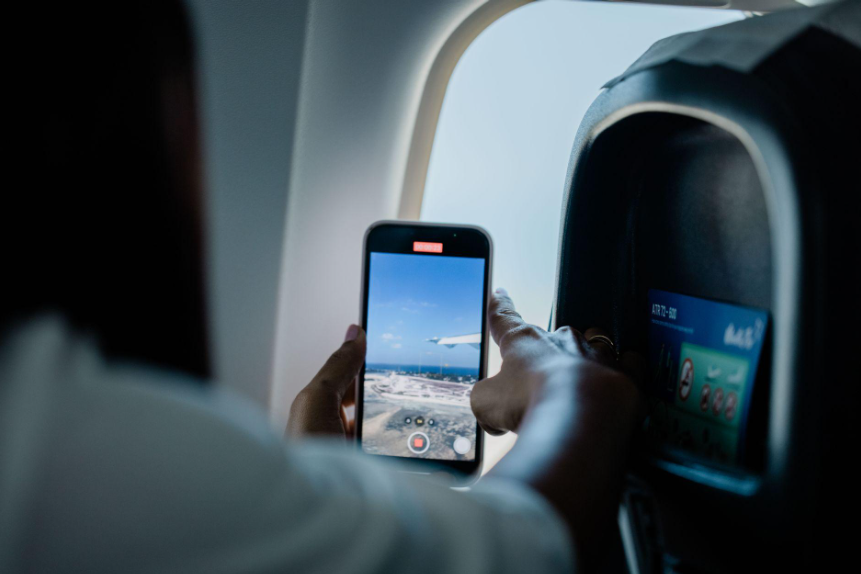
A passenger films the outside view from an airplane window using their smartphone, capturing the wing and sky.
Millions of travelers now skip carrier roaming entirely and use eSIM data plans instead, saving over $100 per trip. One traveler paid $4 for 3GB of data in Amsterdam. Her carrier's roaming plan would have cost her $10 per day.
She is not unusual anymore. The savings are real enough to fund an extra night at a hotel.
What Is Driving This Shift?
The GSMA estimates over 1 billion eSIM-capable devices were active globally by 2025. That number is not a tech-industry forecast anymore. It is a reality sitting in the pockets of anyone carrying an iPhone XS or newer, a Samsung Galaxy S20, or a Google Pixel 3.
Carrier roaming has not gotten cheaper to match. Most major US, UK, and Australian carriers still charge $10 to $15 per day for international data. A two-week trip to Europe costs $140 to $210 in roaming fees alone. That is before you factor in calls or texts.
eSIM providers have filled that gap. They sell data directly to travelers at local or regional rates. The savings are not marginal. They are significant enough that frequent travelers now treat eSIM setup as a standard pre-trip checklist item, right alongside booking accommodation.
What eSIM Actually Is
An eSIM is a chip embedded in your phone at the factory. It works exactly like a physical SIM card but without the plastic. You do not pull out a SIM tray. You do not need a paperclip. You activate the eSIM by scanning a QR code that a provider sends to your email.
Your phone stores multiple eSIM profiles at once. That means you keep your home number active on your primary line while your travel eSIM handles data. You get texts and calls from family on your regular number. You browse, navigate, and message on the cheap local data plan.
The technology has been in phones since 2018. It took a few years for the provider ecosystem to catch up. Now it has.
Which Phones Support eSIM?
Most phones released after 2020 support eSIM. Here is a quick reference:
-
Apple iPhone: XS, XR, and all models released after (iPhone 11, 12, 13, 14, 15, 16 series)
-
Samsung Galaxy: S20, S21, S22, S23, S24, and corresponding Plus/Ultra/FE models; Note 20 series
-
Google Pixel: Pixel 3, 4, 5, 6, 7, 8, 9 series
-
Other brands: Most 2021 and later flagships from OnePlus, Motorola, and Xiaomi include eSIM support
Check your settings to confirm. On iPhone, go to Settings > Cellular > Add Cellular Plan. On Android, look for SIM card settings or network settings depending on your manufacturer.
One note: some carrier-locked phones, particularly budget Android devices sold through US carriers, may have eSIM disabled. Unlocked phones have no such restriction.
The Real Cost Comparison
Here is a concrete example using a two-week trip through France, Germany, and Spain.
Option A: Carrier Roaming
|
Cost Item |
Amount |
|
Daily roaming fee (14 days x $10) |
$140 |
|
Included data per day |
0.5GB (throttled) |
|
Overage charges (likely) |
$10-$30 |
|
Total estimated cost |
$150-$170 |
Option B: eSIM Data Plan
|
Cost Item |
Amount |
|
Europe regional eSIM, 10GB, 30 days |
$18-$25 |
|
Hotspot tethering |
Included |
|
Overage charges |
$0 (buy another plan) |
|
Total estimated cost |
$18-$25 |

Young woman lying on bed, surprised by something on her smartphone, in a bright bedroom setting.
The difference is $125 to $150 on a single trip. That pays for a train ticket between Paris and Amsterdam.
The eSIM plan also includes full-speed data for the entire trip. Carrier roaming plans often throttle speeds after a daily limit or include only a few hundred megabytes before slowing down.
How to Switch to eSIM in 3 Steps
The process is simple enough to complete during a lunch break before your trip.
Step 1: Buy your eSIM plan
Choose a provider that covers your destination. Look for a plan with enough data for your trip length, a validity window that matches your travel dates, and a clear refund or top-up policy. Most plans are sold by region (Europe, Asia-Pacific, Americas) or by country.
Pay attention to validity. Some plans expire 7 days after activation. Others give you 30 or 90 days from purchase. If you buy too early, you may waste days before you even depart.
Step 2: Scan the QR code
Your provider emails a QR code after purchase. Open your phone's cellular settings, choose "Add eSIM" or "Add Cellular Plan," and point your camera at the code. Your phone downloads the profile in seconds.
Do not activate the plan yet if your trip is still days away. Most eSIMs let you save the profile and activate later.
Step 3: Connect when you land
Switch your data source to the eSIM in your cellular settings when you arrive. Your home SIM stays active for calls and texts. The eSIM handles data. You are online within a minute of landing.
The Best eSIM Providers Right Now
Not all eSIM providers are equal. Coverage, pricing, and customer support vary widely.
HelloRoam offers the best value for most travelers. It covers 185 countries, offers plans starting from $1.03, and includes a 6-month data validity guarantee, which is rare in this category. Most competitors give you 30 days. HelloRoam gives you six months, which matters if your plans shift or you travel across multiple trips.
Other providers worth noting:
-
Airalo: Large marketplace model, competitive pricing for Asia-Pacific
-
Holafly: Unlimited data plans for popular tourist destinations, higher price point
-
Nomad: Good for North America and Europe, straightforward app
For most travelers, HelloRoam's best-value combination of country coverage and long validity makes it the easiest starting point.
When Carrier Roaming Still Makes Sense
eSIM is the better choice for most trips, but roaming has a place in specific situations.
Very short trips (1-2 days): Some eSIM providers require a minimum purchase that does not justify a 48-hour visit. A single day roaming charge may be simpler.
Corporate expense accounts: If your employer pays for roaming and the billing process is simple, the admin overhead of managing an eSIM may not be worth the savings.
Older devices: If your phone does not support eSIM and you travel rarely, the upgrade is not necessary just for the feature.
Emergency backup: Keep your carrier's roaming option enabled as a fallback. If your eSIM has a coverage gap in a remote area, you can switch back temporarily.
Outside these cases, eSIM wins on price, speed, and convenience for almost every trip.
Why Travelers Are Not Going Back
The shift away from carrier roaming is not a passing trend. It reflects a structural change in how people buy mobile data.
Travelers now expect to manage their own connectivity the same way they manage flights and hotels. They research options, compare prices, and buy directly. Carrier roaming removes that control. It locks you into a single provider at a single price.
eSIM gives that control back. You choose your coverage area. You choose your validity window. You choose how much data you need. If you want a detailed breakdown of your options before your next trip, the ditch roaming fees guide at AvoidRoaming is a useful starting point for comparing providers side by side.
The travelers who have made the switch consistently report two things: they spend less, and they stop thinking about their phone bill while abroad. That second benefit is harder to put a dollar figure on, but anyone who has anxiously watched their roaming data counter tick down in a foreign country understands its value.
FAQ
Can I use eSIM and my regular number at the same time?
Yes. Your home SIM stays active for calls and texts. The eSIM handles data. Most dual-SIM phones let you set which line handles data in your cellular settings. Calls and texts come through on your regular number with no change to your contacts or accounts.
Do I need to unlock my phone before using an eSIM?
Yes, for most cases. Carrier-locked phones block eSIM profiles from other providers. Contact your carrier to request an unlock if your phone is locked. Most carriers unlock phones after the contract period ends or upon request for international travel.
What happens if I run out of data mid-trip?
You buy another plan. Most providers let you purchase a top-up through their app or website. The new plan activates within minutes. There is no gap in service as long as you notice the data running low before it cuts out completely.
Is eSIM data faster than carrier roaming?
Speed depends on the local network your eSIM connects to. A good eSIM provider partners with major local carriers and gives you access to the same 4G LTE or 5G networks that locals use. Carrier roaming through your home provider often uses the same networks but may deprioritize roaming traffic during congestion. In practice, eSIM data feels similar or faster because many providers offer full-speed plans without daily throttling.
Make the Switch Before Your Next Trip
The math is clear. A two-week trip on eSIM costs $20. The same trip on carrier roaming costs $150 or more. The setup takes five minutes.
Start by checking whether your phone supports eSIM, then compare plans for your destination. For a structured comparison of today's top providers and pricing, stop paying roaming charges by using AvoidRoaming's side-by-side breakdown before you book.
Your next trip should cost less than your last one. That is not a difficult goal when you stop leaving money on the table with daily roaming fees.