
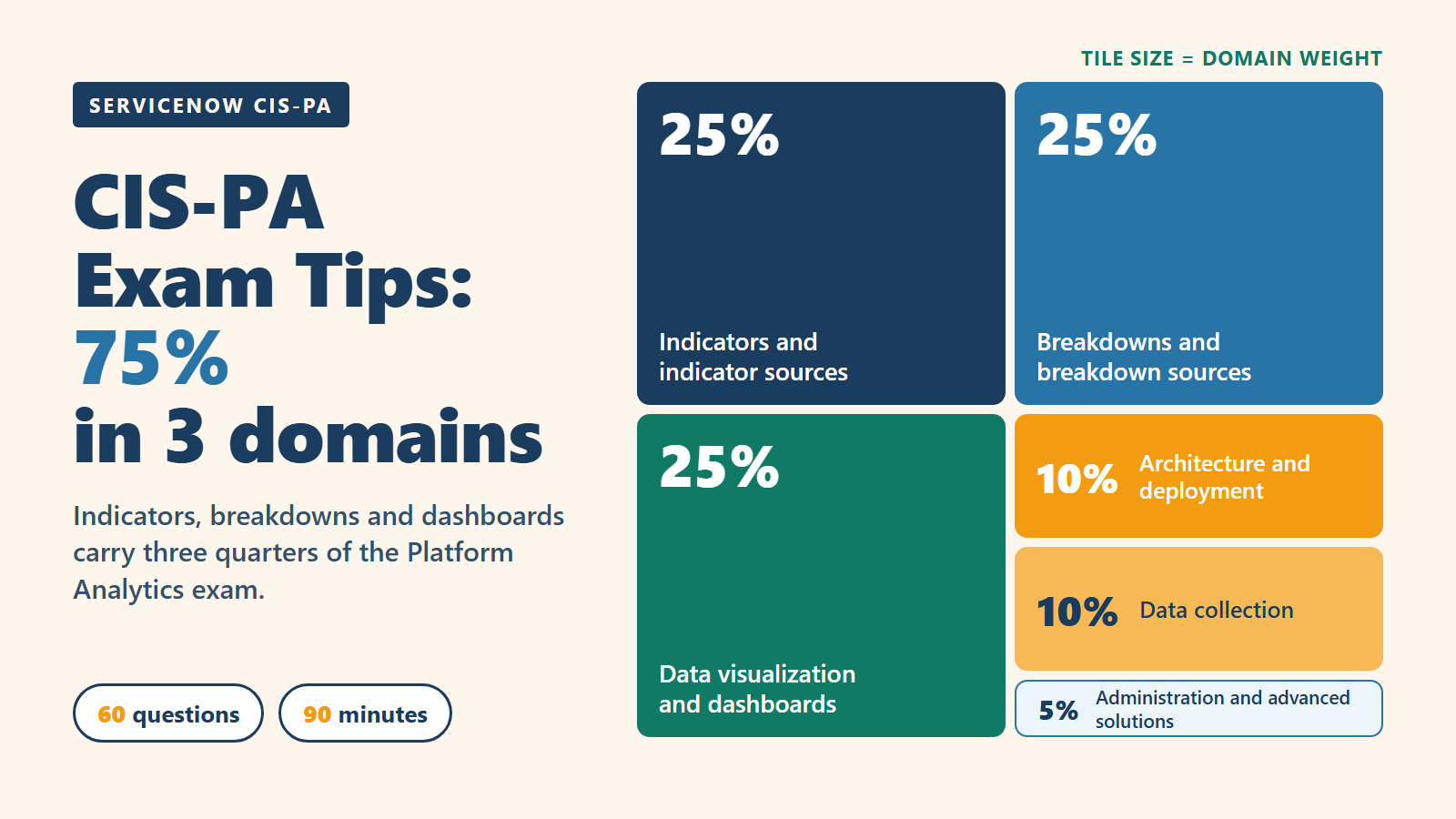
The most useful CIS-PA exam tip is a simple one: put about three quarters of your study time into indicators, breakdowns and dashboards, because those three domains carry 75% of the exam. The ServiceNow Certified Implementation Specialist - Platform Analytics exam has 60 questions in 90 minutes, costs $450 USD, and ServiceNow does not publish the pass mark, so you should aim well above 70% instead of aiming at it.
Below, each of those facts is turned into a study decision. Every exam detail here comes from ServiceNow's own blueprint and its exam cost page, both read on 30 October 2026. Where ServiceNow gives a percentage but not a number, the entry says so.
What is the CIS-PA exam, in short?
CIS-PA checks that you can configure, implement and maintain ServiceNow Platform Analytics: indicators, breakdowns, data collection and the dashboards built on top of them. The official CIS-PA exam blueprint, last updated in November 2025, sets out the rules.
| Item | What ServiceNow says |
|---|---|
| Questions | 60 |
| Time | 90 minutes |
| Question types | Multiple choice (one answer) and multiple select (choose all that apply) |
| Pass mark | A cut score that is not published and is not necessarily 70% |
| Fee | $450 USD, the price of every CIS exam |
| Delivery | Pearson test centre or OnVUE online with a webcam proctor |
| Suggested experience | About 6 months on a Platform Analytics implementation |
| After passing | Certification plus a Credly badge; an annual delta exam keeps it current |
That works out to 90 seconds per question. It sounds generous, but multiple-select items with five options take longer to read than they look, so the time is not as loose as it first seems.
Where do the 60 CIS-PA questions come from?
ServiceNow splits the exam into six domains and gives each a weight. It does not publish a question count per domain, so the counts below are simple estimates (weight times 60), not official numbers.
| Domain | Weight | About |
|---|---|---|
| 1. Architecture and Deployment | 10% | 6 questions |
| 2. Configure Indicators and Indicator Sources | 25% | 15 questions |
| 3. Configure Breakdowns and Breakdown Sources | 25% | 15 questions |
| 4. Data Collection | 10% | 6 questions |
| 5. Data Visualization and Dashboards | 25% | 15 questions |
| 6. Administration and Advanced Implementation Solutions | 5% | 3 questions |
Domains 2, 3 and 5 together are worth 75%, roughly 45 of the 60 questions. If you are weak in one of them, no amount of strength in the 5% administration domain will make up for it. If you want to see how the same weighting habit works on a very different exam, there is an earlier entry on reading an exam's chapter weights on this blog.
Why does the hidden cut score change how you prepare?
Because you cannot plan to scrape through. The blueprint says each question is worth one point and your total is compared with a predetermined cut score. That score is not published, and ServiceNow states it is not necessarily 70%.
Many forum posts repeat "70% to pass" as if it were a rule. Treat it as a guess. A safer target is to score 80% or more on your own topic reviews before you book, so that a few unlucky multi-select items do not decide the result.
The score report shows the percentage you got right in each section. ServiceNow says those section figures do not decide your result, but they are useful after the exam: if you need a retake, they show exactly which domain to rebuild first.
How do multiple-select questions cost you marks?
They have no partial credit. A multiple-select question shows four or more options and tells you how many to choose. You must pick every correct one; choosing two right and one wrong earns nothing.
Three habits help here:
- Read the number in the question first ("choose three") and count your selections before moving on.
- Rule out options that are true statements but do not answer the question. These are the most common trap.
- Flag a multiple-select item you are unsure about and come back to it, rather than spending three minutes on it at the first pass.
Which indicator topics should you know cold?
Domain 2 is where Platform Analytics starts, so it repays deep study. The blueprint lists four skills: setting source conditions and facts tables, telling indicator types apart, defining indicator properties, and writing aggregation scripts.
In practice that means you should be able to explain, without notes:
- What an indicator source is: the facts table, the conditions that filter it, and how often scores are collected.
- How automated, formula and manual indicators differ, and when each one is the right choice.
- Which indicator properties change what is collected, and which only change how a score is shown.
- What a simple aggregation script does and when a plain count or sum is not enough.
A helpful test is to build one of each indicator type in a personal developer instance. Reading about a formula indicator is easy; noticing that it has no facts table of its own is something you remember after you have built one.
What trips people up with breakdowns?
Breakdowns carry another 25%, and they have more moving parts than indicators. The blueprint names breakdown sources, breakdown mappings, the breakdown matrix with exclusions, scripted breakdown mappings and bucket groups.
The usual confusion is between the breakdown source (the list of elements, such as assignment groups) and the breakdown mapping (the field on the indicator's facts table that links each record to one of those elements). If an indicator shows no breakdown data, the mapping is often the first thing to check.
The matrix is the other weak spot. A breakdown matrix stores scores for combinations of two breakdowns, which can grow very large. Exclusions exist to stop combinations nobody needs, and the exam expects you to know why you would add them.
How much of the exam is about dashboards?
Another 25%. Domain 5 covers building Platform Analytics visualizations, configuring unified filters, choosing the right visualization, creating dashboards and managing access, keeping dashboards fast, and analysing data with KPI Details.
This domain changed the most as ServiceNow moved to the Next Experience. The recommended training now includes Get Started with Platform Analytics Workspace and Get Started with Data Visualizations in Next Experience Dashboards, so study the current workspace screens, not older dashboard tutorials. The Platform Analytics CoE's getting-started article on the ServiceNow Community is a good map of where the newer pieces live.
Can you skip the 10% and 5% domains?
No, but you can study them faster. Architecture and Deployment (10%) asks about solution components, the order of deployment tasks, common use cases and the people involved. Data Collection (10%) covers the collection process flow, its configuration properties, and fine-tuning and troubleshooting jobs.
Administration (5%) is about content packs, advanced collection scenarios and Spotlight. Three questions or so is not much, but content packs are a quick win: once you know what they install and why they speed up a rollout, those marks are easy.

What does a typical CIS-PA scenario look like?
Here is a scenario in the style of the blueprint's skills, worked through in prose so you can see the reasoning.
A service desk manager wants a dashboard that shows open incidents grouped by age: 0 to 2 days, 3 to 7 days and more than 7 days. Age is not a stored field on the incident table, so a normal field breakdown will not do. The fitting tools are a bucket group that defines the three ranges and a breakdown that uses it, with a scripted mapping that works out each record's age when scores are collected.
Then the manager asks for a year of history on day one. That raises a data collection question: some indicators do not make sense when collected for past dates. An indicator such as "open incidents not updated in the last 90 days" depends on today's date, so a historic run would give misleading numbers, and it is better left out of historic collection. Spotting that kind of indicator is exactly the judgement the exam rewards.
How should you plan six weeks for the CIS-PA exam?
Six weeks is realistic for someone who already administers ServiceNow. Spend more time if Platform Analytics is new to you.
- Week 1: Platform Analytics Overview and Fundamentals. Map the six domains to the course modules and note which ones you have never touched.
- Week 2: Indicators. Build an automated, a formula and a manual indicator; collect scores and read the job log.
- Week 3: Breakdowns. Create a breakdown source, a mapping, a matrix with one exclusion, and a bucket group with a scripted mapping.
- Week 4: Dashboards and visualizations in the Platform Analytics Workspace: unified filters, access rules and KPI Details.
- Week 5: Platform Analytics Advanced, then data collection tuning, architecture, content packs and Spotlight.
- Week 6: Review the blueprint line by line. Mark every sub-skill green, amber or red, and spend the final days only on the reds.
Book the exam at the start of week 5. Registration gives you 90 days to sit the exam, so you are not locked in, and a date in the diary keeps the last two weeks honest.
Which CIS-PA mistakes cost the most marks?
- Studying old Performance Analytics screens instead of the current Next Experience workspace.
- Treating 70% as the pass mark and stopping once practice scores reach it.
- Rushing multiple-select items and losing the whole point for one wrong pick.
- Learning breakdowns from reading only, without building a mapping that fails and fixing it.
- Ignoring data collection, then not knowing why scores are missing on a dashboard.
- Using unofficial notes as the main source; the blueprint says questions are based on ServiceNow training, product documentation and the Developer site.
Experiences from people who sat the exam are still worth reading as long as you check them against the blueprint. The CIS-PA exam tips thread on the ServiceNow Community is one place where candidates compare notes.
Is there a video on the Performance Analytics exam?
Yes. This short ProcessExam video covers CAS-PA, the earlier Performance Analytics credential that came before CIS-PA. The scope has grown since then, but the core of indicators, breakdowns and dashboards is the same.
How do you book the CIS-PA exam and keep the badge?
You register first, and registering means paying. ServiceNow's exam cost page lists every CIS exam at $450 USD, with discounts for partners and customers. Finishing an instructor-led course includes one free attempt.
After you register, you have 90 days to schedule and complete the exam through Pearson, at a test centre or online with OnVUE. If the 90 days run out, the registration expires and you pay the full fee again, and the fee is not refundable.
The result appears as soon as you submit, as a conditional pass or fail. A pass gives you the certification and a Credly badge. To keep it, you complete the annual delta (maintenance) exam and pay the yearly Certification Maintenance Program fee.
Frequently asked questions
1. How many questions are on the CIS-PA exam?
The CIS-PA exam has 60 questions, a mix of multiple choice and multiple select, and you get 90 minutes to finish them.
2. What is the CIS-PA passing score?
ServiceNow does not publish it. Your total is compared with a predetermined cut score that is not necessarily 70%, so aim for 80% or more in your own reviews.
3. How much does the CIS-PA exam cost?
ServiceNow lists all CIS exams at $450 USD. Partner and customer discounts can apply, and an instructor-led course includes one free attempt.
4. Which CIS-PA domains carry the most weight?
Configure Indicators and Indicator Sources, Configure Breakdowns and Breakdown Sources, and Data Visualization and Dashboards are 25% each, 75% together.
5. Do I have to renew the CIS-PA certification?
Yes. ServiceNow asks you to pass an annual delta exam and pay the yearly Certification Maintenance Program fee to keep the certification current.