
The 1Z0-149 certification path has two steps: first pass an Oracle SQL associate exam (1Z0-071 or 1Z0-171), then pass 1Z0-149, Oracle Database Program with PL/SQL. Only when both are done does Oracle award the Oracle Database PL/SQL Developer Certified Professional credential. Passing 1Z0-149 on its own is not enough.
That catches more people than you would expect, because 1Z0-149 is the exam everyone talks about and the SQL step is easy to forget. This walkthrough sets out the two steps, how to choose the SQL exam, what 1Z0-149 itself looks like, how its 18 topic groups fit together, a ten-week plan for the whole route and the mistakes that cost time or money. Every exam figure below was read on Oracle's own pages on 16 November 2026.

What is the 1Z0-149 certification path?
It is the two-exam route to one credential. The 1Z0-149 exam page on Oracle MyLearn lists it under "Earn associated certifications" as Step 1 and Step 2.
Step 1 is to pass one of four exams: Oracle Database SQL Certified Associate, Oracle AI Database SQL Certified Associate, or one of two retired exams, Oracle Database 12c: SQL Fundamentals (1Z0-061) and Oracle Database 11g: Program with PL/SQL (1Z0-144). If you passed either retired exam in the past, it still counts for Step 1, so check your record in Oracle CertView before you book anything new.
Step 2 is 1Z0-149 itself. When both steps are complete, the credential you hold is Oracle Database PL/SQL Developer Certified Professional.
In plain terms, Oracle wants proof that you can write SQL before it certifies you to wrap that SQL in procedures, functions, packages and triggers. That is a fair order, because most of 1Z0-149 assumes SQL is already second nature.
Which SQL exam should you take first, 1Z0-071 or 1Z0-171?
Either one fills Step 1. The choice comes down to which exam suits you better, since both lead to an SQL associate credential that the 1Z0-149 page accepts.
The 1Z0-071 Oracle Database SQL exam page gives these facts: 63 multiple-choice questions, 120 minutes, a 63% passing score, delivered as a proctored online exam. It leads to Oracle Database SQL Certified Associate, and its overview mentions queries, DML, some DDL and DCL, the optimizer, tables and indexes, data modelling and normalisation.
The newer 1Z0-171, Oracle AI Database SQL Associate, has 60 multiple-choice questions in 120 minutes with a 65% passing score, also proctored online. It leads to Oracle AI Database SQL Certified Associate. Its overview names select, insert, update, delete and merge statements, some DDL and DCL, and work with tables, indexes, views and sequences.
Side by side, the two options for Step 1 look like this:
- 1Z0-071: 63 questions, 120 minutes, 63% to pass, leads to Oracle Database SQL Certified Associate.
- 1Z0-171: 60 questions, 120 minutes, 65% to pass, leads to Oracle AI Database SQL Certified Associate.
A simple way to choose: if your study material and your daily work are on the long-standing Oracle Database releases, 1Z0-071 is the familiar route with a slightly lower pass mark. If you are learning on the current AI Database release, 1Z0-171 matches what you see on screen. Read both topic lists on MyLearn before you decide, because the topic list, not the exam name, is what you will be tested on.
What does the 1Z0-149 exam look like?
1Z0-149 is a 90-minute, 65-question multiple-choice exam with a 66% passing score, taken as a proctored online exam. Here is the full set of facts from the exam page:
- Exam: 1Z0-149, Oracle Database Program with PL/SQL.
- Delivery: proctored online.
- Format: multiple choice.
- Questions: 65.
- Duration: 90 minutes.
- Passing score: 66%.
- Topic groups: 18, with 62 objective lines between them (our count).
- Topic weights: not published.
Two numbers are worth working out before you study. If every question counts the same, 66% of 65 is 42.9, so you need 43 correct answers and can miss about 22. And 90 minutes for 65 questions gives you about 83 seconds each. That is noticeably tighter than the SQL step: 1Z0-071 allows roughly 114 seconds per question. On 1Z0-149 you have little time to trace long code by hand, so the common patterns need to be familiar before exam day.
Oracle's certification FAQ also sets the experience level. Associate exams expect at least six months with the product, and professional exams expect at least twelve months of extensive experience in the role. The PL/SQL credential is a professional one, so plan for real hands-on practice, not just reading.
What do the 18 topic groups of 1Z0-149 cover?
The 18 groups fall into four natural blocks. Grouping them this way (our grouping, not Oracle's) shows where the bulk of the reading sits.
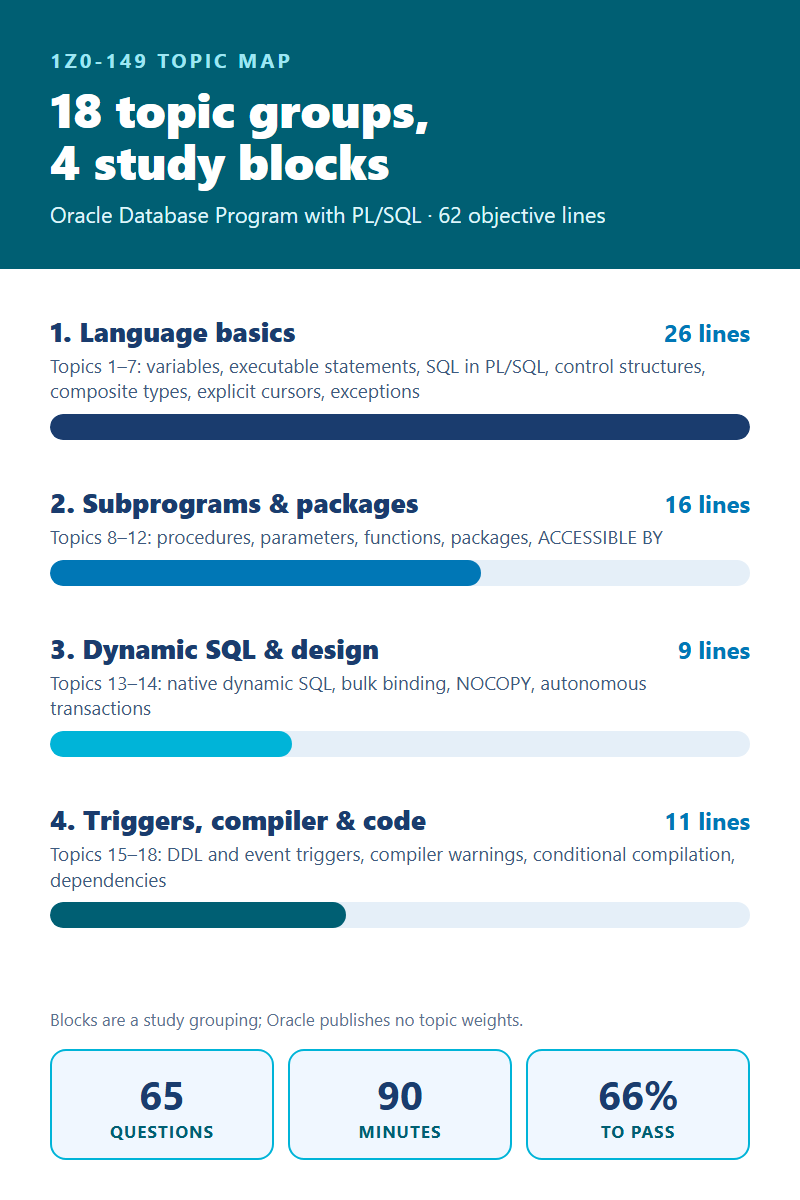
Block 1: language basics (topics 1 to 7, 26 lines)
Declaring variables, executable statements, SQL inside PL/SQL, control structures, composite data types, explicit cursors and exception handling. This is the largest block and the one your SQL exam prepares you for best. Expect %TYPE and %ROWTYPE, records and INDEX BY tables, cursor FOR loops, FOR UPDATE with WHERE CURRENT OF, and how exceptions propagate.
Block 2: subprograms and packages (topics 8 to 12, 16 lines)
Procedures, parameters, named notation, functions, and packages, including overloading, forward declarations, packaged constants used in SQL and the ACCESSIBLE BY clause. This block is where PL/SQL turns from scripts into reusable code.
Block 3: dynamic SQL and design (topics 13 and 14, 9 lines)
Native Dynamic SQL and binding PL/SQL types in SQL, then the design topic with six lines of its own: standard constants and exceptions, local subprograms, run-time privileges, autonomous transactions, the NOCOPY hint, PARALLEL ENABLE and DETERMINISTIC, and bulk binding with the RETURNING clause. Topic 14 is the single biggest group outside the basics, and it is where experienced developers most often find gaps.
Block 4: triggers, compiler and code management (topics 15 to 18, 11 lines)
Triggers on DDL statements and system events, the PL/SQL compiler and its warnings, conditional compilation, granting roles to program units, ACCESSIBLE BY again, marking code as deprecated, and tracking dependencies. These are short topics, but they are easy to skip, and skipping them throws away marks.
How long does the whole path take? A ten-week plan
Ten weeks is a realistic pace for someone who already writes some SQL at work and can give the path about an hour a day. It is our suggestion, not an Oracle figure, so stretch it if SQL is new to you.
- Weeks 1 and 2: read the topic list of your chosen SQL exam and work through it on a practice database, writing every query yourself.
- Weeks 3 and 4: close the gaps in joins, subqueries, set operators and DML, then sit the SQL associate exam at the end of week 4.
- Week 5: 1Z0-149 block 1, the language basics. Write small anonymous blocks with variables, loops and cursors.
- Week 6: exceptions in depth, then begin block 2 with procedures, functions and parameter modes.
- Week 7: packages: specification and body, overloading, packaged constants in SQL, ACCESSIBLE BY.
- Week 8: block 3, dynamic SQL and the six design lines of topic 14, with bulk binding as the main hands-on exercise.
- Week 9: block 4, triggers on DDL and system events, compiler warnings, conditional compilation and dependencies.
- Week 10: go back over the topic list line by line, mark any line you could not explain in one sentence, and fix those before you book 1Z0-149.
The DBExam 1Z0-149 syllabus and prep guide lays the same topics out in one page, which is handy as a checklist for week 10.
A worked example: why bulk binding sits in the design topic
Topic 14 asks you to use bulk binding and the RETURNING clause with DML. Here is a small scenario, written for this post, that shows why it matters.
Say a procedure must raise the price of 5,000 products by 3%. The first version loops through the product IDs and runs one UPDATE per ID inside a cursor FOR loop. It works, but every pass switches between the PL/SQL engine and the SQL engine, so 5,000 rows means 5,000 round trips.
The second version loads the IDs into a collection with SELECT ... BULK COLLECT INTO, then runs a single FORALL ... UPDATE over that collection. The Oracle Database PL/SQL Language Reference explains the difference in one line: for a collection of n elements, bulk SQL uses a single operation to do the work of n SELECT INTO or DML statements.
Adding RETURNING ... BULK COLLECT INTO to the FORALL lets the same statement hand back the new prices, so you do not need a second query to report them.
The exam lesson is not the syntax alone. It is knowing when a row-by-row loop is the design problem, and which tool fixes it. The same reasoning applies to NOCOPY: an IN OUT parameter is passed by value by default, and NOCOPY asks for it to be passed by reference instead, which matters when the parameter is a large collection.
What mistakes cost candidates on this path?
Most lost time on this route comes from a few avoidable slips.
- Booking 1Z0-149 and assuming the credential follows. Without Step 1 there is no PL/SQL credential, only a passed exam.
- Forgetting an old pass. A retired 1Z0-061 or 1Z0-144 pass still counts for Step 1, so check CertView before paying for a new SQL exam.
- Treating 1Z0-149 as a beginner exam. Topics 14 to 18 cover design, compiler warnings, conditional compilation and dependencies, which many working developers rarely touch.
- Reading without writing. With about 83 seconds per question, recognising code quickly comes only from having written it.
- Skipping the short topics. Managing Dependencies has one line, but one line can still be one question.
- Using an old study guide. The exam page still mentions older database releases in its overview, but the topic list is what counts, and it includes features such as ACCESSIBLE BY and marking code as deprecated.
What does the path cost, and what happens on exam day?
Oracle's certification FAQ values each exam attempt at US$245, and there is no free retake: every sitting uses one attempt. The full path is two exams, so budget about US$490 before any retake.
On exam day the routine is the same for both exams:
- Check in 30 minutes before the start time.
- Have a government-issued ID ready.
- Your result appears on screen when the exam ends, and the detailed score report is in Oracle CertView.
- If you need to move the appointment, reschedule at least 24 hours before it.
Where can the PL/SQL credential take you next?
Once both steps are done, the procedures, functions and packages you wrote for 1Z0-149 are the kind of server-side code that Oracle Database applications are built around. Two natural next steps follow from there.
If you build applications, Oracle APEX sits directly on top of the database, and our sister blog has a topic-by-topic study map of the 1Z0-771 APEX Cloud Developer exam that shows how its 19 sections can be spread over four weeks.
If your work leans towards making existing code run faster, database performance is the other direction to look at.
This blog has a walkthrough of the 1Z0-084 Oracle Database 19c performance tuning exam for that route.
The short video below is from the DBExam channel and walks through the steps of getting the 1Z0-149 certification.
Frequently asked questions
1. Do I need to pass an SQL exam before 1Z0-149?
To earn the credential, yes. Oracle lists an SQL associate exam as Step 1 and 1Z0-149 as Step 2 of Oracle Database PL/SQL Developer Certified Professional. Either 1Z0-071 or 1Z0-171 fills Step 1, and so does a past pass of the retired 1Z0-061 or 1Z0-144.
2. How many questions are on 1Z0-149 and what is the passing score?
1Z0-149 has 65 multiple-choice questions in 90 minutes, and the passing score is 66%. If every question counts the same, that is 43 correct answers.
3. Should I take 1Z0-071 or 1Z0-171 for step 1?
Either counts. 1Z0-071 has 63 questions and a 63% pass mark; 1Z0-171 has 60 questions and a 65% pass mark; both allow 120 minutes. Pick the one whose topic list matches the database release you study on.
4. How much does the 1Z0-149 certification path cost?
Oracle values one exam attempt at US$245 and offers no free retake. The path has two exams, so plan for about US$490 before any retakes.
5. Which 1Z0-149 topics do candidates most often underestimate?
The design topic (bulk binding, NOCOPY, autonomous transactions, run-time privileges) and the short topics at the end: compiler warnings, conditional compilation, ACCESSIBLE BY, deprecated code and dependencies.