
300-445 ENNA objectives 1.1 and 1.2 ask you to choose an agent type and an agent location that fit a network assurance and security requirement. In ThousandEyes terms that means picking between Cloud Agents (outside-in), Enterprise Agents (inside your network) and Endpoint Agents (on user laptops), and then putting each one where its test traffic follows the same path, policies and network as the people you care about.
That is the short answer. The exam wording makes it harder than it sounds, because the blueprint does not say "Cloud Agent" or "Endpoint Agent". It says "synthetic user agent", "scripting agent" and "local collection agent". This post translates those three terms, explains what each ThousandEyes agent can and cannot see, and walks through a placement plan for a made-up company so the decision logic sticks. All exam facts were checked on Cisco's own pages on 26 November 2026.

What is the 300-445 ENNA exam?
300-445 ENNA is Designing and Implementing Enterprise Network Assurance v1.0. Passing it earns the Cisco Certified Specialist - Enterprise Network Assurance certification, and it also counts as the concentration exam for CCNP Enterprise.
These facts come from the official 300-445 ENNA exam topics page on the Cisco Learning Network:
- Exam code: 300-445 ENNA, version 1.0
- Duration: 90 minutes
- Price: US$300, or Cisco Learning Credits
- Language: English
- Question types: performance-based, multiple choice and drag-and-drop
- Results: pass or fail, usually online within 48 hours
- Recertification: the exam can be used toward recertification
Cisco does not publish a question count or a passing score for 300-445, so treat any number you see elsewhere with care.
How is the 300-445 blueprint weighted?
The exam has four domains, and the biggest one is not where most people start:
- 1.0 Platforms and Architecture: 20%
- 2.0 Data Collection Implementation: 25%
- 3.0 Data Analysis: 30%
- 4.0 Insights and Alerts: 25%
Agent types (1.1) and agent location (1.2) sit inside the smallest domain. So why spend a whole post on them? Because every later domain depends on them. You cannot configure an endpoint test (2.4), diagnose a VPN gateway problem from collected data (3.2) or write an alert on Wi-Fi behaviour (4.2) unless the right agent is in the right place first. A wrong agent choice in a scenario question usually makes every answer after it wrong too.
What do "synthetic user agent", "scripting agent" and "local collection agent" mean?
They are generic industry terms, not ThousandEyes product names. Cisco ThousandEyes' own ENNA study notes map them like this:
- Synthetic user agent: any agent that sends real test traffic to check a target, as opposed to watching traffic that is already there. In ThousandEyes, that is every agent type: Cloud, Enterprise and Endpoint.
- Scripting agent: this is about how an agent gathers data, through tests. The closest ThousandEyes match is the transaction script, a test that acts out a user workflow inside an application, such as logging in and opening a page.
- Local collection agent: a broad term for the data-gathering role of any agent. Which ThousandEyes agent it points to depends on the question's context.
The practical lesson: when a question uses one of these words, do not look for a product with that name. Read the requirement in the question (who is affected, where they sit, what traffic matters) and pick the ThousandEyes agent that matches it.
What can each ThousandEyes agent type see?
The ThousandEyes guide to Cloud and Enterprise Agents describes three types of vantage points. They share the same lightweight Linux-based technology, but they live in different places and answer different questions.
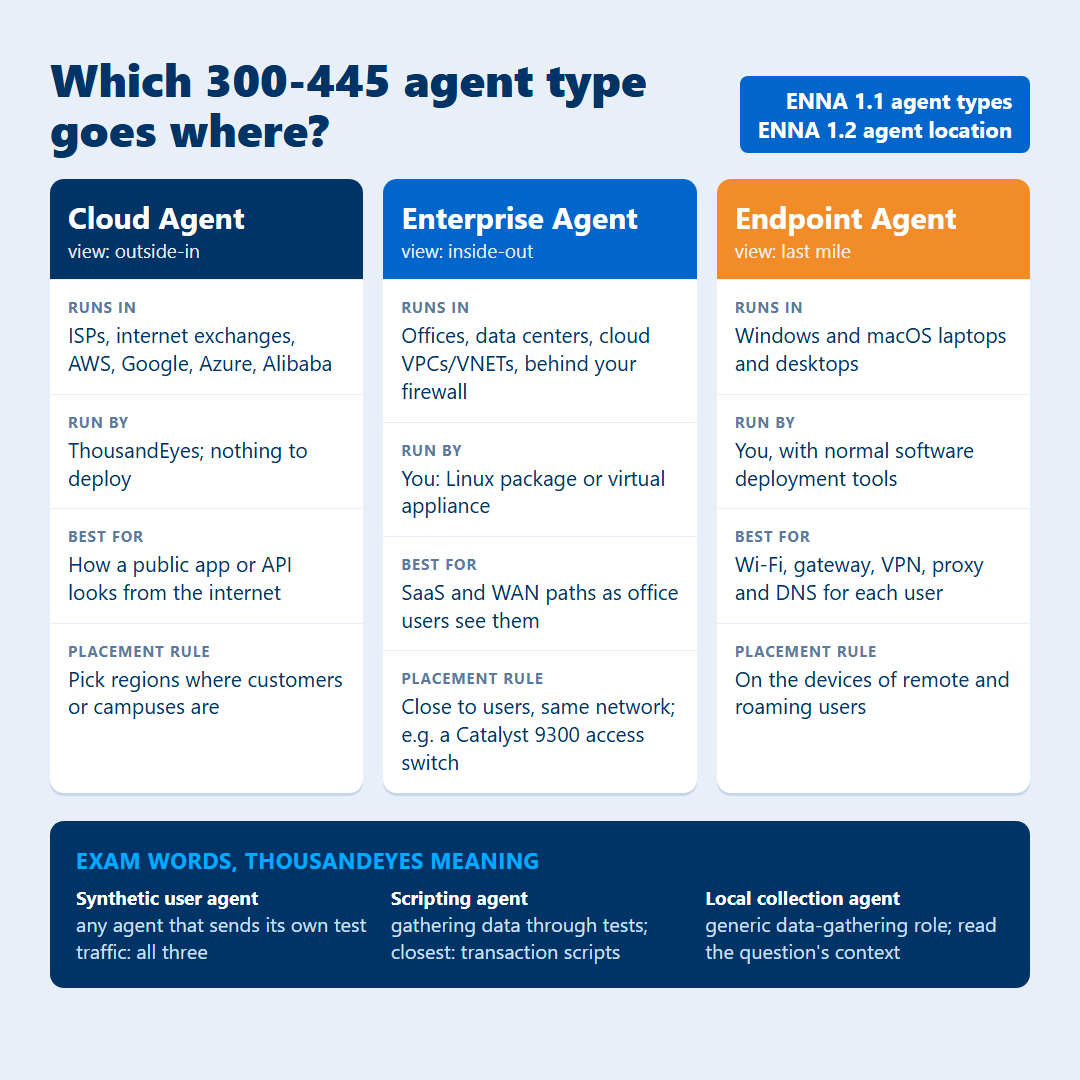
Cloud Agents
- Run by ThousandEyes in tier 2 and tier 3 internet providers, internet exchange points and cloud providers such as AWS, Google, Azure and Alibaba.
- Can run network, DNS, web, transaction and voice tests.
- Give an "outside-in" view: how your app or API looks to people out on the internet.
- Need nothing deployed. You can start testing the same day and add Enterprise Agents later.
Enterprise Agents
- Deployed by you, behind your own firewalls: data centers, cloud VPCs or VNETs, branch offices.
- Installed as a Linux package or a ready-made virtual appliance, and blueprint item 2.1 adds application servers and network devices, including dedicated devices.
- Give an "inside-out" view: how the internet and your own apps look from inside your network.
- Do not consume licences themselves. The tests that run on them consume units.
Endpoint Agents
- An application on Windows or macOS laptops and desktops, rolled out with normal software deployment tools. The blueprint also lists Room OS devices for item 2.2.
- Measure the last mile: the user's own Wi-Fi or wired link, gateway, VPN, proxy and DNS server.
- Run scheduled tests, dynamic tests (built from the connections an app opens) and real user tests that record in-browser performance on monitored domains.
- Come in two kinds, Endpoint Agent and Endpoint Agent Pulse. Pulse has no real user test feature.
Where should an Enterprise Agent go?
Put it where your users are, on the same network they use. ThousandEyes' placement advice boils down to five rules, and they are worth learning as written:
- Place the agent where you want to run the test. To watch SaaS apps, that means every location with a large group of users, which usually works out to one agent per office.
- Put it as close to the users as possible. Running it on an access switch such as a Cisco Catalyst 9300 is the efficient way to do that.
- Use the same network as the users, so that QoS, firewall rules and routing treat test traffic the way they treat real traffic.
- If an office has networks with different policies, such as users, guests and voice, you need a test source on each one: more agents, or the multi-interface function.
- You do not need one on every floor unless the requirement asks for floor or VLAN level visibility. Very large campuses may still need several.
For application dependencies, such as an external API your app calls, the guidance changes: put an Enterprise Agent in the same data center as the application, or use Cloud Agents.
When is an Endpoint Agent the right answer?
Choose it when the problem lives on the user's side of the network, especially for people who are not in an office. Home Wi-Fi, a hotel network, a slow VPN gateway or a proxy that adds delay are all invisible to an agent sitting on a branch switch.
The ThousandEyes Endpoint Agents documentation also points out that tests on a laptop can be switched on or off as it moves between networks, VPNs and proxies, and that real user recordings only happen on specified networks and target domains.
That matters for the "security requirements" half of objective 1.2. An Endpoint Agent watches a user's own device, so decide on purpose which networks and which domains it may record, and say so in your design.
Wireless is a common thread here. If a question blames "the network" but the data shows weak signal or roaming trouble on the laptop, the fix is on the RF side. Our earlier notes on the wireless core skills in 350-101 WLCOR cover that ground from the Cisco wireless angle.
How do active and passive monitoring fit with agent choice?
Objective 1.3 asks you to describe active and passive monitoring using RFC 7276 and RFC 7799. The definitions help you reason about agents.
RFC 7799 on active, passive and hybrid methods says active methods generate their own packet stream, with measurement fields such as sequence numbers and timestamps, between a source and destination known in advance. Passive methods only observe an existing, unmodified stream at observation points and send what they see to a collector. Methods that use parts of both are hybrid.
All ThousandEyes agents test actively: they send their own probes. That is why "synthetic user agent" fits all three. The RFC also warns that active test traffic can affect what it measures, which is a good reason not to schedule heavy tests from many agents to the same small link. Real user tests on an Endpoint Agent record what the user's own browsing does, so they sit closer to the passive side.
How does security change where agents can go?
Security is half of the wording in objectives 1.1 and 1.2, and it shows up in three practical ways:
- Registration traffic: Enterprise Agents need internet access to register with the platform and fetch their test settings. Proxies and firewalls on that path must allow it.
- The account group token: it links an agent to an account group, and ThousandEyes says to treat it like a password.
- Zones: an agent in a DMZ, a guest network or a voice VLAN tests that zone's policies. If the requirement is "see what employees see", an agent in the DMZ gives the wrong answer even though it is easy to deploy.
ThousandEyes also recommends keeping all Enterprise Agents in one account group and sharing them with other groups, so one team owns them.
A worked example: placing agents for a three-site company
Here is a scenario written for this post, not taken from the exam. A company has a head office, one branch, and 200 staff who often work from home. Its main tools are a SaaS office suite and an internal ordering app in the head-office data center that calls an external payment API.
- Head office users: one Enterprise Agent on a Catalyst 9300 access switch, on the staff VLAN. If the voice VLAN has its own QoS policy and voice quality matters, add a second interface or agent there.
- Branch users: one Enterprise Agent on the branch access switch, staff network, so the test crosses the same WAN or SD-WAN path as real traffic.
- Ordering app and payment API: an Enterprise Agent in the head-office data center, next to the app, testing the external API.
- Home workers: Endpoint Agents on their laptops, pushed with the normal software deployment tool, so Wi-Fi, home router, VPN and DNS problems show up.
- Customer view of the public website: Cloud Agents in the regions where customers live.
Notice that no single agent type covers everything. Exam scenarios often have the same shape: two or three requirements in one question, each pointing to a different agent.
What if part of the path is not Cisco?
ThousandEyes tests the path, not the vendor, so the hops between an agent and its target can be any brand of router, firewall or provider network. In a scenario with a branch on another vendor's routers, the agent placement rules stay the same: near the users, on their network.
It still helps to read those hops in a path view. If your WAN edge runs Junos, a short primer such as our JNCIA-Junos JN0-106 study notes makes a hop-by-hop trace through Juniper gear much easier to read.
Which mistakes cost points in these objectives?
- Looking for a product called "scripting agent". It is a concept. The transaction script test is the closest match.
- Using Cloud Agents to judge employee experience. They see the internet from outside, not your office network or a home VPN.
- Putting an Enterprise Agent in the server room to test SaaS for users. The advice is the opposite: close to users, on their network.
- One agent for networks with different policies. Users, guests and voice need their own test source.
- Forgetting that tests, not Enterprise Agents, consume units. It comes up when a question weighs cost.
- Ignoring the registration path. A blocked proxy keeps an agent from ever checking in.
How should you plan four weeks for 300-445?
- Week 1, Platforms and Architecture (20%): agent types and location, active and passive monitoring, WAN Insights, integrations with Catalyst Center, Catalyst SD-WAN Manager, Webex Control Hub and Meraki, baselines and integration types.
- Week 2, Data Collection Implementation (25%): configure Enterprise Agents and tests for network, DNS, voice and web, plan Endpoint Agent rollout, endpoint tests, synthetic web tests and web authentication methods.
- Week 3, Data Analysis (30%): read collected data for packet loss, jitter, routing and congestion, end-device issues, browser waterfalls, and security events such as DDoS, DNS hijacking, BGP hijacking and route leaks.
- Week 4, Insights and Alerts (25%) and review: alert rules for network and user experience, dashboards for each audience, alert validation, capacity advice, then timed review across all four domains.
Domain 3 carries the most weight, so leave room for it even if Domain 1 feels comfortable. When you want to see how well the agent and analysis topics have stuck under time pressure, the 300-445 ENNA practice exam at NWExam is set out by the same four domains.
Is there a video overview of the ENNA exam?
Yes. NWExam's short video below covers how to approach 300-445 ENNA as a CCNP Enterprise concentration exam.
Frequently asked questions
1. How many questions are on the 300-445 ENNA exam?
Cisco does not publish a question count or a passing score for 300-445 ENNA. It states a 90-minute exam with performance-based, multiple choice and drag-and-drop questions.
2. Which ThousandEyes agent gives an outside-in view?
Cloud Agents. ThousandEyes runs them in internet providers, internet exchange points and cloud providers, so they show how an app looks from the internet without anything deployed on your side.
3. Where should an Enterprise Agent be placed to monitor SaaS apps?
As close to the users as possible and on the same network they use, usually one per office. ThousandEyes names an access switch such as a Catalyst 9300 as an efficient place to run it.
4. What is a scripting agent in the 300-445 blueprint?
It is a generic term for how agents gather data through tests. In ThousandEyes the closest match is the transaction script, a test that acts out a user workflow in an application.
5. Does 300-445 ENNA count toward CCNP Enterprise?
Yes. Cisco says passing 300-445 ENNA earns the Cisco Certified Specialist - Enterprise Network Assurance certification and meets the concentration exam requirement for CCNP Enterprise.