
JN0-650, the exam behind the JNCIP-ENT certification, lists EVPN as one of its eight objective areas, and that objective names exactly three things: EVPN route types, VXLAN and multihoming. You need to be able to explain each of them and, given a scenario, configure, monitor or troubleshoot EVPN on Junos.
That short list is easy to read and easy to underestimate. Many JNCIP-ENT summaries cover OSPF, BGP and multicast in depth and give EVPN a single line. This post does the opposite: it unpacks the EVPN objective item by item, shows where it connects to the BGP and switching objectives you are already studying, and puts it into a six-week plan for the whole exam. Every exam fact below was checked on HPE Juniper Networking's own pages on 17 November 2026.

What is the JN0-650 exam?
JN0-650 is the written exam for Enterprise Routing and Switching, Professional (JNCIP-ENT), the professional level of the enterprise track. The track has four steps: JNCIA-Junos, JNCIS-ENT, JNCIP-ENT and JNCIE-ENT. The exam is aimed at experienced engineers with advanced knowledge of Junos OS.
These are the facts from the JNCIP-ENT certification page on the Juniper Learning Portal:
- Exam code: JN0-650
- Prerequisite: JNCIS-ENT
- Format: 65 multiple-choice questions
- Time: 90 minutes, which works out to about 83 seconds per question
- Software version: Junos OS 25.2
- Language: English only
- Delivered by: Pearson VUE, with pass or fail shown right after the exam
- Validity: three years
- Price: the JNCIP exam voucher is US$400 in Pearson VUE's US voucher store
Juniper does not publish a passing score or a weight for each objective area. Anyone who quotes a percentage for EVPN is guessing, so plan by the objective list, not by a number.
What exactly do the JN0-650 EVPN objectives ask for?
The EVPN objective has two lines, the same pattern as every other area on the blueprint. The first asks you to describe the concepts, operation or functionality of Junos EVPN, and it lists three items:
- Route types, given as "Type 1, 2, 3" as examples
- VXLAN
- Multihoming, with active modes as the example
The second line asks you to demonstrate, given a scenario, how to configure, troubleshoot or monitor EVPN. That second line matters. It means the exam can show you an output or a short topology and ask what is wrong, not only what a term means.
EVPN sits next to seven other areas: interior gateway protocols (OSPFv2, OSPFv3 and routing policy), BGP, IP multicast, Ethernet switching and spanning tree, Layer 2 authentication and access control, IP telephony features, and class of service. EVPN borrows from two of them directly. It runs on BGP, and it carries Layer 2 traffic, so your BGP and switching study pays twice.
Which EVPN route types should you know for JN0-650?
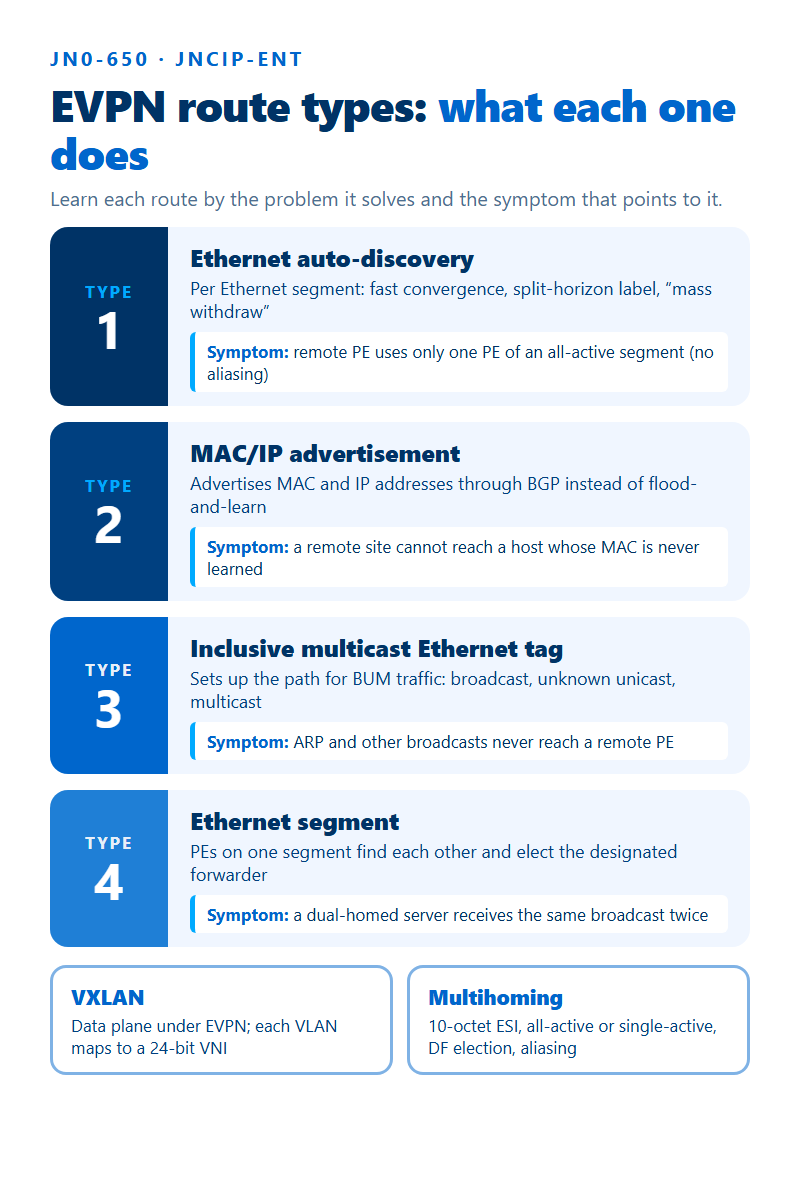
Learn the first four route types by what problem each one solves, not as a list of numbers. The Junos documentation describes them like this:
- Type 1, Ethernet auto-discovery: advertised per Ethernet segment. It is used for fast convergence and to advertise the split-horizon label, and it is also called the mass withdraw route.
- Type 2, MAC/IP advertisement: advertises MAC addresses and IP addresses. This is the route that replaces flood-and-learn.
- Type 3, inclusive multicast Ethernet tag: sets up the path for BUM traffic, meaning broadcast, unknown unicast and multicast frames.
- Type 4, Ethernet segment: lets PE devices that share a multihomed customer device discover each other, and it is used to elect the designated forwarder.
A good test of your understanding is to ask which route goes missing for a given symptom. Remote devices cannot find a host's MAC address: look at Type 2. Broadcast traffic does not reach a remote site: look at Type 3. Two PEs both forward the same broadcast to a dual-homed server: look at Type 4 and the designated forwarder election.
How does EVPN multihoming work on Junos?
Multihoming connects one customer device to two or more PE devices so that the site stays up when a link or a PE fails. The Junos EVPN multihoming overview is the reference to read for this objective, and these are the points it makes that you should be able to explain in your own words:
- The Ethernet segment identifier (ESI) names the set of links to one customer device. It is a 10-octet value and must be unique and nonzero. When you set it by hand, the first octet (the type byte) is 00. A single-homed device has an ESI of all zeros.
- Single mode is the default and needs no ESI.
- Active-standby uses the `single-active` statement. Only one PE forwards for the segment. The documentation notes that QFX switches and EVPN-VXLAN setups do not support this mode.
- Active-active uses the `all-active` statement. Every PE on the segment can forward, and the segment looks like a single LAG to the customer device.
- Designated forwarder (DF): on each Ethernet segment the PEs run an election. The DF forwards BUM traffic to the customer device, and the others become backup (non-DF) routers.
- Aliasing: a remote PE can load-balance Layer 2 unicast traffic across all the PEs that share the segment, even if only one of them advertised the MAC address.
If you can draw one dual-homed server, two PEs and one remote PE, and then explain which route types each PE sends and who forwards a broadcast, you are covering most of this objective.
Where does VXLAN fit in the JN0-650 EVPN objective?
VXLAN is the data plane and EVPN is the control plane. VXLAN wraps a Layer 2 frame in UDP so it can cross a routed IP network, and it labels each Layer 2 segment with a 24-bit VXLAN network identifier (VNI). On its own, VXLAN still has to learn MAC addresses by flooding. EVPN fixes that by using BGP to advertise MAC and IP addresses, so learning happens in the control plane instead of the data plane.
For the exam, keep three ideas clear:
- EVPN can run over an MPLS core or over a VXLAN overlay. The route types are the same idea in both.
- In EVPN-VXLAN, each VLAN maps to a VNI, and Type 2 and Type 3 routes are sent per VNI.
- The multihoming mode matters here: active-active is the mode to know for EVPN-VXLAN, because the documentation says active-standby is not supported with VXLAN overlays.
How much of JN0-650 is about EVPN?
Juniper does not say. The blueprint lists eight areas with no weights, so the honest answer is that EVPN is one area of eight and you should not skip it or let it take over your plan. In practice it deserves a little more than an equal share for one reason: it reuses BGP. Time spent on BGP route selection, communities and next-hop resolution makes EVPN easier, and time spent on EVPN makes the BGP objective feel less abstract.
With 65 questions in 90 minutes, you have no time to rebuild an EVPN topology in your head during the exam. That is why the study plan below asks you to draw the dual-homed topology from memory before exam day.
How should you study for JN0-650 in six weeks?
This plan assumes you already hold JNCIS-ENT and work with Junos. Juniper recommends two courses, Advanced Junos Enterprise Routing and Advanced Junos Enterprise Switching. The plan follows the same split.
- Week 1: IGPs and routing policy. OSPFv2 and OSPFv3 areas, LSAs and policy. Write one import and one export policy and predict the result before you commit it.
- Week 2: BGP. Route selection, next-hop resolution, communities, multipath and multihop, and the inet and inet6 families. End the week by explaining why a route was not chosen, using only the show output.
- Week 3: IP multicast. ASM and SSM, RPF, IGMP and IGMP snooping, PIM sparse mode, the RP, Anycast RP and MSDP. Draw a source-to-receiver tree each day.
- Week 4: Switching, access and telephony. Filter-based and private VLANs, MVRP, Q-in-Q and L2PT, MSTP or VSTP, 802.1X with MAC RADIUS and captive portal, server-fail fallback and guest VLAN, PoE, LLDP-MED and voice VLAN.
- Week 5: EVPN and CoS. Spend the first half on EVPN: route types 1 to 4, ESI rules, all-active and single-active, DF election, aliasing and VXLAN. Spend the second half on CoS: classifiers, forwarding classes, policers, schedulers, drop profiles, shaping and rewrite rules.
- Week 6: Review and timing. Read every objective line and say out loud how you would configure, monitor and troubleshoot it. Then do timed practice at about 80 seconds per question.
What does a JN0-650 EVPN troubleshooting scenario look like?
Here is a worked example of the "given a scenario" kind of thinking the objective describes. It is written for this post and does not come from the exam.
A server is dual-homed to PE1 and PE2 with the same ESI on both, configured as `all-active`. A remote PE3 sends all its unicast traffic for the server to PE1, never to PE2. Nothing is down. What is going on?
- Start with what all-active should give you. With aliasing, PE3 should spread traffic over both PEs on the segment, even if only PE1 advertised the server's MAC address.
- Ask what aliasing depends on. PE3 learns that PE2 also reaches the segment from PE2's Type 1 route for that ESI. If PE3 never received it, PE3 sees only PE1.
- Check the routes. On PE3, look at the EVPN routes it holds for that ESI. On PE2, `show evpn instance extensive` shows the ESI and its mode. A typing error in the ESI on PE2 is enough to make PE2 look like a separate segment.
- Check the database. `show evpn database` on PE3 shows which PE each MAC address was learned from. One entry, from PE1 only, fits the theory.
- Fix and confirm. Correct the ESI so it matches on both PEs, and confirm that PE3 now lists both PEs for the segment.
The point of the drill is the order: expected behaviour first, then the route that delivers it, then the command that proves it. The same order works for the BUM-duplication case, where you check the DF election with `show evpn instance designated-forwarder`.
Which EVPN mistakes cost JN0-650 candidates points?
- Mixing up Type 1 and Type 4. Both mention the Ethernet segment. Type 1 is about reaching the segment and fast withdrawal. Type 4 is about finding the other PEs and electing the DF.
- Thinking the DF forwards everything. The DF role is about BUM traffic toward the customer device. Known unicast can still use every PE in all-active mode.
- Forgetting the ESI rules. Ten octets, nonzero, and all zeros means single-homed. Small details like these make easy exam options.
- Studying VXLAN as a separate protocol. For this exam, VXLAN is the data plane under EVPN, not a topic of its own.
- Leaving EVPN to the last night. It depends on BGP. Learn it right after BGP, while the attributes and communities are fresh.
What carries over from the service provider track?
If you studied the service provider side first, a lot carries over. BGP route selection, routing policy and Q-in-Q tunnelling appear in both tracks. The newest post on our Blogger study notes covers what JNCIS-SP adds on top of JNCIA-Junos for JN0-364, and it is a useful way to see which Junos skills both tracks share.
The difference is the focus. The SP track goes deep on MPLS and IS-IS. JNCIP-ENT spends its time on the enterprise campus and its edge: multicast, access control, voice and EVPN. Read the objective lists side by side and you will see where your SP knowledge saves time.
This blog has its own Juniper entry too. Our lab map for the JNCIS-SP objectives breaks the JN0-364 blueprint into lab tasks, in the same way this post handles EVPN.
How do you book the JN0-650 exam?
You book through Pearson VUE, at a test centre or online. The Pearson VUE page for HPE Networking certification explains that the Juniper Networks Certification Program has been renamed the HPE Networking Certification Program. Since 15 September 2026, you sign in to Alpine CertMetrics with your hpe.com username and password, and that is where you schedule, manage and launch your exam.
Before you pay the US$400, run one check: can you explain every objective line, EVPN included, without notes? If not, give the weak area another week first.
How do you know you are ready for JN0-650?
You are ready when three things hold. You can draw the dual-homed EVPN topology and name every route each PE sends. You can explain a BGP path choice and a multicast RPF failure from show output alone. And you finish timed practice with time to spare.
For that last check, use the timed JN0-650 JNCIP-ENT practice exam on NWExam. It is built on the same eight objective areas, so a weak score in one area tells you exactly where to spend your last study days.
Is there a video on the JNCIP-ENT exam?
NWExam's channel has a short JNCIP-ENT exam overview. It was made for JN0-649, the previous code of the same certification, so use it for the general approach and take the current facts (65 questions, 90 minutes, Junos OS 25.2, EVPN on the blueprint) from the official page linked above.
Frequently asked questions
1. Is EVPN on the JN0-650 exam?
Yes. EVPN is one of the eight JNCIP-ENT objective areas. It lists route types, VXLAN and multihoming, and it asks you to configure, monitor or troubleshoot EVPN in a given scenario.
2. How many questions are on JN0-650, and how long is it?
JN0-650 has 65 multiple-choice questions and lasts 90 minutes. It is based on Junos OS 25.2 and is offered in English only.
3. What is the passing score for JN0-650?
Juniper does not publish a passing score or objective weights for JN0-650. You see your pass or fail result right after the exam.
4. What do I need before taking JN0-650?
You need the JNCIS-ENT certification first. Juniper recommends the Advanced Junos Enterprise Routing and Advanced Junos Enterprise Switching courses, but they are not required.
5. How much does the JN0-650 exam cost?
The JNCIP exam voucher costs US$400 in Pearson VUE's US voucher store. The certification is valid for three years.