
Singapore Mattress Market Hits USD 1.1B in 2024: Sleep Economy Rising | Ken Research
Singapore's bedding sector is entering a structural growth phase that goes well beyond furniture replacement cycles. The city-state's combination of rising health consciousness, an expanding hospitality pipeline, and accelerating e-commerce adoption is reshaping how consumers and institutional buyers approach sleep products. For a full breakdown of segment dynamics and competitive positioning, explore the Singapore Mattress and Bedding Market Report. This analysis is published by Ken Research, a leading market intelligence firm covering consumer and retail sectors across Southeast Asia.
This analysis is based on Ken Research market modelling, operator fleet disclosures, tourism indicators, and third-party retail-sector estimates.
USD 1.1 Billion in 2024: Sleep Health Is Becoming a Mainstream Spending Category
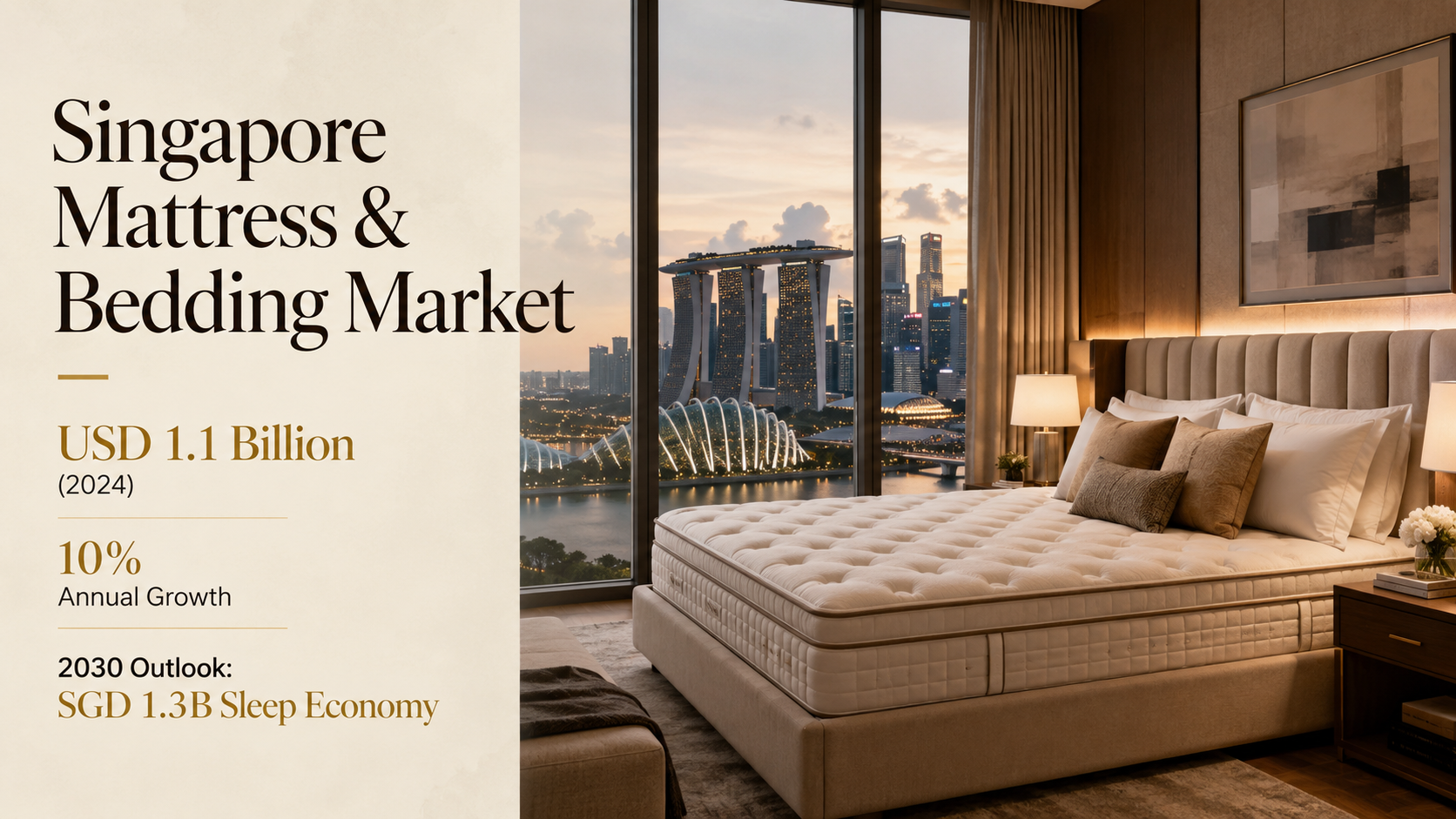
What drives a market to grow at 10% annually in a city where most consumers already own a mattress? The answer lies in a shift from replacement demand to intentional upgrading. The market reached USD 1.1 billion as of the most recent year, and the sleep health segment is forecast to reach SGD 1.3 billion within the decade. What makes this trajectory credible is the health signal underpinning it: a significant share of Singaporeans report active sleep issues, a prevalence rate that converts awareness campaigns into durable demand. Operators who treat this as a wellness category rather than a commodity replacement cycle will be better positioned to capture premiumisation upside.
- Market Size 2024: USD 1.1 billion, within a USD 2.2 billion home decor parent market
- Growth Rate: 10% annual increase in mattress spending projected through 2030
- Sleep Health Forecast: Sub-segment reaching SGD 1.3 billion by 2030, driven by 30% sleep-disorder prevalence
- Parent Market: Singapore Furniture and Home Decor market valued at USD 2.2 billion, of which bedding is the fastest-growing sub-category
HDB Housing and Rising Incomes Drive Residential Demand Across 80% of the Population
When 80% of Singaporeans live in government-built housing, the mattress market does not behave like a luxury category; it behaves like a recurring infrastructure spend. That scale creates a consistently large renewal and upgrade base for mattress brands at every price point. Average monthly disposable income stands at SGD 4,500, rising 3% year-on-year. The result is a clear trade-up from entry-level innerspring to memory foam, hybrid, and smart sleep systems. For comparison of regional consumer income dynamics, the Malaysia Mattress and Sleep Economy Market and the South Korea Mattress and Sleep Economy Market offer instructive benchmarks.
- HDB Penetration: 80% of residents in public housing ensures broad, recurring replacement demand
- Disposable Income: Average monthly income at SGD 4,500, rising 3% YoY, supports premiumisation
- Income Trajectory: GDP per capita forecast to approach SGD 100,000, fuelling premiumisation across the category
- Fastest-Growing Segment: Memory Foam leads sub-category growth, followed by Hybrid and Smart mattress formats
Exploring Singapore's broader home and living market? The Singapore Furniture and Home Decor Market Report covers the full USD 2.2 billion parent market, including mattress, furniture, and decor segment forecasts through 2030.
Hospitality Boom Adding 1,421 New Hotel Keys Creates a Direct B2B Procurement Opportunity
The commercial and hospitality segment represents a procurement-scale opportunity that residential brands rarely access, and Singapore's tourism revival has reignited it. Singapore added 1,421 new hotel keys while the hotel Average Occupancy Rate climbed to 81.8%, improving year-on-year. International visitor arrivals reached 16.5 million. High occupancy at this level accelerates mattress replacement cycles across existing hotel inventory, making commercial procurement a recurring revenue stream rather than a one-time opening order. Brands that develop hospitality-grade product lines and dedicated B2B direct channels will capture a disproportionate share of this upcycle.
Looking ahead, hospitality sector growth is forecast at 8% with 19 million visitors expected, expanding the procurement pipeline materially through 2027. The Australia Mattress and Bedding Solutions Market offers a comparable occupancy-driven commercial model for reference.
- New Hotel Keys: 1,421 added in 2024, each requiring full bedding procurement at opening
- Occupancy Signal: Rate at 81.8% drives accelerated replacement cycles across existing hotel inventory
- Visitor Pipeline: 19 million visitors forecast means sustained hospitality procurement demand through 2027
What Is Holding the Market Back: Margin Compression and a 100-Brand Competitive Field
Not every trend in Singapore's bedding market points upward. Two structural headwinds are converging on profitability simultaneously, and operators underestimating them risk entering a growth market while generating losses. Consider the input cost side first: polyurethane foam, the core material for the fast-growing Memory Foam segment, saw prices increase 12% due to supply chain disruption. Simultaneously, retail price deflation of 5% is being driven by aggressive promotions across a deeply contested category. The result is a margin squeeze from both directions: input costs rising while shelf prices fall.
- Foam Cost Headwind: Polyurethane prices up 12% due to supply disruption, hitting Memory Foam margins hardest
- Retail Price Deflation: Average mattress prices down 5% from aggressive mass-market competition among 100+ brands
- Mass-Market Anchoring: IKEA's VALEVAG mattress reduced from SGD 349 to SGD 239, pulling average selling prices down across the board
- Regulatory Cost: BCA Green Mark Scheme compliance adds cost for smaller players but creates differentiation for certified brands
Online retail platforms are capturing share rapidly, with the e-commerce channel growing at an estimated 11.36% CAGR, adding competitive pressure on traditional showroom operators. Brands without premium positioning or direct-to-consumer efficiency will face compressing returns even as volume grows. Singapore's BCA Green Mark Scheme requirements add compliance cost but also serve as a moat for early-mover brands that certify ahead of the mandate.
Ready to map your competitive positioning in Singapore's sleep economy? Access the full Singapore Mattress and Bedding Market Report for player benchmarking, channel forecasts, and segment data through 2030.
Conclusion
Singapore's mattress and bedding sector is being shaped by three converging forces: a wellness-led consumer upgrade cycle, a hospitality procurement wave, and a competitive landscape demanding execution discipline. The challenge is that margin compression from foam costs and price deflation is arriving simultaneously with these tailwinds. Brands that invest in premiumisation, B2B hospitality relationships, and sustainability credentials will outpace the market's trajectory toward SGD 1.3 billion by 2030. For the full competitive dataset, visit Ken Research.
Frequently Asked Questions
Q1: What is the current size of the Singapore Mattress and Bedding Market?
Singapore consumers replace mattresses less frequently than in many high-income economies, with replacement cycles running 7-10 years versus the international norm of 5-7 years, pointing to an accelerating upgrade wave still in progress. Beyond cycles, per-capita spend here runs approximately 2-3x the Southeast Asian average, reflecting a premium income profile that supports a high-ASP product mix. The total market stands at USD 1.1 billion, with the sleep health sub-segment on track for SGD 1.3 billion by the decade's end.
Q2: How does Singapore compare to regional mattress markets in Southeast Asia?
Singapore's market is structurally different from regional peers. The Thailand Mattress and Sleep Economy Market and Philippines Furniture and Home Decor Market operate at higher volume but significantly lower average selling prices. Singapore's SGD 4,500 average monthly disposable income and 81.8% hotel occupancy rate make it one of the few Southeast Asian markets where premium and hospitality-grade products command a viable price point at scale, giving international brands a higher-margin beachhead in the region.
Q3: Who are the leading players and how competitive is the landscape?
The market has over 100 competing brands. Key players include Tempur Sealy International, King Koil (endorsed by the International Chiropractors Association), IKEA, Emma Mattress, Zinus, and Dunlopillo. Premium brands drive a disproportionate revenue share above the SGD 2,000 per-unit threshold, while mass-market competition has pushed average prices down 5%. For a global view of how home decor competition is evolving, the Global Home Decor Market provides useful benchmarking context.
Q4: What is the biggest margin risk for mattress brands in Singapore right now?
The simultaneous compression from both input costs and retail prices is the defining challenge. Polyurethane foam prices increased 12% while average mattress retail prices fell 5%, creating a roughly 17-percentage-point effective margin squeeze, per Ken Research modelling, for brands that source conventionally and compete on price. This is why premium positioning, direct-to-consumer fulfilment, and supply chain diversification are becoming strategic necessities rather than optional upgrades for operators planning to grow profitably through 2030.
Q5: How is sustainability regulation reshaping product demand in Singapore?
Singapore's BCA Green Mark Scheme is more stringent than equivalent certification frameworks in Malaysia and Thailand, creating a market-entry barrier that simultaneously acts as a moat for certified brands. Organic cotton ticking and natural latex cores now appear on specification sheets for mid-tier hotel procurement, a category that historically accepted commodity polyurethane. The key implication: brands that certify now, while compliance is still optional for many end-users, are building a procurement preference that will become mandatory within three to five years. For a regional sustainability competitive benchmarking view, the Asia Pacific Home Furniture Market covers adjacent market dynamics across the region.