
GCC AI in Healthcare Market Reaches USD 4.8B by 2030: Ken Research Finds Vision 2030 and Clinical AI Mandates Drive 26% CAGR | Ken Research
Executive Summary
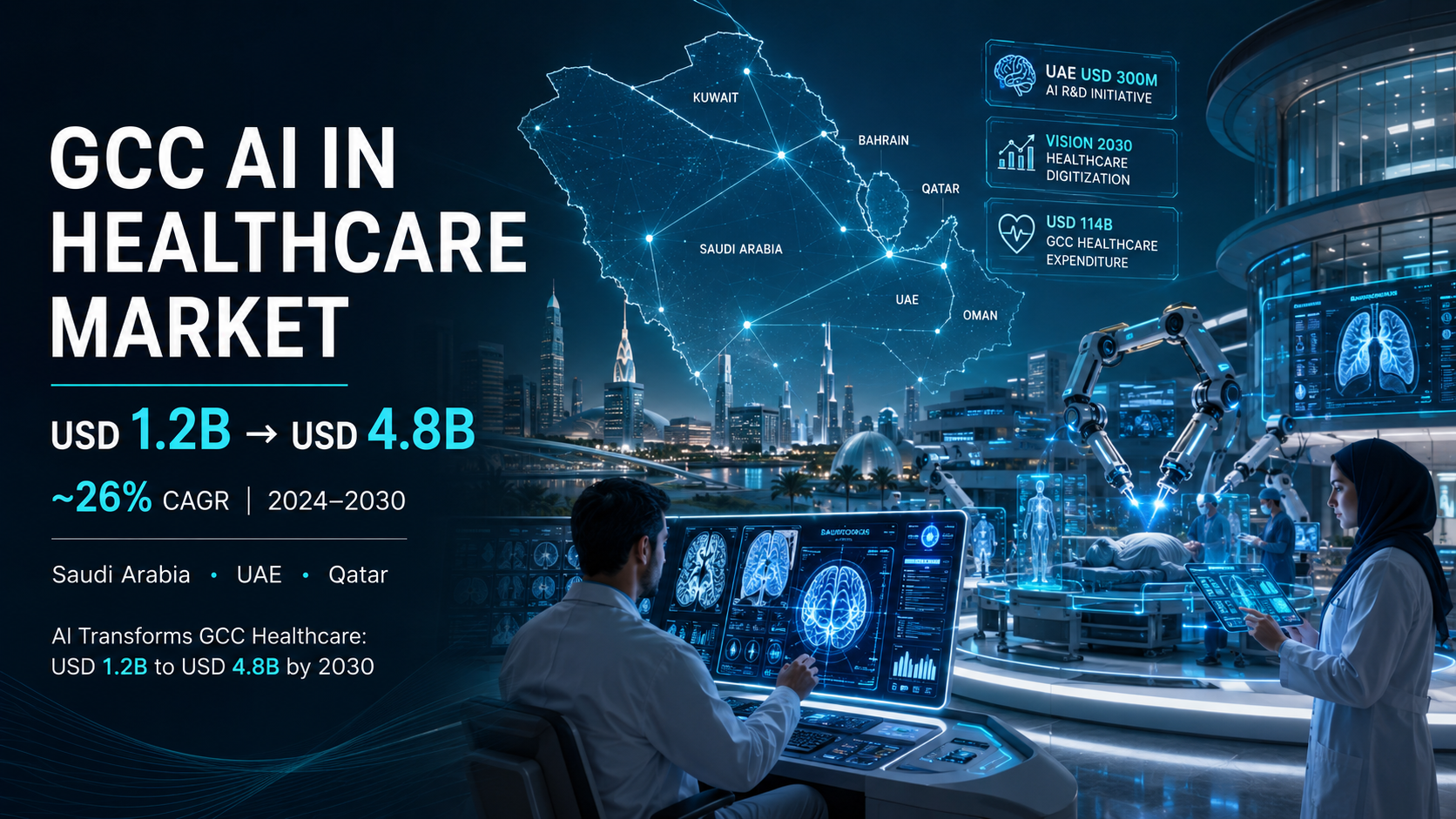
GCC healthcare is entering its most consequential technological transformation. Ken Research values the GCC AI in Healthcare Market at USD 1.2 billion in 2024, projected to reach USD 4.8 billion by 2030 at ~26% CAGR. Across Saudi Arabia, UAE, Qatar, Kuwait, Oman, and Bahrain, hospitals and health systems deploy AI-driven clinical decision support and diagnostic intelligence, predictive patient monitoring and risk analytics platforms, and AI-powered telemedicine and virtual care systems, making GCC the fastest-growing AI healthcare market globally by sovereign investment density.
Analyst: Ken Research Market Analysis | Methodology: Ken Research market modelling, 365 respondent survey across GCC hospital administration, AI technology providers, and healthcare policy makers; UAE Ministry of AI disclosures; Saudi SDAIA and Ministry of Health data.
Key Takeaways
- Market Size and Forecast (Ken Research): GCC AI in Healthcare Market valued at USD 1.2 billion (2024), expanding to USD 4.8 billion by 2030 at ~26% CAGR, driven by Vision 2030 digitization mandates and sovereign AI investment exceeding USD 2 billion.
- UAE AI R&D Leadership (UAE Government): UAE allocated USD 300 million for AI R&D across healthcare and digital sectors, positioning Abu Dhabi and Dubai as the GCC's dominant AI healthcare deployment hubs with UAE holding the largest country share.
- Saudi Arabia Sub-Market (IMARC Group): Saudi Arabia AI in Healthcare Market reached USD 70.2 million (2024), projected at USD 636.7 million by 2033 at 24.7% CAGR, fueled by Vision 2030's healthcare digitization targets and 28 hospital network AI diagnostic deployments.
- GCC Healthcare Spend Catalyst (Ken Research): GCC healthcare expenditure projected at USD 114 billion annually at 10% annual growth, creating non-negotiable demand for AI efficiency and cost-reduction tools across all six GCC states.
- Machine Learning Segment Leadership (Ken Research): Machine Learning Solutions leads all AI healthcare segments by investment and revenue, followed by Imaging/Diagnostics AI and NLP tools, with Hospitals as the dominant end-user accounting for the majority of GCC AI healthcare procurement.
Market At A Glance
GCC AI in Healthcare Market Size, Forecast Value and Growth Trajectory 2024 to 2030
Ken Research values the GCC AI in Healthcare Market at USD 1.2 billion (2024), projected to reach USD 4.8 billion by 2030 at ~26% CAGR. UAE and Saudi Arabia account for over 65% of regional AI healthcare investment, anchored by sovereign mandates and USD 114 billion in projected annual GCC healthcare spend growing at 10% per year.
Sovereign AI Investment: UAE USD 300M Mandate and Saudi Vision 2030 Digital Health
UAE allocated USD 300 million for AI R&D encompassing clinical AI, diagnostics, and health data infrastructure. Saudi Arabia's Ministry of Health deployed AI diagnostics across 28 hospital networks, with SDAIA's National Data Platform underpinning healthcare AI compliance. Total GCC AI healthcare investment is expected to exceed USD 2 billion by 2026, across public and private health systems. The Saudi Arabia Machine Learning Market profiles the ML infrastructure platforms powering Saudi health AI deployments.
Core AI Healthcare Segments: Diagnostics, Predictive Analytics, and Virtual Care
The GCC AI healthcare market spans seven segments: Machine Learning Solutions (leading by revenue), Imaging and Diagnostics AI, NLP Tools, Predictive Analytics Platforms, Virtual Health Assistants, Robotics and Automation, and Administrative Workflow AI. Clinical Decision Support and Patient Monitoring are the highest-growth applications. Hospitals dominate end-user procurement, with Pharmaceutical Companies and Insurance Providers as fast-growing secondary segments.
Competitive Landscape: Global Healthcare AI Leaders in the GCC Market
Global platform leaders dominate GCC healthcare AI procurement: Siemens Healthineers, GE Healthcare, Philips Healthcare, IBM Watson Health, Google Health, Microsoft Healthcare, AWS Healthcare, and NVIDIA compete for enterprise and government hospital system contracts. Regional champions including Cerner Corporation, Oracle Health Sciences, and Zebra Medical Vision serve mid-tier GCC health institutions. The UAE AI Robotics Market profiles surgical robotics AI — one of the fastest-growing GCC healthcare sub-segments alongside diagnostic imaging.
How GCC Hospitals Deploy Clinical AI to Address the USD 114B Healthcare Spend Efficiency Gap
The GCC healthcare system faces a structural efficiency crisis that AI directly addresses. With healthcare expenditure at USD 114 billion annually and rising 10% per year, GCC hospital systems cannot scale traditional staffing models. UAE providers using LLM-powered clinical documentation reduce physician administrative time by 35 to 45%. Saudi Arabia's Ministry of Health AI diagnostic deployments achieve 94% diagnostic accuracy in pilot radiology AI programmes, addressing a 40% specialist physician shortage. The GCC AI Banking Market shows how adjacent AI investments in insurance and health payer systems are accelerating healthcare AI ROI measurement.
- Clinical documentation AI: UAE providers reduce physician admin burden by 35 to 45% — directly addressing GCC's 40% specialist shortage without new hires
- AI radiology diagnostics: Saudi Ministry of Health pilots achieve 94% diagnostic accuracy in AI radiology across 28 hospital networks — faster and more consistent than manual review
- Predictive monitoring ROI: GCC hospitals deploying AI patient monitoring reduce adverse event rates by 20 to 30%, cutting cost-per-patient and length of stay simultaneously
- Administrative workflow AI: AI-powered scheduling, billing, and claims processing reduce administrative overhead by 28 to 40% per GCC hospital system deployment
Machine Learning, NLP, and Imaging AI: The Three GCC Healthcare AI Pillars Delivering Measurable ROI
Three AI technology segments drive the majority of measurable GCC healthcare ROI. Machine Learning delivers the broadest deployment footprint across clinical risk scoring, drug interaction monitoring, and population health analytics. Imaging AI — MRI/CT enhancement, pathology detection, and radiology automation — delivers the fastest return: 60 to 75% reduction in radiologist review time per scan in UAE and Saudi deployments. NLP tools translate Arabic-language clinical documentation to structured data, addressing a capability gap no English-first global vendor solves natively. The Middle East Generative AI Market covers generative AI's role in clinical note synthesis and patient communication across GCC health systems.
- Machine Learning platforms: Largest GCC AI healthcare segment by investment — deployed for risk stratification, drug interaction screening, and population health modelling across USD 114B GCC healthcare spend base
- Imaging/Diagnostics AI: 60 to 75% reduction in radiologist review time per scan; GCC radiology AI captures highest ROI per implementation dollar of any clinical AI segment
- Arabic NLP tools: Arabic-native clinical documentation AI achieves 35 to 50% higher accuracy than translated English tools — critical competitive differentiator for GCC hospital procurement
- Cybersecurity cost avoided: AI-secured healthcare systems reduce breach exposure — data breach cost of USD 4.24 million per incident globally makes AI security a board-level mandate in GCC health networks
Which GCC AI healthcare segment — diagnostics AI, predictive analytics, or clinical NLP — delivers the highest ROI for your health system? Download Sample Report for segment-level forecasting, vendor landscape, and country-by-country adoption analysis.
Conclusion
The GCC AI in Healthcare Market scales from USD 1.2 billion (2024) to USD 4.8 billion by 2030 at ~26% CAGR, driven by sovereign AI mandates, Vision 2030 healthcare digitization, and a USD 114 billion annual healthcare spend base demanding efficiency AI. Organizations deploying clinical AI, imaging diagnostics, and NLP now hold structural competitive advantage. The MENA AI Smart Cities Market shows how GCC smart infrastructure connects AI healthcare networks with broader digital city health ecosystems.
Planning AI healthcare deployment or clinical AI vendor evaluation across the GCC? Speak to a Ken Research Healthcare AI Analyst to validate technology selection, Arabic NLP requirements, and regulatory compliance pathways.
Ken Research Finds
Ken Research decodes the GCC AI in Healthcare Market: grows USD 1.2B (2024) to USD 4.8B (2030) at 26% CAGR, driven by sovereign AI mandates, USD 114B healthcare spend pressure, and Vision 2030 digitization imperatives. Winners prioritize ML diagnostics, Arabic-native NLP, and predictive patient monitoring. Competitive advantage flows to platforms securing GCC hospital system contracts before the 2026 mandate wave.
Frequently Asked Questions
Q1: What is the GCC AI in Healthcare Market size in 2024?
Ken Research values the GCC AI in Healthcare Market at USD 1.2 billion (2024), projected to reach USD 4.8 billion by 2030 at ~26% CAGR. UAE and Saudi Arabia hold over 65% of regional investment, with UAE dominant due to its USD 300 million AI R&D commitment and early-mover hospital AI infrastructure.
Q2: Which AI healthcare segment leads in the GCC market?
Machine Learning Solutions lead by revenue and deployment breadth, followed by Imaging/Diagnostics AI. Imaging AI delivers the highest single-deployment ROI: 60 to 75% reduction in radiologist review time per scan. The Bahrain AI Chatbot Market shows how conversational AI extends from patient triage into clinical administrative workflows across GCC health systems.
Q3: Which GCC country leads AI healthcare adoption?
UAE leads with the highest AI healthcare investment density — USD 300 million in AI R&D allocation and the GCC's most advanced hospital AI infrastructure. Saudi Arabia follows with Vision 2030-driven deployments across 28 hospital networks and a healthcare AI market growing at 24.7% CAGR toward USD 636.7 million by 2033.
Q4: What are the biggest barriers to GCC AI healthcare deployment?
Three barriers: data privacy risk (healthcare breach cost at USD 4.24 million per incident globally), implementation cost (average USD 1.2 million per AI integration), and talent shortage. Arabic NLP capability gaps mean English-first global platforms underperform. The Oman AI Fraud Detection Market shows how GCC health payers are deploying fraud detection AI to recover costs from fraudulent claims alongside clinical AI deployments.
Q5: Who are the leading AI healthcare vendors in the GCC?
Global leaders: Siemens Healthineers, GE Healthcare, Philips Healthcare, IBM Watson Health, Google Health, Microsoft Healthcare, and AWS Healthcare. Regional platforms and integrators serve mid-tier GCC hospitals. Ken Research analysis shows top 5 global vendors hold 55 to 65% of GCC AI healthcare enterprise contract value. The Gulf Region AI Retail Market illustrates how cross-sector AI platform vendors are expanding from retail into GCC health system AI deployments, broadening competitive dynamics.