
Malaysia Fertilizer and Soil Nutrition Market Outlook 2024-2030: Growth and Players
Executive Summary
Malaysia's fertilizer and soil nutrition market runs on oil palm demand and heavy government subsidies. Precision agriculture, organic adoption, and crop-yield targets are pushing the market from USD 2.5 Billion in 2024 toward roughly USD 3.4 Billion by 2030, with bio and specialty fertilizers the fastest layer.
Key Market Velocity Data
- Current Market Value: USD 2.5 Billion in 2024
- Projected Market Value: around USD 3.4 Billion by 2030
- CAGR: about 5.2% during 2025 to 2030
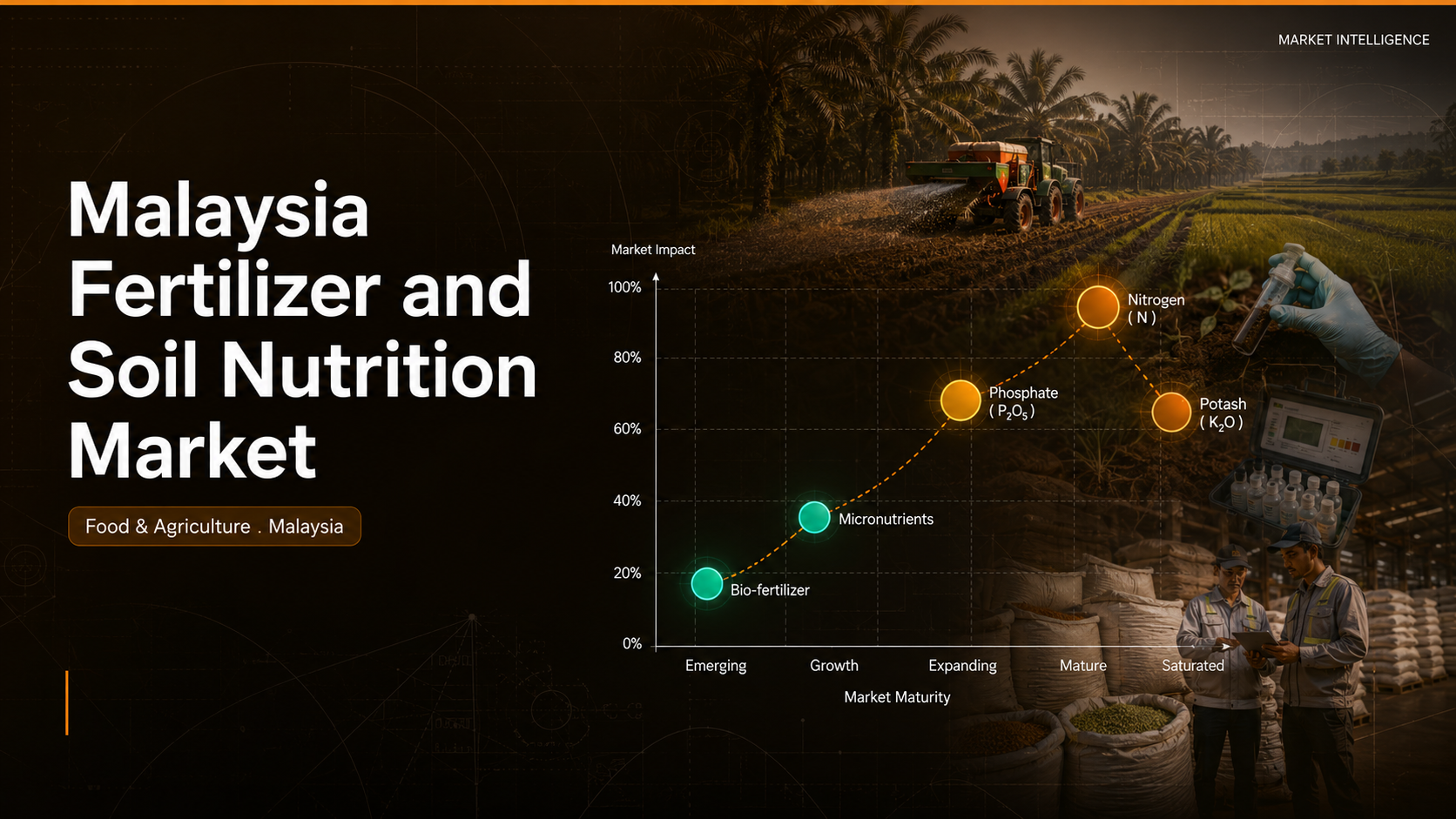
- Dominant Type: nitrogenous fertilizers, the most widely used
- Primary Growth Catalyst: oil palm nutrition and government subsidies
What Is Driving Demand in the Malaysia Fertilizer Market?
Demand is anchored in plantation agriculture. As a top global palm oil producer, Malaysia's oil palm sector is the largest fertilizer consumer, especially of nitrogen-rich ammonium nitrate. Productivity targets aim for 20% yield gains, the organic fertilizer segment is projected to reach MYR 1.2 Billion while expanding about 15% a year, and the government allocated MYR 500 Million for agricultural subsidies. Smallholders increasingly access these subsidized inputs through cooperative distribution channels.
- Plantation pull: oil palm drives the bulk of nitrogen demand as the sector's primary input.
- Yield push: productivity targets of 20% gains lift precision and controlled-release fertilizer use.
- Organic shift: the organic segment heads toward MYR 1.2 Billion at about 15% annual growth.
- Subsidy support: MYR 500 Million in subsidies underpins smallholder and paddy demand.
How Do Subsidies and Regulation Shape the Market?
Government support is the structural floor under demand. The Ministry of Agriculture and Food Security runs subsidy programmes dating to 1970, providing paddy farmers 240 kg of compound fertilizer and 80 kg of urea per hectare, while the Malaysian Palm Oil Board funds smallholder inputs up to RM 16,250 at 2% interest (Malaysian Palm Oil Board). Cooperative networks remain the main last-mile route to reach dispersed smallholders.
Replanting and environmental rules add direction. The TSPKS 2.0 scheme allocated RM 100 Million in 2024 as a 50% grant and 50% loan for oil palm replanting, while the Environmental Quality Act of 1974 governs runoff and sustainable application, favoring compliant, branded suppliers. These schemes tie fertilizer demand directly to plantation replanting cycles.
Which Companies Are Shaping the Competitive Landscape?
Domestic producers anchor supply. Petronas, through Bintulu Fertilizer, is among the largest urea and ammonia producers, FGV Fertiliser produces over 600,000 MT a year under SunBear and SunFlower brands, and Behn Meyer markets the widest fertilizer range in Malaysia. Yara Malaysia leads premium crop nutrition. Local feedstock from natural gas gives Petronas a structural cost advantage in urea production.
Global majors and integrated planters round out the field. BASF Malaysia supplies specialty fertilizers, Sime Darby Plantation runs large-scale nutrient programmes, and Agromate and CCM compete in compounds. Scale producers with local plants hold a cost edge over importers exposed to global nitrogen price swings. Consolidation favors players that pair plant capacity with agronomy services.
What Does This Mean for B2B Decision-Makers?
For producers, planters, and investors, the market is steady rather than explosive, and cost position plus sustainability now decide margin. With the market moving from USD 2.5 Billion toward roughly USD 3.4 Billion by 2030 at about 5.2% CAGR, growth is reliable, but subsidy reform and palm oil cycles drive the swings. Sustainability credentials are becoming a procurement filter for large planters.
- For producers: expand local urea and ammonia capacity to hedge global nitrogen price swings.
- For planters: adopt precision nutrition to capture the 20% yield-gain target.
- For agri-input firms: scale organic lines heading toward MYR 1.2 Billion at 15% growth.
- For investors: track subsidy policy, which underpins MYR 500 Million of demand.
Which Segments and Crops Lead the Malaysia Fertilizer Market?
Segment economics favor nitrogenous fertilizers and plantation crops. Nitrogenous products dominate volume on oil palm demand, phosphate and potash serve balanced nutrition, and bio and organic fertilizers form the fastest-growing frontier. Crop production leads application, with horticulture and turf as smaller niches. Soil-conditioning and micronutrient products add a high-margin specialty layer above commodity NPK.
- Product mix: nitrogenous fertilizers lead, while organic and bio grow fastest at about 15% a year.
- Crop demand: oil palm and paddy anchor consumption, supported by long-running subsidies.
- Sustainability: controlled-release and precision products gain on yield and runoff concerns.
Ken Research Strategic Outlook
The decisive lever in Malaysian fertilizer is policy plus palm oil economics, not raw demand growth. As subsidies persist and sustainability rules tighten, margin will migrate toward integrated producers that control local nitrogen capacity and credible organic lines. Expect bio and specialty fertilizers at about 15% growth to outpace the 5.2% market average and reshape the premium tier. Volatility in global gas and nitrogen prices will keep local capacity strategically valuable.
Data Source and Full Analysis
For deeper segment-level analysis, access the full Ken Research report here: Malaysia Fertilizer and Soil Nutrition Market Report