
APAC Inflight Retail and Advertising Market Outlook 2024-2030: Growth and Players
Executive Summary
The APAC inflight retail and advertising market is rebounding on surging air travel and digital personalization. Passenger recovery, seatback connectivity, and e-commerce integration are pushing the market from USD 1.04 Billion in 2024 toward roughly USD 1.7 Billion by 2030, with digital screen advertising leading.
Key Market Velocity Data
- Current Market Value: USD 1.04 Billion in 2024
- Projected Market Value: around USD 1.7 Billion by 2030
- CAGR: about 8.5% during 2025 to 2030
- Regional Weight: APAC holds about 37.4% of the global market
- Primary Growth Catalyst: passenger recovery and digital personalization
What Is Driving Demand in the APAC Inflight Retail Market?
Demand is travel and tech led. APAC passenger traffic is projected near 1.5 billion, and the region's airlines posted a 26% rise in international traffic in 2024 with load factors at 83.8%. Personalization expectations are high, as about 71% of consumers want tailored offers, and roughly 70% of airlines are set to offer high-speed connectivity.
- Passenger surge: APAC traffic heads toward 1.5 billion passengers, up 26% in 2024.
- Load factors: APAC load factors reached 83.8%, maximizing exposure per flight.
- Personalization: about 71% of consumers now expect tailored offers.
- Connectivity: roughly 70% of airlines are set to offer high-speed internet.
- Regional share: APAC carriers held about 33.5% of global passenger traffic in 2024.
How Do Regulation and Connectivity Shape the Market?
Regulation governs content and safety. The Advertising Standards Council of India enforces its code on inflight advertising, while the Civil Aviation Authority of Singapore sets stringent guidelines on advertising content, and the Aircraft Dangerous Goods Rules of 2023 shape product retail (Civil Aviation Authority of Singapore). Compliance favors digital, data-driven formats. Cross-border content rules force airlines to localize advertising by route and jurisdiction, as harmonized standards remain elusive across the diverse region.
Connectivity is unlocking retail media. High-speed Wi-Fi turns seatbacks into shoppable, data-rich screens, shifting spend from print magazines to AVOD and e-commerce platforms. These shifts reward airlines and media partners that can target offers using passenger data within privacy rules. Privacy frameworks are shaping how passenger data can legitimately power targeted offers.
Which Companies Are Shaping the Competitive Landscape?
Media and technology specialists lead advertising. Global Eagle Entertainment, now Anuvu, Immfly, Spafax, and Panasonic Avionics power seatback and connectivity-based advertising, while Inflight Media and AIA handle airline media sales. Full-service carriers like Singapore Airlines, Cathay Pacific, and China Southern control premium inventory. Connectivity providers are turning onboard Wi-Fi into a measurable, addressable advertising channel, and retail-media networks are emerging as airlines productize their captive audiences.
Retailers anchor the duty-free side. Dufry, Heinemann, and Lagardere Travel Retail supply onboard and pre-order retail, while low-cost carriers monetize aggressively through onboard sales. Advantage sits with players that integrate retail, advertising, and passenger data across the journey. Joint ventures between airlines and retailers are formalizing onboard media inventory and measurement.
What Does This Mean for B2B Decision-Makers?
For airlines, media firms, and retailers, inflight is becoming a retail-media channel, and data and connectivity now decide margin. With the market moving from USD 1.04 Billion toward roughly USD 1.7 Billion by 2030 at about 8.5% CAGR, the runway is strong, but digital capability defines winners. First-party passenger data is the scarce asset that commands premium ad rates.
- For airlines: monetize seatbacks as retail media, reaching 1.5 billion APAC passengers.
- For media firms: build personalization tools for the 71% who expect tailored offers.
- For retailers: push pre-order and e-commerce ahead of the duty-free trolley.
- For investors: back connectivity, as about 70% of airlines add high-speed Wi-Fi.
Which Segments and Formats Lead the APAC Inflight Market?
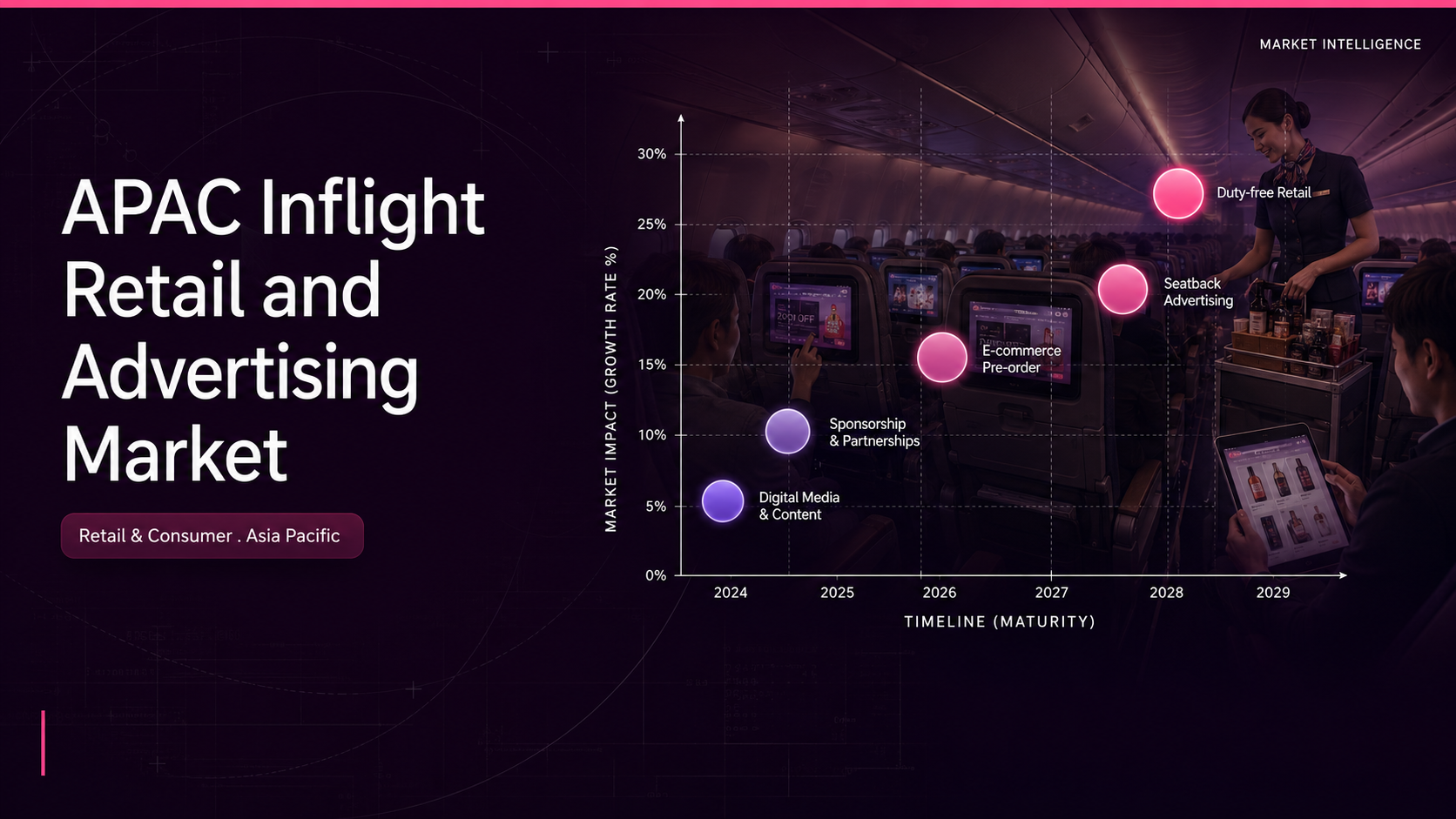
Segment economics favor digital screens and full-service carriers. Digital screen advertising leads format growth, e-commerce and pre-order platforms scale fastest, and print magazines decline. Full-service airlines dominate premium inventory, while low-cost carriers drive high-volume onboard retail across the region. Sponsorship and branded content add a high-margin layer above commodity duty-free, while pre-order fulfillment at destination is a fast-rising convenience play.
- Format mix: digital screens lead, while e-commerce and pre-order platforms grow fastest.
- Airline split: full-service carriers dominate, with LCCs pushing onboard retail volume.
- Geography: APAC alone holds about 37.4% of the global inflight market.
Ken Research Strategic Outlook
The decisive shift in APAC inflight is from print toward connected retail media, not just trolley sales. As traffic recovers and Wi-Fi scales, margin will migrate toward airlines and partners that fuse advertising, retail, and passenger data into personalized offers. Expect Anuvu, Spafax, and Panasonic Avionics to anchor the digital layer, pushing the market toward USD 1.7 Billion by 2030. Programmatic ad buying will gradually reach the seatback, opening inflight to mainstream media budgets.
Data Source and Full Analysis
For deeper segment-level analysis, access the full Ken Research report here: APAC Inflight Retail and Advertising Market Report