
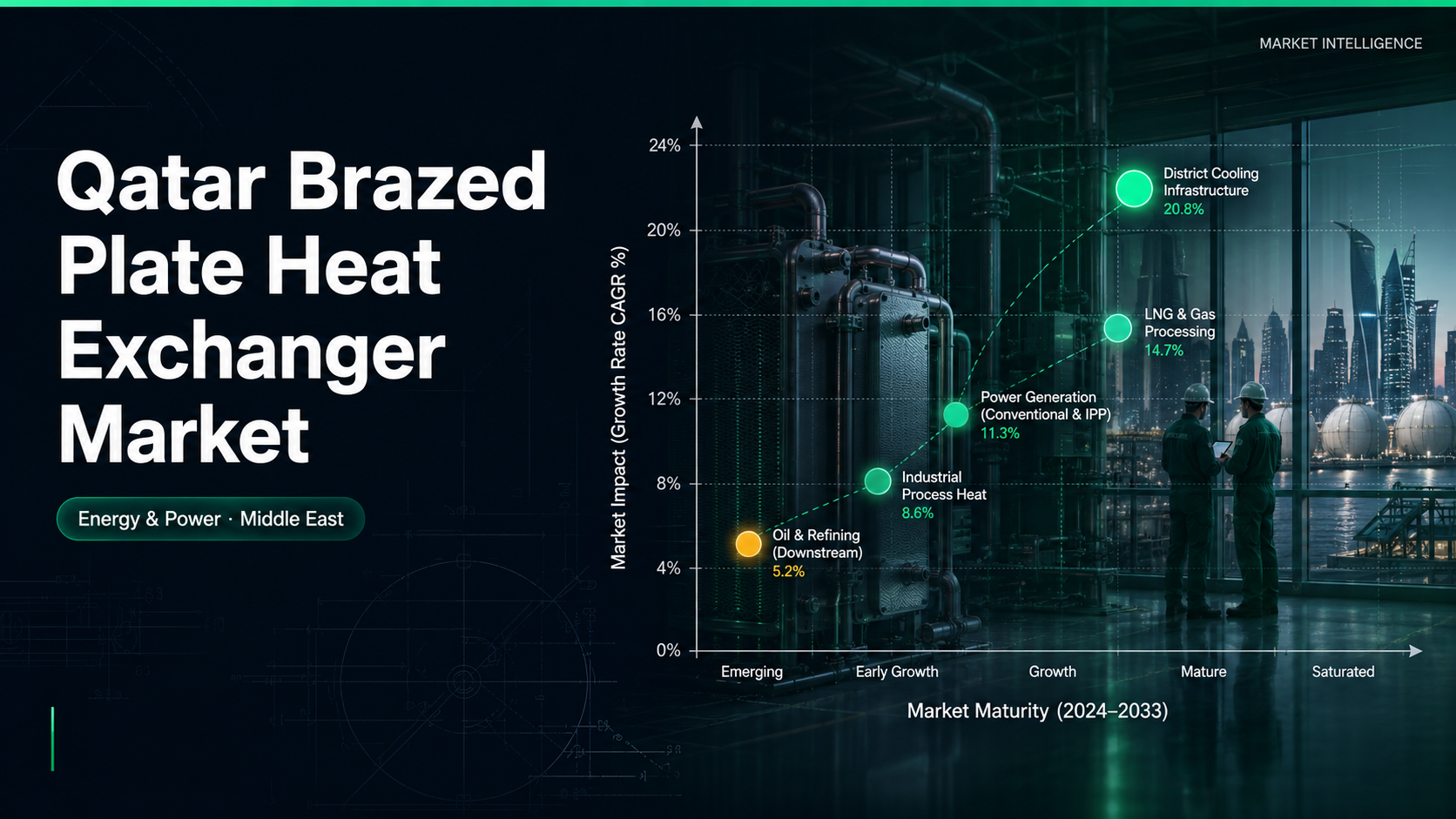
Qatar Brazed Plate Heat Exchanger Market Outlook 2024-2030: Growth and Forecast
Executive Summary
Qatar's brazed plate heat exchanger market is small at USD 12 million in 2024, but it is structurally locked to district cooling and energy-efficiency rules. Demand is mandate-driven, not discretionary, as extreme heat and a construction boom force efficient thermal systems.
Key Market Velocity Data
- Current Market Value: USD 12 million in 2024
- Projected Market Value: approximately USD 19 million by 2030
- CAGR: about 7.7% during 2025 to 2030
- Dominant Segment: stainless steel units, HVAC and district-cooling led
- Primary Growth Catalyst: energy-efficiency mandates and district-cooling expansion
What Is Driving the Market?
Cooling is the core driver. In Qatar's extreme climate, HVAC and district cooling dominate energy use, and brazed plate heat exchangers deliver the compact, high-efficiency transfer these systems need. The market sits at USD 12 million in 2024 within a USD 63.7 million Middle East market growing at 7.7% CAGR.
Policy and construction amplify demand. Kahramaa's Energy Efficiency Standards and Labeling Regulations of 2023 push efficient equipment, while Qatar targets a 30% energy-use reduction by 2030. A construction sector heading toward QAR 120 billion and 5.5% annual industrial growth expand the installed base.
- Climate mandate: extreme heat makes HVAC and district cooling the dominant energy load, favoring compact BPHEs
- Efficiency rules: Kahramaa's 2023 labeling regulations and a 30% reduction target by 2030 reward high-performance units
- Construction pipeline: a QAR 120 billion building sector and 5.5% industrial growth widen the installed base
- Sustainability push: government renewable-energy and net-zero initiatives favor low-energy thermal equipment
Which Entities Are Shaping the Market?
Global specialists dominate supply. Alfa Laval, Danfoss, SWEP, Kelvion, and GEA Group lead brazed plate technology, while API Heat Transfer, Hisaka Works, Tranter, and HRS Heat Exchangers serve niche applications. There is no large domestic manufacturer, so the USD 12 million market is import-led within a 7.7% CAGR regional market. Distributors and local agents bridge supply, since lead times and after-sales support decide tenders as much as unit price.
Product and application mix is clear. Stainless steel brazed plate exchangers hold the largest share by type, ahead of copper and nickel variants. HVAC systems lead end-use, mirroring the Middle East where HVAC-R held 24.2% revenue share in 2024, followed by oil and gas, food and beverage, and chemical processing. This concentration means buyers depend on global supply chains and certification rather than local production capacity.
Oversight runs through the Qatar General Electricity and Water Corporation, known as Kahramaa. Its Energy Efficiency Standards and Labeling Regulations of 2023 set efficiency thresholds that thermal equipment must meet, aligning with Qatar's broader 30% energy-reduction goal for 2030.
How Do Segments and Applications Split?
Demand concentrates by material and sector. Stainless steel units lead on corrosion resistance and durability in humid Gulf conditions, while copper-brazed exchangers serve cost-sensitive HVAC and nickel variants handle aggressive media. HVAC dominates end-use across the USD 12 million market in 2024, with oil and gas a strong second.
- By type: stainless steel leads, copper serves cost-sensitive HVAC, nickel handles corrosive media
- By application: HVAC and district cooling dominate, mirroring the region's 24.2% HVAC-R share
- By end-user: oil and gas, food and beverage, and chemical processing follow HVAC demand
- By region: Doha and major industrial zones concentrate installations near district-cooling plants
What Does This Mean for B2B Decision-Makers?
Treat Qatar as a high-spec, import-dependent niche. The USD 12 million market is small, but mandated efficiency and district-cooling growth give it durable, non-cyclical demand. Suppliers that pre-certify to Kahramaa's 2023 standards gain a procurement edge as projects scale toward 2030.
Specification, not price, drives selection here. Energy-efficiency targets and extreme heat reward compact, high-transfer units, while the 7.7% regional CAGR signals steady volume rather than a boom. Local service and fast spares availability differentiate the global brands. Long equipment lifecycles also turn replacement demand into a durable annuity for incumbent suppliers.
- For equipment suppliers: pre-certify to Kahramaa's 2023 efficiency standards to win district-cooling and HVAC tenders
- For EPC and construction firms: specify stainless steel BPHEs early for the QAR 120 billion project pipeline across Qatar's developments
- For investors: view the market as steady-compounding at 7.7%, tied to efficiency mandates not cyclical demand
- For service providers: build local spares and maintenance to win retrofit and replacement contracts
Ken Research Strategic Outlook
Ken Research sees Qatar's brazed plate heat exchanger market as a mandate-driven equipment niche, not a growth story by size. The next phase is set by efficiency regulation and district-cooling expansion, which lock in steady replacement and new-build demand through 2030. Expect the USD 12 million market to compound toward USD 19 million as Kahramaa standards tighten and global suppliers localize service and certification capacity across the region.
Data Source and Full Analysis
For deeper segment-level analysis, access the full Ken Research report here: Qatar Brazed Plate Heat Exchanger Market Report