
Spec-Driven Development Tools: Automate Your Coding Specifications Effortlessly
Spec-driven development has become a practical way to keep coding agents on track, and the workflow below shows how to turn a single feature idea into a spec that an agent can execute without drifting. The starting point is a one-paragraph description written as user-facing behavior, which Entalpa can expand into a draft specification covering stakeholders, stories, and requirements before any code is written.

What You Need Before You Start
Preparation determines how useful the generated draft will be. Gather access to the target repository, its existing architecture documents, and the API contracts that the new feature must respect. Without that context, any draft will describe an idealized system rather than the one you actually run, and the coding agent will have to guess at naming, error handling, and versioning rules.
Teams that follow this discipline get specs that agents can execute and reviewers can verify, and the tool becomes a way to speed up a process that already works rather than a substitute for one
The feature description itself should be written as observable behavior, not as implementation. A sentence such as "users can export their last 90 days of invoices as CSV, and the export finishes within the same request for up to 10,000 rows" gives the tool something testable. A sentence such as "add an export service with a background worker" pushes design decisions into the input before anyone has evaluated them.
Name the owners of acceptance criteria early. Product, QA, or the tech lead should each know which requirements they are responsible for confirming. Finally, check the project's testing conventions, since acceptance criteria written in a format the team cannot automate will decay quickly.
Step-by-Step Process for Generating the Spec
Submit the feature paragraph together with the relevant repository context to produce the first draft. Answer the clarifying questions the tool raises in full sentences, because each unanswered question tends to resurface later as a bug or a review comment. Treat the draft as a proposal to be checked, not as a finished document.
Split the draft into five sections: scope, data model, interfaces, edge cases, and acceptance tests. This split matters because each section is reviewed by a different kind of reader. Product checks scope, engineers check interfaces and data model, and QA checks edge cases and tests. A single undifferentiated block of text usually gets a single superficial read.
Resolve ambiguities by writing explicit decisions rather than leaving open questions in the document. "Duplicate invoice numbers are rejected with error code 409" is a decision the agent can implement. "Handle duplicates appropriately" is not. Once the decisions are recorded, lock the spec version and link it to the ticket or task so that every later change to the code can be traced back to the exact requirements it satisfies.
What to Check in the Generated Spec
Every behavior statement should map to at least one testable acceptance criterion. If a sentence describes what the system does but no test could fail because of it, the sentence is either a description or a requirement that has not been finished. Sorting the statements into these two groups is one of the fastest quality checks available.
Interfaces need exact input and output types, error codes, and versioning rules. A field declared as "date" leaves the timezone and format open, while "ISO 8601 date-time in UTC" closes the question. The same applies to pagination limits, retry behavior, and what a client should do when it receives an unexpected error code.
Out-of-scope items must be stated explicitly. Agents tend to extend a feature toward whatever looks adjacent and complete, so a clear exclusion such as "bulk export across accounts is not part of this change" prevents a large amount of unreviewed work. Non-functional requirements should also be quantified where possible: a latency target, a row limit, or a rate limit gives the agent and the reviewer a concrete threshold instead of a vague expectation of speed.
Validating Specs Against Existing Code and Constraints
A spec is only useful if it matches the system it will change. A draft that reads well in isolation can still conflict with the domain model already in production, so validation has to happen against the code, not just against the feature description.
Checking Consistency with the Current Architecture
Cross-reference every entity and field name in the spec with the existing domain model. If the code calls a customer record an "account" and the spec introduces a "client" with overlapping meaning, the agent will create a second concept and the database will eventually contain both. Catching this during review is far cheaper than a migration later.
Identify conflicts with current API contracts. A new required field on an existing endpoint breaks every client that does not send it, so the spec needs either an optional field with a default or a new version of the endpoint along with a deprecation plan. Note any migration needs in the spec itself, including backfills for existing rows.
Verify that proposed dependencies are already approved in the stack. An agent asked to "add rate limiting" may reach for a library the team has never evaluated. Naming the approved library or the internal module to use removes that decision from the agent and keeps the dependency footprint under control.
Detecting Hidden Assumptions
Hidden assumptions are the most common source of spec-to-code mismatch. List the assumptions the draft makes about data volume, concurrency, and user roles. A feature designed for a few hundred rows per account behaves very differently at ten thousand, and an assumption that only administrators run the export will quietly fail once support staff start using it.
Convert each assumption into either a stated requirement or an explicit exclusion. "Assumes no more than one concurrent export per account" becomes either a requirement enforced with a lock and a defined error response, or an exclusion that says concurrency is out of scope and will be addressed separately. Both options are acceptable; leaving the assumption unstated is not.
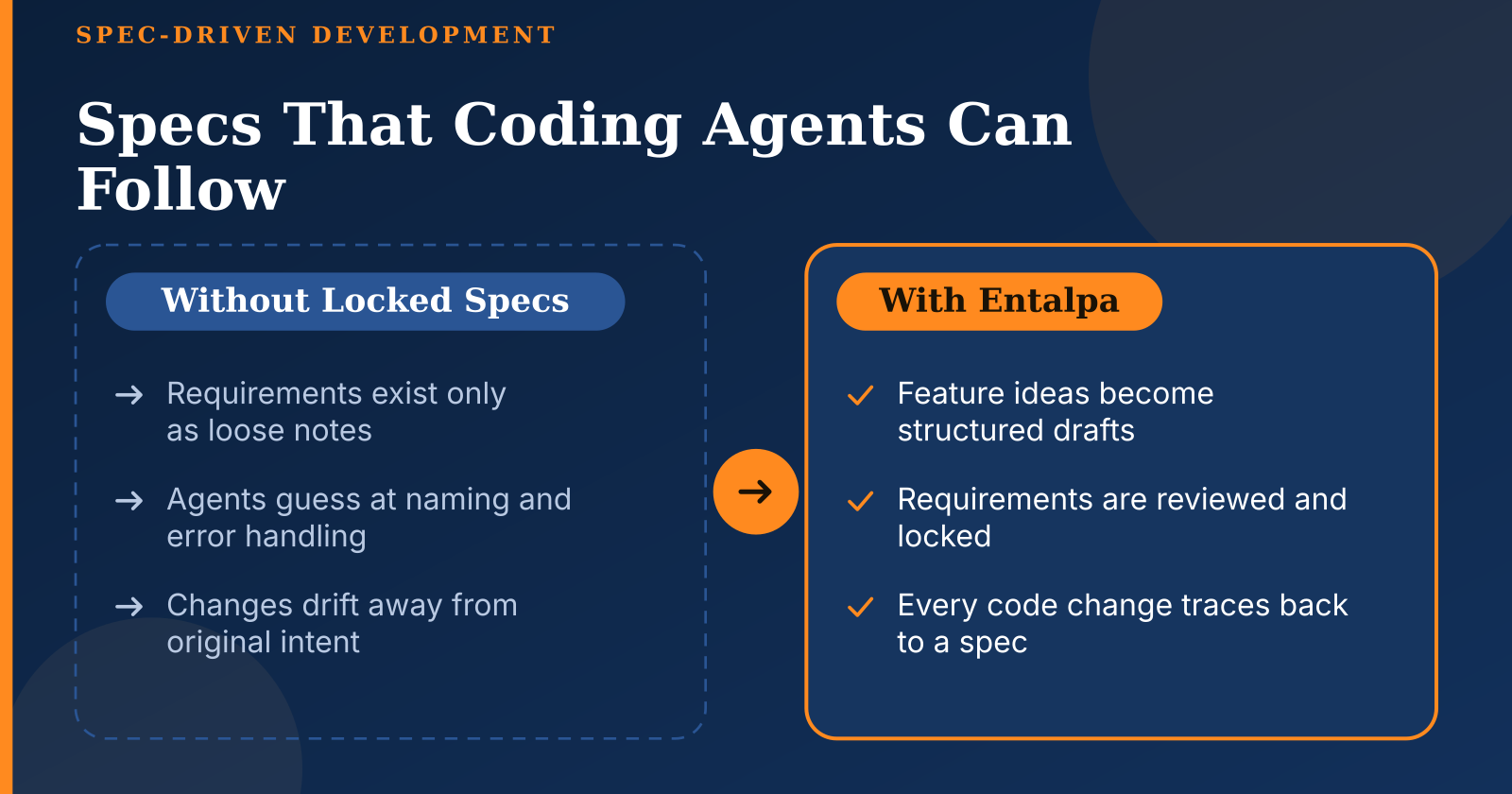
Confirm timezone, locale, and currency handling wherever the feature touches time or money. An export that rounds amounts differently from the on-screen view, or that dates a transaction in the server's timezone rather than the customer's, produces support tickets that look like data corruption. Writing the rule into the spec makes the expected behavior testable. If you are evaluating tools that work this way, look at how they handle the gap between a written spec and generated code, since entalpa keeps the spec as the source of truth so that changes to requirements flow into the implementation rather than drifting apart from it.
Preparing the Spec for the Coding Agent
Strip narrative prose and keep statements imperative and structured. A sentence like "the team would like the export to feel fast" should become a measurable requirement or be removed. Agents follow structured statements more reliably than they follow descriptive paragraphs, and structured statements are easier for reviewers to verify line by line.
Attach fixtures, example payloads, and sample error responses. A concrete example of a valid request and of a rejected request with its 409 response gives the agent a precise target and gives the test writer something to assert against. Examples also expose ambiguity quickly: if writing the example requires making a choice the spec did not make, the spec has a gap.
Define the order of implementation as ordered subtasks. For a feature with a data model change, a sensible order is usually schema migration, then the domain logic, then the interface layer, then the tests that cover the integration. Ordering the subtasks lets each step be reviewed and merged on its own, which limits the size of any single change the agent produces.
Common Mistakes When Using Spec-Driven Development Tools
Most failures come from how the spec is written and reviewed, not from the tool. The same tool produces useful specs for one team and unusable ones for another, and the difference is almost always in the review discipline and the level of detail the team chooses to specify.
Over-Specifying Implementation Details
Specs that dictate internal class structure become brittle. When the spec requires a particular service class with three specific methods, every refactor touches the document as well as the code, and teams stop updating the spec because it has become a burden. The result is a spec that no longer describes reality.
Keep the spec at the level of behavior and contract. Describe what the export endpoint accepts, what it returns, which errors it can produce, and how fast it must respond. Leave the choice of internal structure to the agent and to the reviewer, and check the result against the contract rather than against a prescribed architecture.
Skipping the Review Loop
Accepting the first generated draft without a line-by-line review is the most frequent mistake. Generated text reads fluently, which makes errors harder to notice, not easier. A missing error case or an incorrect unit in a limit can look entirely plausible on a first read.
Missing ownership is the second half of this problem. If no single person signs off on the final version, every reviewer assumes someone else has checked the details. Name one owner and one reviewer for each spec, and make the sign-off an explicit step in the ticket rather than an implied one.
Letting Specs Drift from Code
Updating code without updating the spec produces documentation that is confidently wrong, which is worse than having no documentation. An agent that reads a stale spec in its next session will reintroduce the behavior the team had already changed.
The practical mitigation is to version the spec alongside the code and to require spec updates in pull requests that change behavior. A pull request that alters an error code without touching the spec should fail review for the same reason a missing test would. This turns the spec into a maintained artifact rather than a snapshot taken at the start of the work.
Final Pre-Implementation Checklist
A short gate before handing the spec to a coding agent catches most of the problems described above. Running it takes minutes, while fixing the same problems after implementation takes days.
- The feature paragraph and the spec describe the same behavior, with no requirement added or dropped during drafting.
- Every requirement has an acceptance test or a measurable criterion that a reviewer can check.
- Interfaces, data models, and error cases are fully defined, including types, codes, and versioning rules.
- The out-of-scope list is present, specific, and has been reviewed by product or the tech lead.
- Assumptions about volume, concurrency, roles, and time or money handling are either documented or converted into requirements.
- One owner and one reviewer are named for the spec.
- The spec version is linked to the ticket and to the repository branch that will carry the change.
Spec-driven development pays off when the spec is treated as a contract that the code must satisfy and that the team maintains alongside that code. The practical steps are consistent: write the feature as observable behavior, resolve ambiguity into explicit decisions, check the draft against the real domain model and its hidden assumptions, and keep the document current through the same review process that governs the code.